


In short ⚡
The Consumer Price Index (CPI) is a statistical measure tracking the average change in prices paid by consumers for a basket of goods and services over time. It serves as the primary indicator of inflation, measuring purchasing power fluctuations and cost-of-living adjustments across economies, directly impacting international trade pricing strategies and currency valuation.
Introduction
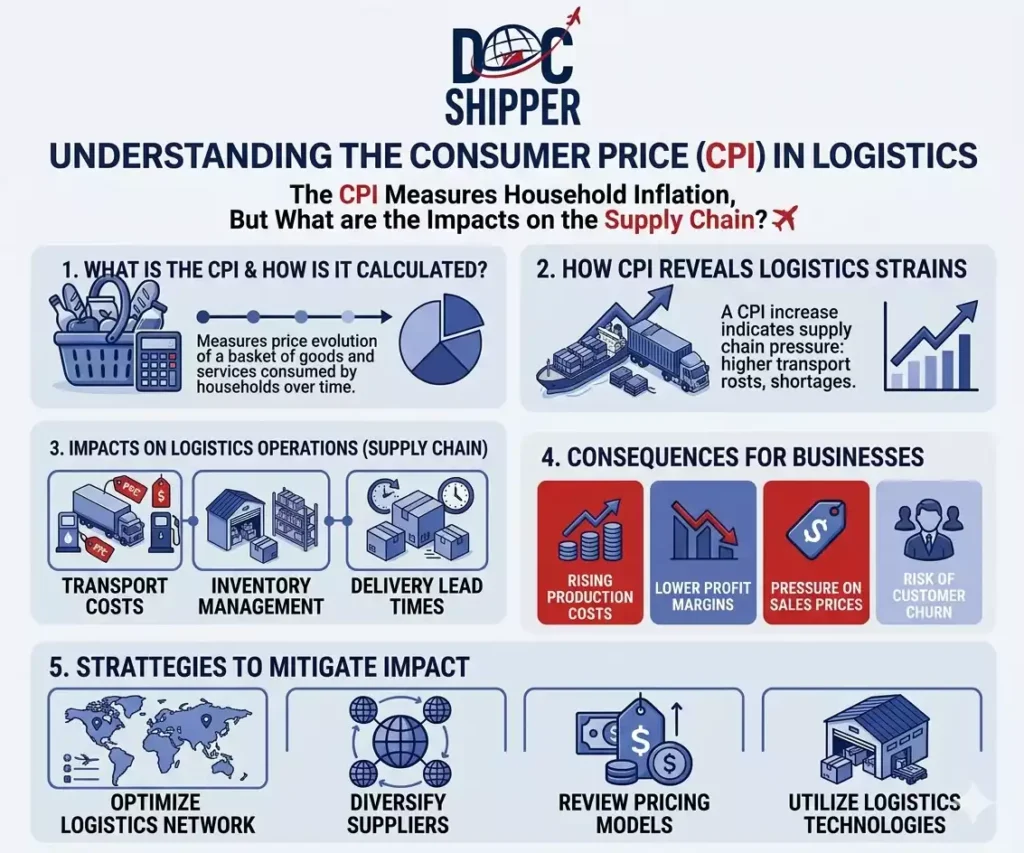
When import costs suddenly spike or export margins shrink without apparent cause, the Consumer Price Index often holds the answer. This economic barometer affects everything from shipping contracts to customs valuations, yet many logistics professionals overlook its strategic importance.
For international traders, CPI fluctuations translate directly into cost volatility. A 2% CPI increase in your supplier’s country can erode profit margins faster than currency fluctuations. Understanding CPI mechanics enables proactive pricing adjustments and smarter procurement timing.
- Inflation measurement: Tracks price changes across 200+ consumer categories monthly
- Currency impact: High CPI triggers central bank rate adjustments affecting exchange rates
- Contract indexation: Many logistics agreements tie pricing to CPI variations
- Purchasing power indicator: Reveals real cost changes beyond nominal price shifts
- Trade policy driver: Governments adjust tariffs and subsidies based on CPI trends
CPI Mechanics & Economic Implications
The base year methodology establishes CPI’s foundation. Statistical agencies select a reference period (typically updated every 2-5 years) and assign it an index value of 100. Subsequent measurements compare current prices against this baseline, creating percentage-based comparisons.
Calculation employs the Laspeyres formula, weighting each product category by its share of typical consumer spending. Housing might represent 33% of the basket, transportation 17%, food 14%. This weighting ensures the index reflects actual household expenditure patterns rather than treating all items equally.
Substitution bias presents a critical limitation. When beef prices surge, consumers switch to chicken—but traditional CPI doesn’t capture this behavioral shift immediately. The result: slight overstatement of true inflation, typically 0.4-0.9 percentage points annually according to U.S. Bureau of Labor Statistics research.
For logistics operations, core CPI matters more than headline figures. This variant excludes volatile food and energy prices, providing clearer signals for long-term contract negotiations. At DocShipper, we monitor core CPI trends across origin countries to advise clients on optimal contract renewal timing.
The international harmonization challenge complicates cross-border comparisons. Japan’s CPI basket includes rice and seaweed; Germany’s emphasizes beer and sausages. These compositional differences mean a 2% CPI increase carries different practical meanings depending on the country, affecting real purchasing power calculations for imported goods.
Practical Examples & Trade Impact Data
Scenario 1: Import Cost Escalation (China-US Route)
A furniture importer sources from Guangzhou with contracts priced in USD. Between January 2021 and December 2022, China’s CPI rose 3.8% while US CPI surged 12.4%. The real impact: Chinese manufacturers demanded 8-11% price increases to maintain purchasing power parity, despite stable nominal exchange rates. Importers who indexed contracts to weighted average CPI (China 40%, US 60%) maintained predictable margins.
| Period | China CPI Change | US CPI Change | Unindexed Cost Impact | Indexed Adjustment |
|---|---|---|---|---|
| Q1 2021 | +0.4% | +2.6% | -$1,200/container | +$340/container |
| Q4 2022 | +1.8% | +7.1% | -$4,800/container | +$1,920/container |
Scenario 2: Currency Hedging Decision (Euro Zone Exports)
A German machinery exporter faced a dilemma in mid-2023. Eurozone CPI stood at 5.3% while their main market (Poland) registered 13.2% CPI. Forward currency contracts seemed expensive at 4.2% premium. Analysis revealed Poland’s central bank would likely raise rates 200+ basis points within six months to combat inflation. The exporter locked 70% of receivables at the “expensive” rate—saving €340,000 when the złoty depreciated 11% over the following quarter.
Key Data Points for Logistics Planning:
- Threshold trigger: CPI differential exceeding 3% between trading partners typically necessitates contract renegotiation
- Lead time factor: 90-day average for CPI changes to fully reflect in wholesale shipping rates
- Sector variance: Electronics CPI correlates 0.73 with shipping demand; food products show 0.91 correlation
- Warehousing costs: Follow local CPI +1.2-1.8% premium due to real estate exposure
- Labor sensitivity: Port labor contracts indexed to CPI result in 6-9 month lag before rate adjustments
At DocShipper, we’ve integrated CPI monitoring into our freight rate forecasting models, enabling clients to lock advantageous rates 60-90 days before market adjustments materialize. This proactive approach saved one electronics client $127,000 annually on the Asia-Europe route alone.
Conclusion
The Consumer Price Index transcends academic economics—it’s a strategic tool for managing international trade costs and timing critical logistics decisions. Mastering CPI interpretation transforms reactive cost management into proactive margin protection.
Need expert guidance on inflation-proofing your supply chain? Contact DocShipper for customized CPI analysis and contract optimization strategies.
📚 Quiz
Test Your Knowledge: Consumer Price Index (CPI)
1. What does the Consumer Price Index (CPI) primarily measure?
2. A logistics manager wants to negotiate long-term freight contracts and needs the most reliable CPI signal. Which CPI variant should they prioritize?
3. An importer sources goods from China with contracts priced in USD. The CPI differential between the US and China exceeds 3%. What is the most appropriate action according to industry standards?
🎯 Your Result
📞 Free Quote in 24hFAQ | Consumer Price Index (CPI): Definition, Calculation & Practical Examples
CPI measures retail consumer prices while Producer Price Index (PPI) tracks wholesale/manufacturing costs. For importers, PPI predicts future CPI movements (typically 2-4 month lead), making it valuable for anticipating supplier cost pressures before they manifest in negotiations.
Industry standard: cumulative CPI change exceeding 2.5% since contract inception, or 4% annual rate sustained over two consecutive quarters. Many carriers include automatic adjustment clauses at 3% CPI movement to avoid constant renegotiation.
Partially. Purchasing Power Parity theory suggests currencies adjust to equalize CPI differences, but short-term (under 18 months) predictions prove unreliable. CPI differentials exceeding 5% annually between countries do correlate with 60-70% accuracy to 12-month currency trends.
China, Vietnam, India, and South Korea for manufacturing; Singapore for transshipment costs; Japan for technology components. Additionally, monitor destination market CPI (US, EU, UK) as it affects consumer demand and acceptable landed cost thresholds.
Ocean freight: 90-120 day lag due to quarterly contract cycles. Air freight: 30-45 days reflecting faster market adjustments. Trucking/last-mile: 60-75 days as fuel surcharges (CPI-linked) update monthly but base rates change quarterly.
Hybrid approach works best: 60% weight to origin country CPI (reflects supplier costs) and 40% to destination CPI (captures market pricing power). This balances cost pass-through with competitive positioning, reducing disputes during inflationary periods.
Customs authorities adjust valuation databases using CPI deflators to identify suspiciously low declared values. Invoices showing prices below CPI-adjusted historical averages (typically 15%+ deviation) trigger enhanced scrutiny and potential revaluation penalties.
CPI above 2-3% targets prompts interest rate hikes, strengthening currency and reducing import costs but dampening export competitiveness. Logistics planners should anticipate policy shifts when CPI exceeds target ranges for three consecutive months.
Yes—online prices show 0.5-1.2% lower inflation rates due to dynamic pricing and reduced overhead. This "Amazon effect" means e-commerce imports face different margin pressures than brick-and-mortar channels, requiring separate CPI tracking for accurate forecasting.
Transportation services (18% of CPI basket), fuel/energy (7%), and housing (affects warehouse rents, 33%) drive 58% of logistics cost variance. Monitor these subindices monthly rather than relying solely on headline CPI figures.
Professional forecasts (IMF, OECD) achieve ±0.8 percentage point accuracy for 6-month horizons, degrading to ±1.9 points at 12 months. Use conservative assumptions: add 0.5-1.0 point buffer to consensus forecasts when modeling multi-year logistics contracts.
Absolutely. Rising CPI environments favor accelerated purchasing before supplier price increases materialize (60-90 day window). Falling CPI suggests delaying orders 30-45 days to capture lower replacement costs, provided demand remains stable and storage costs don't offset savings.
Need Help with
Logistics or Sourcing ?
First, we secure the right products from the right suppliers at the right price by managing the sourcing process from start to finish. Then, we simplify your shipping experience - from pickup to final delivery - ensuring any product, anywhere, is delivered at highly competitive prices.


Fill the Form
Prefer email? Send us your inquiry, and we’ll get back to you as soon as possible.
Contact us




:%20Definition,%20Calculation%20&%20Practical%20Examples)