


In short ⚡
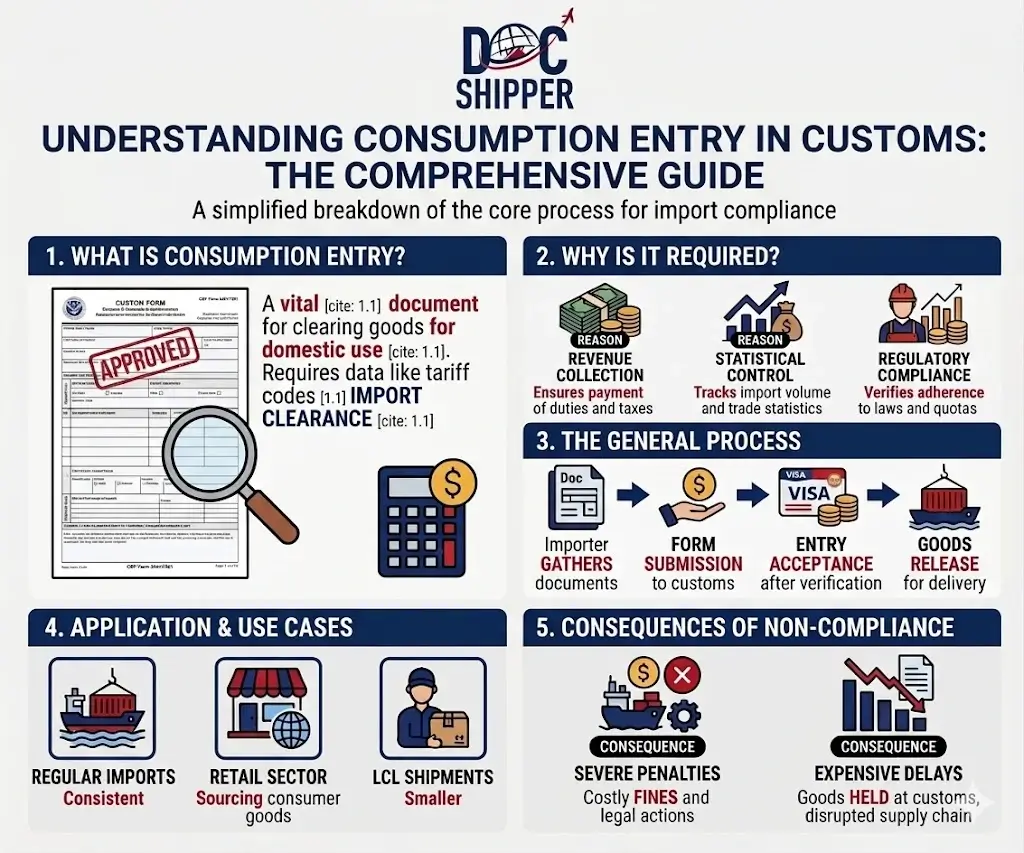
A Consumption Entry (CE) is a U.S. Customs declaration filed when imported goods are intended for immediate domestic consumption rather than warehousing or temporary admission. It triggers duty payment and formal clearance into U.S. commerce.
Introduction
Many importers confuse the various entry types available under U.S. Customs regulations. Choosing the wrong classification can delay shipments or trigger unexpected costs.
The Consumption Entry is the most common customs filing for goods destined to enter U.S. commerce immediately. It applies to commercial imports valued over $2,500 and requires full duty payment at the time of entry.
Key characteristics include:
- Immediate release: Goods clear customs for domestic use without bonded storage.
- Duty obligation: Importers must pay all applicable tariffs, taxes, and fees upfront.
- CBP Form 7501: The official entry summary document required for processing.
- Single Transaction Bond (STB) or Continuous Bond: Financial guarantee covering duties and penalties.
- 10-day filing window: Entry summary must be filed within 10 working days of cargo release.
CE Process & Requirements
Filing a Consumption Entry involves several regulatory steps that ensure compliance with U.S. Customs and Border Protection (CBP) standards.
The process begins with entry documentation, which includes the commercial invoice, packing list, bill of lading, and any required permits or certificates. These documents prove the origin, value, and classification of the goods.
Next comes classification and valuation. Importers must assign the correct Harmonized Tariff Schedule (HTS) code to determine duty rates. Misclassification can result in penalties or shipment holds. The transaction value—typically the price paid or payable—establishes the customs value for duty calculation.
The entry summary (CBP Form 7501) consolidates all shipment details. This form must be filed electronically through the Automated Commercial Environment (ACE) system. It includes the importer of record, consignee, HTS codes, duty amounts, and any applicable trade programs like duty drawback or preferential tariffs under USMCA.
Payment of duties and fees occurs via the Automated Clearinghouse (ACH) debit or through a surety bond. CBP requires payment within 10 working days of entry filing. Late payments incur interest charges and potential penalties.
Finally, post-entry review may trigger audits or requests for additional documentation. CBP retains the right to verify entry accuracy for up to five years. According to U.S. Customs and Border Protection, importers must maintain records supporting their entry filings during this period.
At DocShipper, we handle the entire Consumption Entry process on behalf of our clients, ensuring accurate classification, timely filing, and full regulatory compliance to prevent costly delays.
Practical Scenarios & Data
Understanding how Consumption Entries apply in real-world logistics helps importers anticipate costs and timelines.
Comparative Analysis: Entry Types
| Entry Type | Purpose | Duty Payment | Typical Use Case |
|---|---|---|---|
| Consumption Entry (CE) | Immediate domestic use | Due at entry | Retail goods, finished products |
| Warehouse Entry | Bonded storage | Deferred until withdrawal | Inventory management, delayed sale |
| Temporary Import Bond (TIB) | Temporary admission | Bond in lieu of duties | Trade shows, repairs, samples |
| Foreign Trade Zone (FTZ) Entry | Manufacturing/assembly | Deferred or reduced | Value-added processing |
Use Case: Electronics Importer
A U.S. retailer imports 5,000 smartphones from Taiwan valued at $500,000. The applicable HTS code is 8517.13.00, with a duty rate of 0% under the Most Favored Nation (MFN) tariff schedule.
Cost breakdown:
- Customs duties: $0 (zero-rated category)
- Merchandise Processing Fee (MPF): $528.33 (0.3464% of value, capped at $528.33)
- Harbor Maintenance Fee (HMF): $625 (0.125% of cargo value)
- Customs broker fee: Approximately $150–$300 per entry
- Total entry cost: ~$1,303–$1,453
The importer files a Consumption Entry via ACE, pays the fees within 10 days, and receives cargo release within 24–48 hours. This rapid clearance enables the retailer to stock shelves without delay.
Key Data Points
- Average processing time: 1–3 business days for routine entries.
- Audit rate: CBP examines approximately 5–10% of consumption entries for verification.
- Penalty range: Misclassification fines can reach $10,000 per violation for negligent errors.
- Bond requirement: Single Transaction Bonds typically cost $50–$200; Continuous Bonds (annual) range from $400–$1,500 depending on import volume.
- Record retention: Five years from the date of entry, per 19 CFR 163.4.
Conclusion
The Consumption Entry remains the cornerstone of U.S. import compliance for goods entering domestic commerce. Accurate filing, classification, and timely payment ensure smooth customs clearance and avoid costly penalties.
Need expert guidance on your Consumption Entry process? Contact DocShipper for end-to-end customs brokerage and compliance support.
📚 Quizz
Test Your Knowledge: Consumption Entry (CE)
Q1 — What is the primary purpose of a Consumption Entry (CE) in U.S. Customs?
Q2 — A common misconception about Consumption Entries is that importers have unlimited time to file the entry summary after cargo release. What does U.S. Customs actually require?
Q3 — A U.S. company imports 5,000 smartphones from Taiwan valued at $500,000 for immediate retail sale. Which entry type should they file, and why?
🎯 Your Result
📞 Free Quote in 24hFAQ | Consumption Entry (CE): Definition, Process & Practical Examples
A Consumption Entry clears goods for immediate domestic use with duties paid upfront. A Warehouse Entry places goods in bonded storage, deferring duty payment until withdrawal for consumption.
The importer of record, a licensed customs broker, or an authorized agent can file a Consumption Entry on behalf of the importing party through the ACE system.
Standard processing takes 1–3 business days. Entries flagged for examination or missing documentation may experience delays of several days to weeks.
Late filing triggers liquidated damages claims against your customs bond, typically equal to the entered value or a minimum of $1,000, whichever is greater.
Yes, through a Post-Summary Correction (PSC) or protest. Corrections must be filed before liquidation, typically within 314 days of entry.
No. Informal entries (under $2,500), personal effects, and certain exempt categories follow different procedures. Commercial shipments over $2,500 generally require formal Consumption Entries.
The bond guarantees payment of duties, taxes, and penalties. CBP requires either a Single Transaction Bond (per shipment) or a Continuous Bond (annual coverage).
Consult the Harmonized Tariff Schedule, use CBP's online tools, or work with a licensed customs broker. Accurate classification is critical to avoid penalties.
Essential documents include the commercial invoice, packing list, bill of lading, arrival notice, and any required permits (FDA, USDA, etc.).
Yes. Goods qualifying under USMCA, CAFTA-DR, or other trade agreements may receive preferential duty rates. Proper certification and documentation are required.
Frequent mistakes include incorrect HTS classification, undervaluation, missing permits, and incomplete documentation. These errors can trigger audits, penalties, or shipment holds.
DocShipper manages the entire process—classification, documentation, electronic filing, duty payment, and compliance monitoring—ensuring accurate, timely customs clearance for our clients.
Need Help with
Logistics or Sourcing ?
First, we secure the right products from the right suppliers at the right price by managing the sourcing process from start to finish. Then, we simplify your shipping experience - from pickup to final delivery - ensuring any product, anywhere, is delivered at highly competitive prices.


Fill the Form
Prefer email? Send us your inquiry, and we’ll get back to you as soon as possible.
Contact us




:%20Definition,%20Process%20&%20Practical%20Examples)