


In short ⚡
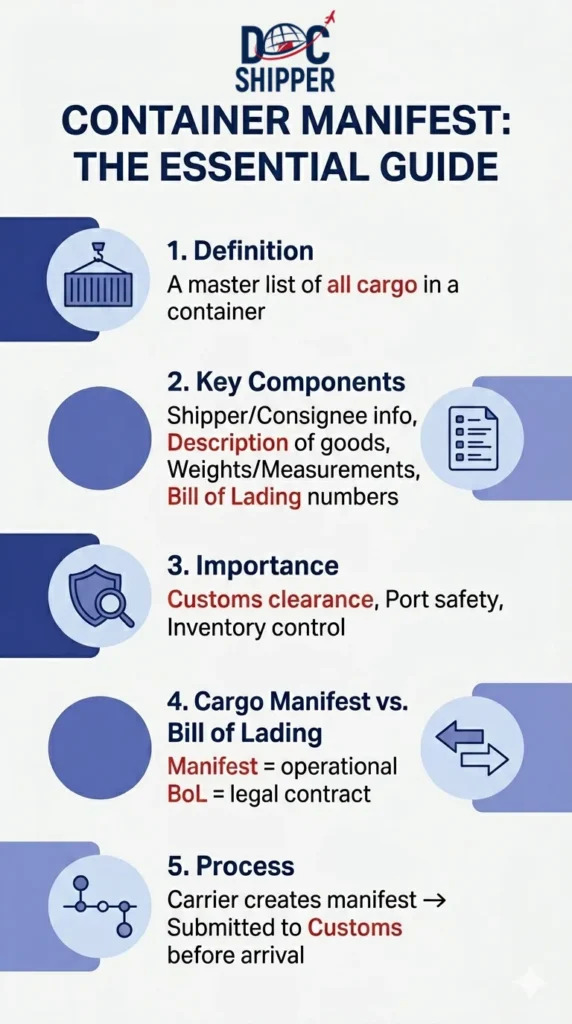
The Container Manifest is a comprehensive cargo document listing all goods loaded in a shipping container, including descriptions, quantities, weights, shipper and consignee details. Required by customs authorities worldwide, it serves as the primary reference for cargo verification, duty calculation, and security screening during international maritime transport.
Introduction
Shipping goods internationally without proper documentation creates costly delays, fines, and potential cargo seizure. The container manifest eliminates this risk by providing authorities with complete transparency about cargo contents before arrival.
In global trade, this document functions as the bridge between commercial transactions and regulatory compliance. Every container crossing international borders must be accompanied by an accurate manifest to satisfy customs, port authorities, and security agencies.
- Mandatory for customs clearance in all jurisdictions
- Contains itemized cargo details including HS codes and values
- Submitted electronically through systems like AMS, ACI, or ENS
- Links to the Bill of Lading as supporting documentation
- Subject to penalties for inaccuracies or late submission
Legal Framework & Documentation Requirements
The container manifest operates under international maritime law and national customs regulations. The International Convention on the Simplification and Harmonization of Customs Procedures (Revised Kyoto Convention) establishes baseline standards, while individual countries impose specific requirements through their customs codes.
In the European Union, the Union Customs Code mandates electronic submission of cargo manifests before vessel departure through the Import Control System (ICS). The United States requires Automated Manifest System (AMS) filing at least 24 hours before loading at foreign ports, enforced by U.S. Customs and Border Protection.
Essential components of a compliant container manifest include:
Shipper and consignee identification requires full legal names, addresses, and tax identification numbers. Incomplete party information triggers automatic holds at destination ports. Cargo description accuracy demands precise commodity names, not generic terms like “general cargo” or “freight all kinds.” Each line item must include quantity, weight, volume, and packaging type.
Harmonized System (HS) classification assigns standardized codes to products for tariff determination. Misclassification represents one of the most common compliance violations, resulting in duty reassessments and penalties. Container seal numbers verify cargo security from origin to destination, with any discrepancy indicating potential tampering.
Dangerous goods declarations follow IMDG Code requirements when applicable, identifying hazardous materials through UN numbers and proper shipping names. Failure to declare dangerous goods can result in criminal prosecution and vessel detention.
At DocShipper, we systematically verify all manifest data against commercial invoices and packing lists before submission, ensuring compliance with destination country requirements and preventing costly clearance delays.
According to the World Customs Organization, harmonized electronic manifest systems reduce clearance times by 40% while improving risk assessment accuracy.
Practical Examples & Data Analysis
Understanding manifest requirements through real-world scenarios demonstrates practical compliance strategies and common pitfalls.
Comparative Analysis: FCL vs. LCL Manifest Requirements
| Aspect | Full Container Load (FCL) | Less than Container Load (LCL) |
|---|---|---|
| Shipper Responsibility | Single shipper provides complete manifest | Consolidator compiles from multiple shippers |
| Detail Level | Master manifest only | Master + house manifests required |
| Submission Timing | 24-48 hours before departure | After consolidation completion |
| Amendment Complexity | Direct shipper control | Requires freight forwarder coordination |
| Customs Scrutiny | Standard risk assessment | Higher inspection probability |
Use Case: Electronics Shipment from Shenzhen to Rotterdam
A European importer orders 15,000 smartphone accessories from China in a 40-foot container. The manifest must reflect:
- Line Item 1: 10,000 units protective cases (HS 3926.90) – 2,500 kg – Value $12,500
- Line Item 2: 5,000 units USB charging cables (HS 8544.42) – 750 kg – Value $8,750
- Total Declared Value: $21,250 for duty calculation
- Container Details: TCLU1234567 (40’HC) – Seal BOLT987654
- Submission Requirement: ENS filing minimum 24 hours before departure
In this scenario, accurate HS classification determines the applicable EU tariff rates (4.7% for cases, 0% for cables under certain trade agreements). An error classifying cables as general electronics (HS 8517) would trigger a 2.5% duty instead of preferential treatment.
Data Insight: Manifest Error Impact
Industry statistics reveal manifest accuracy directly correlates with clearance efficiency:
- Weight discrepancies exceeding 5% trigger automatic physical inspections in 78% of cases
- Missing or incorrect HS codes cause average delays of 3-7 days
- Incomplete consignee information results in $150-$500 amendment fees per container
- Late manifest submission incurs penalties ranging from $500 (Canada) to €5,000 (EU)
- Proper pre-clearance documentation reduces dwell time by 62% on average
DocShipper’s manifest verification process cross-references commercial documents with carrier requirements, achieving a 99.2% first-time acceptance rate and minimizing costly amendments or delays.
Conclusion
The container manifest serves as the foundation of compliant international shipping, directly impacting clearance speed, cost predictability, and regulatory compliance. Accurate preparation and timely submission prevent the majority of customs-related delays.
Need expert assistance with manifest preparation and customs compliance? Contact DocShipper for comprehensive documentation support tailored to your trade lanes.
📚 Quiz
Test Your Knowledge: Container Manifest
Q1 — What is the primary purpose of a Container Manifest?
Q2 — For an LCL (Less than Container Load) shipment, which manifest structure is required?
Q3 — A shipper classifies USB charging cables under HS code 8517 (general electronics) instead of the correct HS 8544.42. What is the most likely consequence?
🎯 Your Result
📞 Free Quote in 24hFAQ | Container Manifest: Definition, Requirements & Practical Examples
The Bill of Lading is a contract of carriage and receipt for goods, while the container manifest is a detailed cargo inventory submitted to customs authorities. The B/L covers transport terms; the manifest focuses on regulatory compliance and cargo description.
The carrier or their authorized agent (typically the freight forwarder or NVOCC) submits the manifest to customs. However, the shipper provides the accurate cargo information that forms the manifest content.
Requirements vary by destination: USA requires 24 hours before loading (AMS), EU requires filing before departure (ENS), Canada requires 24 hours before arrival (ACI). Always verify specific country requirements.
Yes, but amendments must be submitted before vessel arrival and may incur fees. Significant changes after departure can trigger customs examinations. Early accuracy prevents costly corrections.
Errors can result in cargo holds, physical inspections, penalty assessments, delayed clearance, and additional storage charges. Serious discrepancies may trigger investigations for fraud or smuggling.
Yes, carriers must report empty container movements to customs authorities. The manifest indicates "empty" status with container identification details but no cargo line items.
AMS is the U.S. electronic system for receiving manifest data. The container manifest content is transmitted through AMS to CBP for security screening and advance cargo information requirements.
Dangerous goods require UN number, proper shipping name, hazard class, packing group, emergency contact information, and compliance with IMDG Code declarations. Omission can result in criminal penalties.
LCL shipments require both a master manifest (for the entire container) and house manifests (for each individual shipper's cargo). The consolidator coordinates these documents.
Most jurisdictions require 5-7 years retention for customs and tax purposes. Electronic records must remain accessible for audit inquiries. Specific retention periods vary by country.
The manifest supports customs declarations but additional documentation (certificates of origin, trade agreement proofs) is required for preferential duty treatment. The manifest alone does not establish duty-free eligibility.
Penalties range from $500 to $10,000 per violation depending on jurisdiction and severity. Repeated violations can result in carrier sanctions, increased inspection rates, and bond requirements.
Need Help with
Logistics or Sourcing ?
First, we secure the right products from the right suppliers at the right price by managing the sourcing process from start to finish. Then, we simplify your shipping experience - from pickup to final delivery - ensuring any product, anywhere, is delivered at highly competitive prices.


Fill the Form
Prefer email? Send us your inquiry, and we’ll get back to you as soon as possible.
Contact us




