


In short ⚡
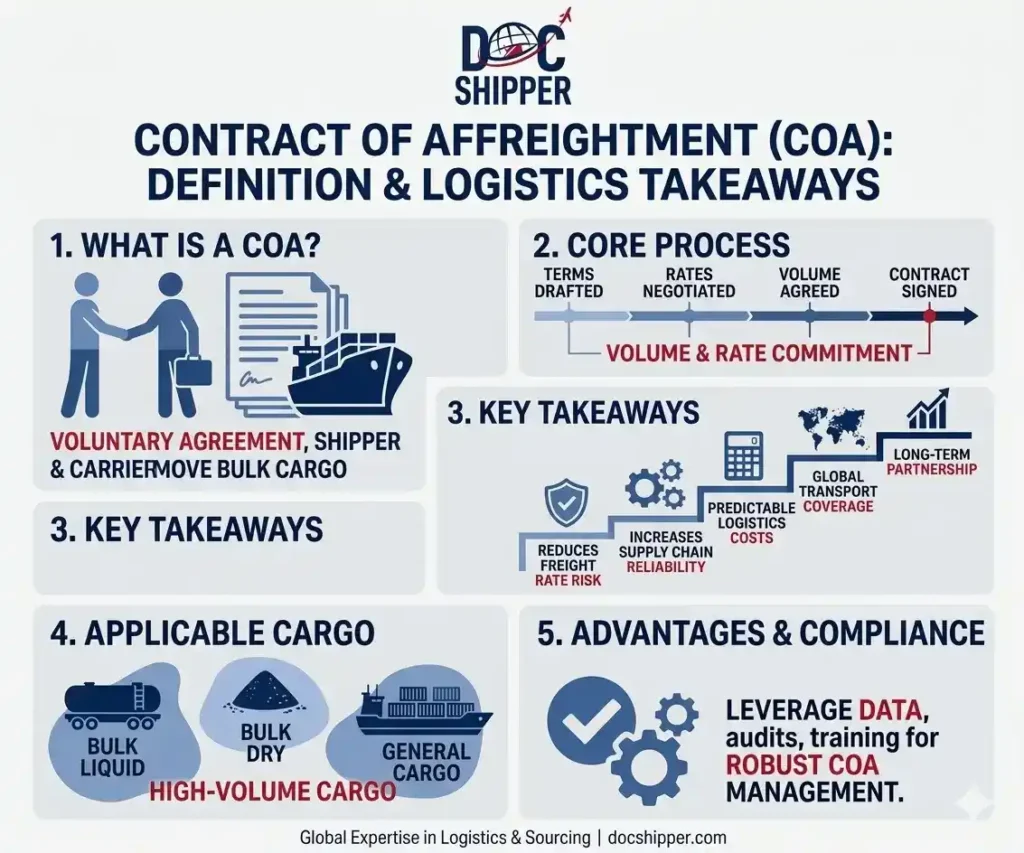
A Contract of Affreightment (COA) is a maritime agreement between a shipper and a carrier to transport specific cargo quantities over multiple voyages within a defined period, without committing to specific vessels. Unlike voyage charters, COAs provide flexibility in scheduling while guaranteeing cargo space and freight rates for bulk commodities.
Introduction
Many shippers confuse Contracts of Affreightment with time charters or consecutive voyage charters. This confusion leads to mismatched expectations regarding vessel commitment, scheduling flexibility, and cost structures.
In international trade, particularly for bulk commodities like grain, coal, or iron ore, COAs represent a strategic solution. They balance the shipper’s need for guaranteed capacity with the carrier’s operational flexibility.
Key characteristics of COAs include:
- Quantity commitment: Fixed cargo volumes over contract duration
- Vessel flexibility: Carrier chooses appropriate ships for each shipment
- Rate stability: Pre-agreed freight rates protecting against market volatility
- Multi-voyage structure: Series of shipments rather than single voyage
- Time-bound obligations: Defined contract period with delivery schedules
COA Mechanisms & Legal Framework
A Contract of Affreightment establishes a quantity-based obligation rather than vessel-specific commitment. The carrier commits to transporting an agreed tonnage within specified timeframes, but retains discretion over which vessels to deploy.
The legal framework typically follows BIMCO standard forms, particularly the VOLCOA or INTERCOA templates. These standardized contracts address critical elements including laycan periods, demurrage provisions, and force majeure clauses. According to BIMCO, proper COA structuring reduces disputes by 40% compared to custom agreements.
Freight calculation mechanisms in COAs differ fundamentally from spot market rates. Parties negotiate either lumpsum amounts per cargo parcel or per-ton rates with minimum/maximum cargo quantities. The contract specifies whether freight is “all-in” or subject to additional charges for port costs, bunker adjustments, or war risk premiums.
The nomination process represents a critical operational aspect. Shippers typically nominate loading dates within agreed windows, while carriers confirm vessel availability. At DocShipper, we systematically review nomination clauses to ensure our clients’ scheduling requirements align with operational realities and avoid costly delays.
Performance guarantees and penalties protect both parties. Shippers face obligations to provide minimum cargo volumes, while carriers must maintain service reliability. Failure to meet contractual quantities may trigger price adjustments or early termination rights.
The duration and renewal provisions typically span 12 to 36 months for commodity trades. Contracts often include extension options or renegotiation triggers based on market conditions, cargo availability, or regulatory changes affecting the trade route.
Practical Examples & Industry Data
Industry data reveals COAs account for approximately 35% of dry bulk shipping contracts globally, with particular concentration in coal and grain trades.
Comparative Analysis: COA vs. Alternative Shipping Contracts
| Contract Type | Vessel Control | Cost Predictability | Operational Flexibility | Typical Duration |
|---|---|---|---|---|
| Contract of Affreightment | Carrier decides vessels | High (fixed rates) | Medium (nomination windows) | 12-36 months |
| Voyage Charter | Specific vessel named | Medium (spot market risk) | Low (single voyage) | Single voyage |
| Time Charter | Charterer controls vessel | Medium (daily hire rate) | High (full operational control) | 6-60 months |
| Bareboat Charter | Charterer operates vessel | Low (all costs variable) | Maximum (complete control) | 3-15 years |
Real-World Case Study: Coal Trade COA
Scenario: An Asian power generation company needs 500,000 metric tons of coal annually from Australia.
COA Structure:
- Total quantity: 500,000 MT over 24 months
- Shipment parcels: 50,000 MT minimum per voyage
- Freight rate: USD 18.50 per MT (fixed)
- Loading ports: Newcastle or Gladstone (Australia)
- Discharge port: Specified Asian terminal
Financial Analysis:
- Total contract value: USD 9,250,000
- Market rate fluctuation during period: USD 15.20 to USD 22.80 per MT
- Savings achieved: Approximately USD 890,000 compared to spot market exposure
- Operational efficiency: 10 voyages completed with 98% on-time performance
- Demurrage costs: USD 45,000 (0.49% of contract value)
At DocShipper, we structure similar COAs for clients requiring predictable shipping costs. Our expertise in negotiating laycan flexibility and demurrage terms has reduced clients’ ancillary costs by an average of 23%.
Key Performance Indicators for COA Success
- Cargo utilization rate: Percentage of contracted volume actually shipped (target: >95%)
- Scheduling adherence: Voyages completed within nomination windows (target: >90%)
- Cost variance: Actual freight costs vs. contracted rates (target: <3% deviation)
- Claim frequency: Cargo damage or shortage claims per voyage (target: <2%)
- Contract renewal rate: Percentage of COAs extended beyond initial term (industry average: 68%)
Conclusion
Contracts of Affreightment provide strategic advantages for shippers requiring volume commitments without vessel ownership responsibilities. They deliver cost certainty while maintaining operational flexibility essential for commodity trades.
Need expert guidance on structuring or negotiating a COA for your shipping requirements? Contact DocShipper for specialized maritime contract advisory services.
📚 Quiz
Test Your Knowledge: Contract of Affreightment (COA)
Q1 — What is the core obligation defined by a Contract of Affreightment (COA)?
Q2 — A shipper signs a COA and later assumes they can specify which vessel the carrier must use for each shipment. Is this interpretation correct?
Q3 — An Asian power company needs to ship 500,000 MT of coal from Australia over 24 months at a fixed rate of USD 18.50/MT. During the contract, spot market rates swing between USD 15.20 and USD 22.80/MT. Which contract structure best fits this scenario?
🎯 Your Result
📞 Free Quote in 24hFAQ | Contract of Affreightment (COA): Definition, Calculation & Concrete Examples
COAs typically require minimum annual volumes of 100,000 to 500,000 metric tons, though smaller contracts exist for specialized trades. The threshold depends on commodity type, trade route, and carrier capacity.
Rates are negotiated based on projected market conditions, trade route competitiveness, and volume commitments. Parties may agree on fixed rates, indexed rates tied to published indices, or hybrid formulas with periodic adjustments.
Cancellation rights depend on contract terms. Most COAs impose penalties for failing to meet minimum quantity obligations. Some include force majeure provisions allowing cancellation under extraordinary circumstances without penalty.
Carrier failure to provide tonnage typically triggers compensation mechanisms, including freight rate reductions, extension of contract duration, or penalties. Contracts specify remedies for non-performance by either party.
COAs primarily serve bulk commodity trades. Container shipping typically uses service contracts or volume agreements with different structural characteristics. However, project cargo and specialized container movements may utilize COA-style arrangements.
COAs specify laytime allowances for loading/discharge operations. Exceeding these periods triggers demurrage charges paid to the carrier. Rates and calculation methods are contractually defined, typically ranging from USD 8,000 to USD 25,000 daily.
Consecutive voyage charters commit specific vessels for multiple voyages, while COAs allow carriers to deploy any suitable vessel. COAs offer greater operational flexibility but less control over vessel specifications.
Rate adjustment mechanisms depend on contract terms. Fixed-rate COAs maintain constant pricing. Others include escalation clauses tied to bunker costs, port charges, or market indices, with adjustment frequencies defined contractually.
Parties select governing law and arbitration venues during negotiation. English law with London arbitration remains prevalent, though New York law and Singapore arbitration have gained popularity. Choice depends on trade participants' preferences and route characteristics.
Most COAs include force majeure clauses addressing weather-related delays. Prolonged delays may trigger laycan extensions or voyage cancellations without penalty. Specific provisions define threshold conditions and notification requirements.
Payment security mechanisms vary by parties' creditworthiness and relationship. Established traders often use open account terms, while new relationships may require Letters of Credit, parent company guarantees, or advance payment for initial shipments.
Each voyage under a COA requires standard shipping documents: Bill of Lading, commercial invoice, packing list, certificate of origin, and quality certificates. The master COA governs terms, while individual Bills of Lading reference the overarching agreement.
Need Help with
Logistics or Sourcing ?
First, we secure the right products from the right suppliers at the right price by managing the sourcing process from start to finish. Then, we simplify your shipping experience - from pickup to final delivery - ensuring any product, anywhere, is delivered at highly competitive prices.


Fill the Form
Prefer email? Send us your inquiry, and we’ll get back to you as soon as possible.
Contact us




:%20Definition,%20Calculation%20&%20Concrete%20Examples)