


In short ⚡
Cost Plus Pricing is a pricing strategy where businesses calculate the total production cost of a product or service and add a predetermined profit margin percentage. This method ensures profitability by systematically covering all expenses while generating consistent returns, making it particularly valuable in international trade and logistics operations.Introduction
Many importers struggle with pricing international shipments accurately. Underestimating costs leads to losses, while overpricing damages competitiveness. Cost plus pricing eliminates guesswork by establishing transparent, replicable pricing structures.
In global logistics, this method proves essential for freight forwarders, customs brokers, and importers managing complex supply chains. It accounts for variable expenses like fuel surcharges, customs duties, and handling fees while maintaining profitability.
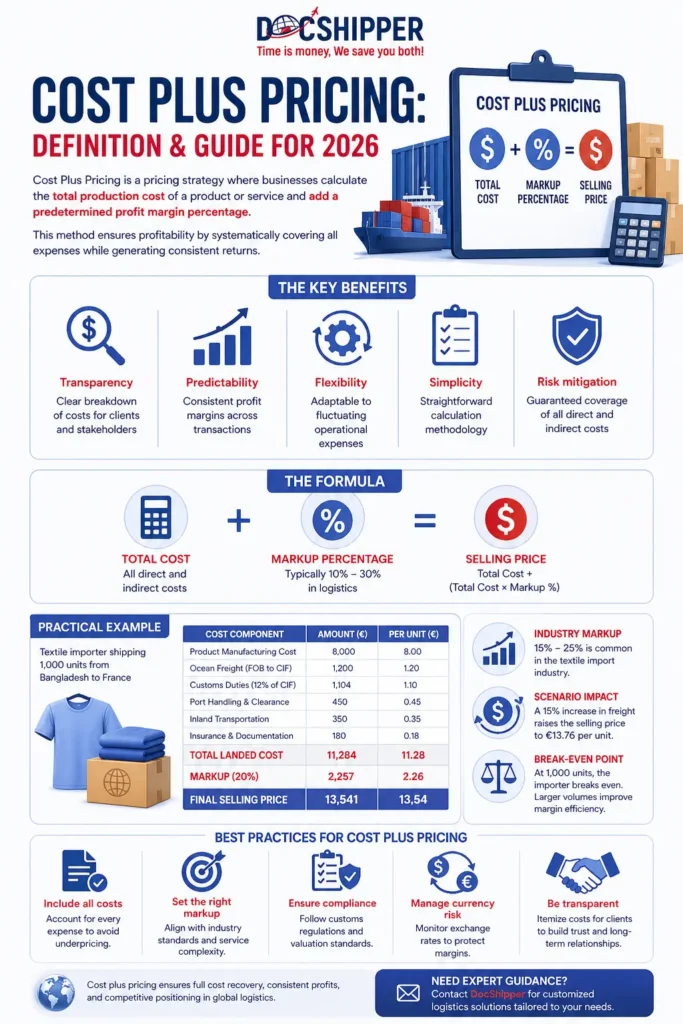
- Transparency: Clear breakdown of costs for clients and stakeholders
- Predictability: Consistent profit margins across transactions
- Flexibility: Adaptable to fluctuating operational expenses
- Simplicity: Straightforward calculation methodology
- Risk mitigation: Guaranteed coverage of all direct and indirect costs
Methodology & Strategic Expertise
Cost plus pricing operates on a fundamental formula: Selling Price = Total Cost + (Total Cost × Markup Percentage). The total cost encompasses direct expenses (materials, labor, shipping) and indirect costs (overhead, administrative fees, insurance).
In international logistics, calculating the total landed cost becomes critical. This includes product cost, freight charges, customs duties, port handling fees, inland transportation, and warehousing. Missing any component undermines the entire pricing structure.
The markup percentage varies by industry and competitive landscape. Logistics providers typically apply 10-30% margins, depending on service complexity. High-value cargo or specialized handling justifies higher markups, while commoditized freight services operate on thinner margins.
Regulatory compliance affects cost calculations significantly. The World Customs Organization mandates accurate valuation for customs purposes. Mispricing can trigger audits or penalties. At DocShipper, we systematically verify all cost components against customs regulations to prevent compliance issues.
Advanced implementations incorporate activity-based costing, allocating overhead proportionally to resource consumption. This refinement improves accuracy for multi-service operations, ensuring each shipment bears its true operational burden.
For reference on customs valuation standards, consult the WCO Valuation Agreement.
Practical Examples & Data Analysis
Consider a textile importer shipping 1,000 units from Bangladesh to France. Understanding the cost plus pricing breakdown clarifies profitability thresholds and competitive positioning.
| Cost Component | Amount (€) | Per Unit (€) |
|---|---|---|
| Product Manufacturing Cost | 8,000 | 8.00 |
| Ocean Freight (FOB to CIF) | 1,200 | 1.20 |
| Customs Duties (12% of CIF) | 1,104 | 1.10 |
| Port Handling & Clearance | 450 | 0.45 |
| Inland Transportation | 350 | 0.35 |
| Insurance & Documentation | 180 | 0.18 |
| Total Landed Cost | 11,284 | 11.28 |
| Markup (20%) | 2,257 | 2.26 |
| Final Selling Price | 13,541 | 13.54 |
Scenario Analysis: If ocean freight increases 15% due to fuel surcharges, the landed cost rises to €11,464. Maintaining the 20% markup, the new selling price becomes €13,757 (€13.76 per unit). This demonstrates how cost plus pricing automatically adjusts to market fluctuations.
Competitive Benchmarking: Industry data shows textile importers operate on 15-25% markups. A 20% margin positions this shipment competitively while ensuring profitability. Lower markups sacrifice margin for volume, while premium positioning justifies higher percentages through value-added services.
Break-Even Analysis: With fixed costs at €11,284, the importer breaks even at 1,000 units. Scaling to 1,500 units reduces per-unit overhead, improving margin efficiency without altering the markup percentage.
Currency Risk Consideration: When sourcing in USD but selling in EUR, exchange rate fluctuations impact costs. A 5% USD appreciation increases manufacturing costs to €8,400, requiring price adjustments to maintain the target markup.
Service Differentiation: DocShipper applies cost plus pricing transparently, itemizing every expense for client verification. This approach builds trust and simplifies budget forecasting for recurring shipments.
Conclusion
Cost plus pricing provides a reliable framework for international logistics pricing, ensuring comprehensive cost recovery while maintaining competitive margins. Its transparency and adaptability make it indispensable for import/export operations facing variable market conditions.
Need expert guidance on optimizing your pricing strategy for international shipments? Contact DocShipper for customized logistics solutions.
📚 Quiz
Test Your Knowledge: Cost Plus Pricing
1. What is the correct formula for Cost Plus Pricing?
2. A common misconception about Cost Plus Pricing is that it automatically accounts for competitor pricing and market demand. Is this true?
3. A freight forwarder ships 1,000 textile units from Bangladesh to France. The total landed cost is €11,284. Applying a 20% markup, what is the correct final selling price?
🎯 Your Result
📞 Free Quote in 24hFAQ | Cost Plus Pricing: Definition, Calculation & Practical Examples
Need Help with
Logistics or Sourcing ?
First, we secure the right products from the right suppliers at the right price by managing the sourcing process from start to finish. Then, we simplify your shipping experience - from pickup to final delivery - ensuring any product, anywhere, is delivered at highly competitive prices.


Fill the Form
Prefer email? Send us your inquiry, and we’ll get back to you as soon as possible.
Contact us




