


In short ⚡
Cost Variance (CV) is a project management metric measuring the difference between budgeted and actual costs. A negative CV indicates cost overruns, while a positive CV shows savings. This KPI enables logistics managers to control spending throughout international shipping operations.Introduction
Many importers struggle to understand why their shipping projects exceed budgets. Without proper cost tracking, unexpected expenses accumulate silently until invoices arrive. Cost Variance provides the clarity needed to identify financial deviations before they become critical.
In international logistics, where multiple service providers and regulatory fees intersect, maintaining budget control is essential. CV analysis transforms raw financial data into actionable insights for procurement teams and supply chain managers.
- Real-time budget monitoring: Identifies spending deviations immediately during project execution
- Performance measurement: Quantifies efficiency of logistics operations against planned costs
- Forecasting accuracy: Improves future budget estimations based on historical variance patterns
- Stakeholder transparency: Provides clear financial reporting for management and clients
- Risk mitigation: Flags potential budget overruns before completion deadlines
Cost Variance Fundamentals & Expert Analysis
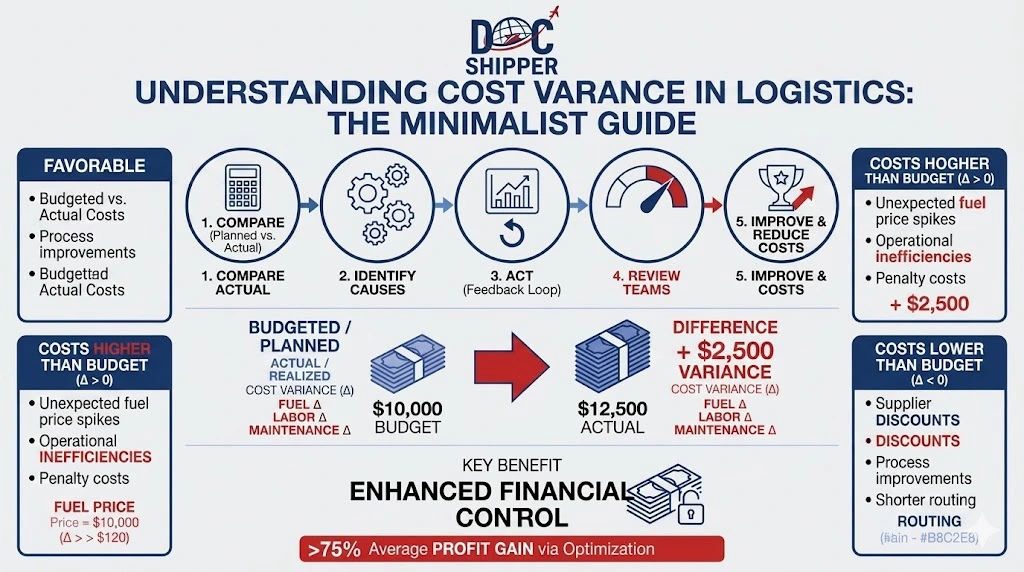
Cost Variance operates within Earned Value Management (EVM), a methodology endorsed by the Project Management Institute. The formula is straightforward: CV = EV – AC, where EV represents Earned Value (budgeted cost of completed work) and AC represents Actual Cost (real expenditure).
Understanding the sign interpretation is critical. Positive CV means the project is under budget—you’ve completed work for less than planned. Negative CV signals overspending—actual costs exceed the value delivered. Zero CV indicates perfect budget alignment, though this rarely occurs in complex logistics operations.
The Cost Performance Index (CPI) complements CV by providing a ratio: CPI = EV / AC. A CPI above 1.0 indicates cost efficiency, while below 1.0 signals inefficiency. At DocShipper, we monitor both metrics simultaneously to provide clients with comprehensive financial visibility across customs clearance and freight forwarding projects.
In international shipping, currency fluctuations complicate CV calculations. A shipment quoted in USD but paid in EUR three months later may show artificial variance due to exchange rate movements rather than operational inefficiency. Sophisticated tracking systems must isolate currency effects from true cost performance.
The timing of cost recognition also matters. Prepaid services like insurance or warehousing deposits create accounting complexities. Should costs be recognized when paid or when services are consumed? Consistent accrual methods ensure CV calculations reflect operational reality rather than cash flow timing.
Practical Examples & Calculation Data
Consider a standard ocean freight project from Shanghai to Rotterdam. The initial budget allocated $15,000 for container shipping, customs clearance, and inland delivery. After completion, actual costs totaled $16,200. This creates a Cost Variance of -$1,200, indicating a budget overrun.
| Cost Component | Budgeted (EV) | Actual (AC) | Variance |
|---|---|---|---|
| Ocean Freight | $8,500 | $8,800 | -$300 |
| Customs Duties | $3,200 | $3,650 | -$450 |
| Inland Transport | $2,100 | $2,450 | -$350 |
| Documentation | $1,200 | $1,300 | -$100 |
| Total | $15,000 | $16,200 | -$1,200 |
The Cost Performance Index for this project calculates to 0.926 ($15,000 / $16,200). This indicates the project delivered only $0.93 of value for every dollar spent—a clear inefficiency signal requiring investigation.
Root cause analysis reveals the customs duties variance stemmed from incorrect HS code classification in the initial quote. The ocean freight increase resulted from peak season surcharges not anticipated during budgeting. At DocShipper, we maintain historical surcharge databases to improve forecasting accuracy for clients.
A contrasting scenario involves air freight consolidation. A client budgeted $22,000 for individual shipments but achieved $19,500 through volume consolidation. This generates a positive CV of +$2,500 and a CPI of 1.13, demonstrating superior cost efficiency.
Cumulative Cost Variance tracking across multiple shipments reveals patterns. If a logistics provider consistently shows negative CV on customs clearance but positive CV on freight, strategic adjustments become evident—perhaps switching customs brokers while maintaining the freight forwarder relationship.
Industry benchmarks suggest a CV tolerance of ±5% for standard shipments. Complex projects involving hazardous materials or multiple transshipments may accept ±10%. Exceeding these thresholds triggers formal reviews and process improvements.
Conclusion
Cost Variance transforms abstract budget concerns into measurable, actionable financial intelligence. By systematically tracking CV and CPI, logistics managers gain the visibility needed to optimize spending and improve forecasting accuracy across international supply chains.
Need support implementing cost variance tracking in your logistics operations? Contact DocShipper for expert guidance on financial management and supply chain optimization.
📚 Quiz
Test Your Knowledge: Cost Variance
Q1 — What does a negative Cost Variance (CV) indicate in a logistics project?
Q2 — A shipping project shows a positive Cost Variance of +$2,500. Can this still signal a problem?
Q3 — An ocean freight project from Shanghai to Rotterdam had a budgeted cost of $15,000 and actual costs of $16,200. What is the Cost Performance Index (CPI)?
🎯 Your Result
📞 Free Quote in 24hFAQ | Cost Variance: Definition, Calculation & Practical Examples
Cost Variance measures budget performance (planned vs. actual spending), while Schedule Variance measures time performance (planned vs. actual progress). Both use Earned Value methodology but track different project dimensions.
For short-term shipments (under 30 days), calculate CV at key milestones: booking, departure, customs clearance, and delivery. Long-term projects benefit from weekly or bi-weekly CV assessments to enable timely corrective actions.
Yes. Positive CV from cutting essential services (insurance, proper packaging) creates hidden risks. Always investigate unusually high positive variances to ensure quality standards weren't compromised for cost savings.
Currency fluctuations, incorrect customs duty estimates, undisclosed surcharges, demurrage fees, and incomplete documentation requirements account for approximately 70% of negative CV instances in cross-border logistics.
Negative CV directly erodes profit margins unless contracts include cost-plus pricing. A -10% CV on a project with 15% margin reduces actual profit to 5%, significantly impacting financial performance.
Standard practice separates controllable variance from force majeure impacts. Track both metrics independently—total CV for complete financial picture, adjusted CV for operational performance assessment excluding uncontrollable external factors.
CPI between 0.95 and 1.05 generally indicates acceptable performance. Values below 0.90 signal serious inefficiency requiring immediate intervention, while sustained CPI above 1.10 may indicate overly conservative budgeting.
Prepaid costs should be recognized when services are consumed, not when paid. Using accrual accounting rather than cash accounting ensures CV reflects actual operational performance rather than payment timing artifacts.
Historical CV patterns enable forecasting through trend analysis. Consistent negative CV in specific cost categories (e.g., customs) signals systematic estimation errors requiring budget model adjustments for future projects.
Enterprise Resource Planning (ERP) systems with logistics modules, specialized Transportation Management Systems (TMS), and project management platforms like Microsoft Project or Primavera provide CV tracking capabilities with varying sophistication levels.
Calculate CV separately for each transportation mode (ocean, air, road, rail) to identify specific inefficiencies. Aggregate CV provides overall project performance, while segmented analysis enables targeted improvements.
Traditional CV calculations exclude opportunity costs, focusing on direct expenditures. However, strategic analysis may incorporate opportunity costs of delayed shipments or inventory carrying costs for comprehensive financial impact assessment.
Need Help with
Logistics or Sourcing ?
First, we secure the right products from the right suppliers at the right price by managing the sourcing process from start to finish. Then, we simplify your shipping experience - from pickup to final delivery - ensuring any product, anywhere, is delivered at highly competitive prices.


Fill the Form
Prefer email? Send us your inquiry, and we’ll get back to you as soon as possible.
Contact us




