



In short ⚡
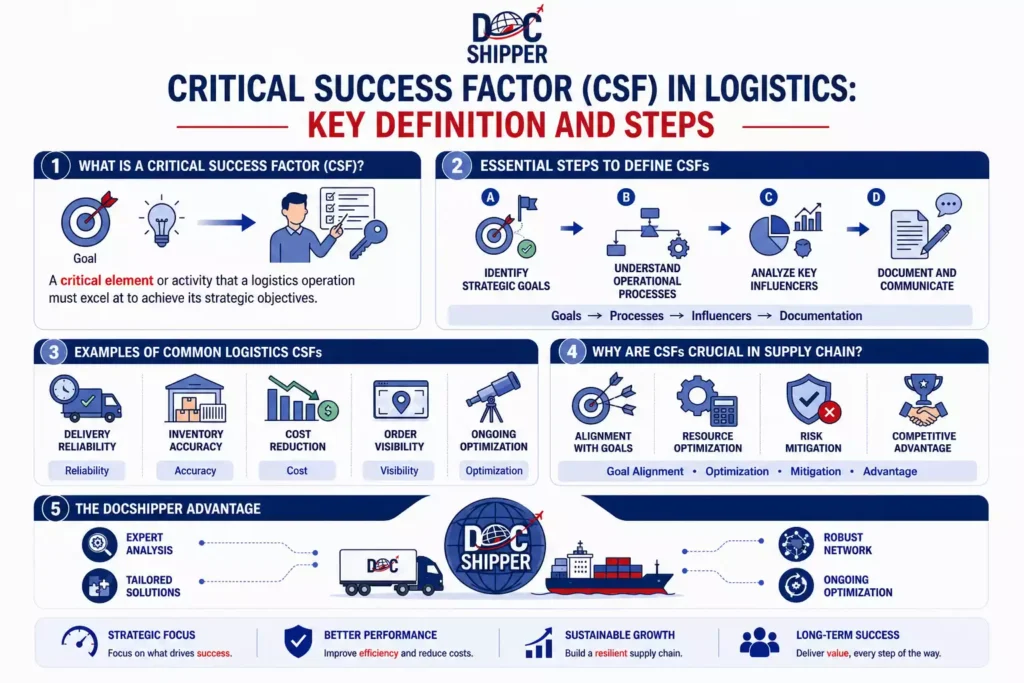
Critical Success Factors (CSFs) are essential strategic elements that determine whether an organization achieves its objectives in international logistics. These factors represent the limited number of areas where satisfactory results guarantee competitive performance and operational excellence throughout the supply chain.
Introduction
Many logistics companies struggle to prioritize initiatives that truly impact their bottom line. Without identifying Critical Success Factors, resources scatter across non-essential activities while core performance drivers remain neglected.
In international freight forwarding and customs brokerage, CSFs provide the strategic compass that aligns operations with business objectives. They transform abstract goals into measurable performance areas that directly influence customer satisfaction, cost efficiency, and competitive positioning.
Key characteristics of effective CSFs in logistics include:
- Measurability – Each factor must connect to specific KPIs and metrics
- Strategic alignment – Direct linkage to organizational mission and vision
- Limited scope – Typically 3-7 factors to maintain focus
- Controllability – Within the organization’s sphere of influence
- Temporal relevance – Adaptable to changing market conditions
Strategic Framework & Implementation
Identifying CSFs requires systematic analysis across operational, managerial, and environmental dimensions. The methodology originated from management research in the 1960s and gained prominence through John F. Rockart’s work at MIT in 1979.
In freight forwarding, on-time delivery performance consistently emerges as a primary CSF. This factor cascades into multiple operational requirements: carrier reliability, customs clearance efficiency, documentation accuracy, and real-time tracking capabilities. At DocShipper, we systematically monitor these sub-components to ensure our 98% on-time delivery rate across international shipments.
Regulatory compliance represents another critical factor, particularly given evolving trade regulations and customs requirements. Organizations must maintain current knowledge of HS codes, origin rules, restricted goods lists, and documentation standards. The European Union’s Union Customs Code exemplifies the complexity logistics providers must navigate.
Cost optimization balances service quality with financial efficiency. This CSF encompasses freight rate negotiation, route optimization, consolidation strategies, and warehouse utilization. Successful implementation requires sophisticated data analytics to identify cost-saving opportunities without compromising service levels.
Technology integration has become non-negotiable in modern logistics. Digital platforms enable visibility, automate documentation, facilitate communication, and generate predictive analytics. Companies lacking robust TMS (Transportation Management Systems) or WMS (Warehouse Management Systems) face significant competitive disadvantages.
Customer relationship management extends beyond basic service provision. Proactive communication, customized solutions, problem anticipation, and consultative expertise differentiate premium logistics providers. This CSF directly correlates with client retention rates and referral generation.
Practical Applications & Data
Translating CSFs into operational reality requires concrete measurement frameworks and implementation protocols. The following examples demonstrate how logistics organizations operationalize critical success factors.
Comparative CSF Framework: Air vs. Ocean Freight
| Critical Success Factor | Air Freight Priority | Ocean Freight Priority |
|---|---|---|
| Speed to Market | Critical (24-72h delivery) | Moderate (15-45 days acceptable) |
| Cost Efficiency | Secondary concern | Primary driver ($/kg optimization) |
| Cargo Security | High (pharmaceutical, electronics) | Variable (depends on commodity) |
| Documentation Accuracy | Critical (tight customs windows) | Critical (complex bill of lading) |
| Environmental Impact | Growing concern (carbon offset) | Increasing priority (IMO 2030) |
Case Study: E-commerce Fulfillment CSFs
A mid-sized electronics retailer importing from Shenzhen to European markets identified five CSFs for their logistics operations:
1. Inventory accuracy (99.8% target) – Implemented RFID tracking and daily cycle counts, reducing stockouts by 67% over six months.
2. Customs clearance speed (<4 hours) – Pre-classification of 95% of SKUs and AEO (Authorized Economic Operator) status reduced average clearance time from 18 hours to 2.5 hours.
3. Returns processing (<48h turnaround) – Dedicated reverse logistics workflow with quality inspection protocols improved customer satisfaction scores from 3.2 to 4.6 out of 5.
4. Shipment visibility (real-time updates) – API integration between their e-commerce platform and freight forwarder’s TMS enabled proactive customer communication, reducing inquiry volume by 43%.
5. Landed cost accuracy (±2% variance) – Comprehensive duty/tax calculation engine with currency hedging strategies stabilized pricing and protected margins during volatile periods.
Results after 12 months: 34% reduction in total logistics costs, 28% improvement in delivery performance, and 52% increase in customer retention rate. These outcomes directly validate the strategic selection and execution of CSFs aligned with business objectives.
Conclusion
Critical Success Factors transform logistics strategy from reactive operations into proactive competitive advantage. By concentrating resources on the limited areas that genuinely drive performance, organizations achieve measurable improvements in efficiency, reliability, and customer satisfaction.
Need expert guidance on identifying and implementing CSFs for your international logistics operations? Contact DocShipper for customized strategic consultation and end-to-end supply chain solutions.
📚 Quizz
Test Your Knowledge: Critical Success Factors (CSF)
Q1 — What best defines a Critical Success Factor (CSF) in international logistics?
Q2 — A logistics manager states: "Our KPI is a 95% first-time customs clearance rate, so that's our CSF." Is this interpretation correct?
Q3 — An electronics retailer importing from Shenzhen to Europe wants to reduce customs clearance time from 18 hours to under 4 hours. Which approach best reflects correct CSF implementation?
🎯 Your Result
📞 Free Quote in 24hFAQ | Critical Success Factor (CSF): Definition, Implementation & Practical Examples
Optimal range is 3-7 CSFs. Fewer than three indicates insufficient strategic depth, while more than seven dilutes focus and complicates resource allocation. The exact number depends on organizational complexity and market positioning.
CSFs are strategic areas requiring excellence for success (e.g., "customs compliance"), while KPIs are specific metrics measuring performance within those areas (e.g., "95% first-time clearance rate"). CSFs define what matters; KPIs measure how well you're performing.
Annual comprehensive reviews align with strategic planning cycles, with quarterly assessments to validate continued relevance. Market disruptions (regulatory changes, technology shifts, competitive moves) may trigger immediate re-evaluation outside scheduled reviews.
Departmental CSFs should cascade from corporate-level factors while addressing specific functional requirements. For example, corporate CSF "customer satisfaction" translates to "documentation accuracy" for customs teams and "damage-free delivery" for warehouse operations.
Technology serves as an enabler rather than a CSF itself. Digital tools (TMS, WMS, IoT sensors, AI analytics) provide the infrastructure to monitor, measure, and optimize performance across genuine CSFs like speed, accuracy, and cost efficiency.
Each CSF requires 2-4 linked KPIs with baseline measurements, targets, and tracking frequency. Success manifests through consistent achievement of targets, positive trend lines, and demonstrated correlation between CSF performance and business outcomes like revenue growth or market share.
Core principles remain consistent, but specific factors vary by sector. Pharmaceutical logistics prioritizes temperature control and regulatory validation, while automotive logistics emphasizes just-in-time delivery and sequencing accuracy. Context determines CSF selection.
Persistent underperformance requires root cause analysis to determine if the issue stems from inadequate resources, flawed processes, external constraints, or misidentified priorities. Solutions may include process redesign, technology investment, training programs, or strategic repositioning.
Regulatory environments directly shape CSFs, particularly for cross-border operations. Countries with complex customs regimes (China, India, Brazil) elevate compliance and documentation accuracy to critical status, while free-trade zones may shift focus toward speed and cost optimization.
Strategic outsourcing can enhance CSF performance when partners possess superior capabilities (specialized warehousing, customs expertise, regional networks). However, it introduces dependency risks requiring robust vendor management, SLA monitoring, and contingency planning to maintain control over critical factors.
CSFs executed at superior levels create differentiation. When competitors struggle with 85% on-time delivery, achieving 98% through excellent CSF management becomes a market-winning capability. Sustainable advantage requires continuous improvement and adaptation as industry standards evolve.
Effective communication requires cascading frameworks that translate corporate CSFs into department-specific objectives, visual dashboards displaying real-time performance, regular review meetings linking daily activities to strategic factors, and recognition programs rewarding contributions to CSF achievement.
Need Help with
Logistics or Sourcing ?
First, we secure the right products from the right suppliers at the right price by managing the sourcing process from start to finish. Then, we simplify your shipping experience - from pickup to final delivery - ensuring any product, anywhere, is delivered at highly competitive prices.


Fill the Form
Prefer email? Send us your inquiry, and we’ll get back to you as soon as possible.
Contact us




:%20Definition,%20Implementation%20&%20Practical%20Examples)