


In short ⚡
Deadhead refers to the movement of a transportation vehicle (truck, container, vessel, or aircraft) without carrying revenue-generating cargo. This empty repositioning represents a significant cost factor in logistics, directly impacting profitability, fuel consumption, and environmental sustainability across global supply chains.
Introduction
In international logistics, deadhead movements create a paradox: vehicles must travel to maintain operational flow, yet these journeys generate zero revenue while consuming fuel, labor, and time. This inefficiency affects every stakeholder in the supply chain, from carriers to shippers.
Understanding deadhead is crucial for optimizing logistics operations. The concept applies across all transportation modes and directly influences pricing structures, route planning, and environmental impact assessments.
Key characteristics of deadhead operations include:
- Zero revenue generation during the empty movement phase
- Operational necessity for vehicle repositioning and fleet balance
- Cost absorption through increased rates on loaded movements
- Environmental impact from unnecessary emissions and fuel consumption
- Strategic planning opportunity for backhaul optimization and route efficiency
In-Depth Analysis & Logistics Expertise
Deadhead occurs when supply and demand imbalances create directional freight flow asymmetries. For instance, manufacturing hubs generate more outbound shipments than inbound deliveries, forcing carriers to reposition empty equipment.
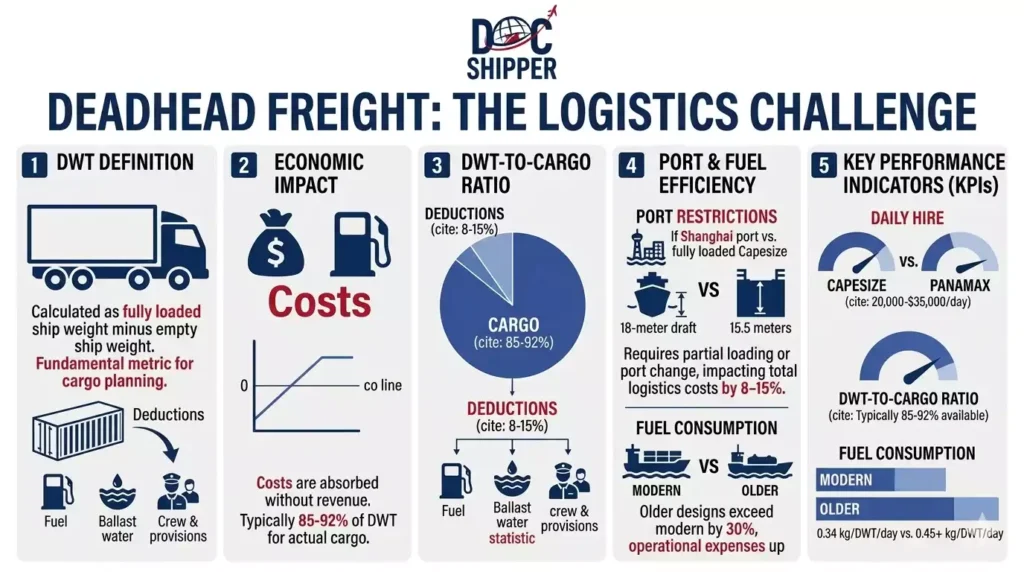
The deadhead ratio quantifies this inefficiency as the percentage of total miles traveled without cargo. Industry benchmarks vary by mode: trucking averages 15-20% deadhead, while container shipping faces repositioning challenges particularly on Asia-Europe-Americas trade lanes.
Economic implications extend beyond direct fuel costs. Deadhead miles contribute to driver wages, vehicle depreciation, insurance, and maintenance expenses—all without offsetting revenue. Carriers typically distribute these costs across profitable loads, increasing overall freight rates.
From a regulatory perspective, deadhead movements still require compliance with hours-of-service rules, weight restrictions, and border crossing documentation. According to EU Regulation 2020/1055, cabotage restrictions further complicate empty repositioning strategies within European markets.
Technology solutions now address deadhead through digital freight matching platforms, predictive analytics, and collaborative logistics networks. Real-time visibility enables carriers to identify backhaul opportunities and reduce empty miles systematically.
At DocShipper, we leverage our global network to minimize deadhead exposure for clients by coordinating multi-modal shipments and identifying consolidation opportunities that maximize equipment utilization across international routes.
Concrete Examples & Data-Driven Insights
Real-world deadhead scenarios demonstrate the financial and operational impact across different transportation segments:
Comparative Analysis by Transport Mode
| Transport Mode | Average Deadhead % | Annual Cost Impact | Primary Cause |
|---|---|---|---|
| Road Freight | 18-22% | $15,000-$25,000 per truck | Regional trade imbalances |
| Container Shipping | 30-35% | $800-$1,200 per TEU repositioning | Trans-Pacific trade lane asymmetry |
| Air Cargo | 25-30% | $5,000-$12,000 per positioning flight | Seasonal demand fluctuations |
| Rail Intermodal | 12-15% | $400-$600 per container move | Port-to-inland distribution patterns |
Use Case: Trans-Pacific Container Repositioning
Scenario: A shipping line operates on the Asia-US West Coast route where export volumes from China to the US significantly exceed return shipments.
Challenge: After delivering 10,000 TEU from Shanghai to Los Angeles, only 3,500 TEU of US exports are available for the return voyage, creating a 65% deadhead ratio for equipment.
Financial Impact:
- Repositioning cost per empty container: $950
- Total repositioning expense: 6,500 containers × $950 = $6,175,000
- Cost absorption: Distributed across loaded eastbound shipments, adding $617 per TEU
Optimization Strategy: The carrier implements dynamic pricing for westbound shipments, offering 40% discounts to stimulate US export volumes, reducing deadhead to 45% and lowering overall repositioning costs by $2.1 million annually.
Key Mitigation Strategies
- Backhaul optimization: Proactive identification of return cargo opportunities through digital freight platforms
- Collaborative logistics: Sharing capacity with complementary carriers to balance directional flows
- Dynamic pricing: Offering reduced rates on underutilized lanes to stimulate demand
- Equipment pooling: Participating in container or trailer-sharing programs to reduce individual repositioning needs
- Route redesign: Triangulation strategies that create circular routing patterns instead of linear point-to-point movements
Conclusion
Deadhead represents one of logistics’ most persistent efficiency challenges, directly affecting profitability, sustainability, and service quality. Strategic management of empty movements separates industry leaders from competitors struggling with operational inefficiencies.
Need expert guidance on optimizing your logistics operations and minimizing deadhead costs? Contact DocShipper for customized solutions tailored to your international shipping requirements.
📚 Quiz
Test Your Knowledge: Deadhead
Q1 — What is the correct definition of "deadhead" in logistics?
Q2 — A logistics manager claims that deadhead miles only impact fuel costs. Is this correct?
Q3 — A shipping line delivers 10,000 TEU from Shanghai to Los Angeles but only finds 3,500 TEU of return cargo. Which strategy best reduces the deadhead ratio on the return voyage?
🎯 Your Result
📞 Free Quote in 24hFAQ | Deadhead: Definition, Calculation & Concrete Examples
Deadhead refers to any empty vehicle movement, while bobtail specifically describes a truck tractor operating without a trailer attached. Bobtail is a subset of deadhead operations in trucking.
Carriers typically distribute deadhead expenses across revenue-generating loads through rate adjustments, fuel surcharges, or dedicated deadhead fees. This cost allocation increases overall freight rates to maintain profitability.
Yes. Shippers offering balanced bidirectional volumes, flexible pickup/delivery windows, or willingness to consolidate shipments provide carriers with backhaul opportunities, often resulting in preferential pricing and reduced deadhead-related charges.
Industry benchmarks suggest 10-15% deadhead is operationally efficient for trucking. Ratios exceeding 20% indicate significant optimization opportunities, while sub-10% performance represents best-in-class fleet utilization.
Empty vehicle movements contribute directly to carbon footprints without productive output. A 20% deadhead ratio effectively increases per-unit emissions by 25%, making deadhead reduction critical for sustainability initiatives and ESG compliance.
While not universally mandated, many jurisdictions require electronic logging device (ELD) data that captures all vehicle movements, including deadhead. EU regulations increasingly demand transparency in empty running for environmental monitoring purposes.
Digital freight matching platforms, transportation management systems (TMS) with optimization algorithms, predictive analytics, and blockchain-based collaborative networks enable real-time visibility and automated backhaul identification to reduce empty miles.
Container repositioning involves maritime logistics with longer timelines, higher per-unit costs, and global trade imbalances. Truck deadhead operates on shorter regional cycles with more frequent optimization opportunities and lower individual repositioning expenses.
Complete elimination is practically impossible due to inherent supply-demand asymmetries, seasonal variations, and geographic trade imbalances. However, strategic planning can reduce deadhead to minimal operational levels of 5-10% in optimized networks.
In air cargo, deadhead positioning refers to empty aircraft movements to reposition capacity for scheduled operations or charter flights. These flights incur full operational costs without revenue, significantly impacting airline profitability during low-demand periods.
Brokers analyze lane-specific deadhead probabilities and incorporate risk premiums into their margin calculations. They leverage market intelligence to match loads with carriers having favorable positioning, reducing deadhead exposure while maintaining competitive pricing.
Strategic deadhead capacity provides flexibility during disruptions, enabling rapid equipment repositioning to address unexpected demand surges or route changes. This operational buffer enhances supply chain responsiveness despite its cost implications.
Need Help with
Logistics or Sourcing ?
First, we secure the right products from the right suppliers at the right price by managing the sourcing process from start to finish. Then, we simplify your shipping experience - from pickup to final delivery - ensuring any product, anywhere, is delivered at highly competitive prices.


Fill the Form
Prefer email? Send us your inquiry, and we’ll get back to you as soon as possible.
Contact us




