


In short ⚡
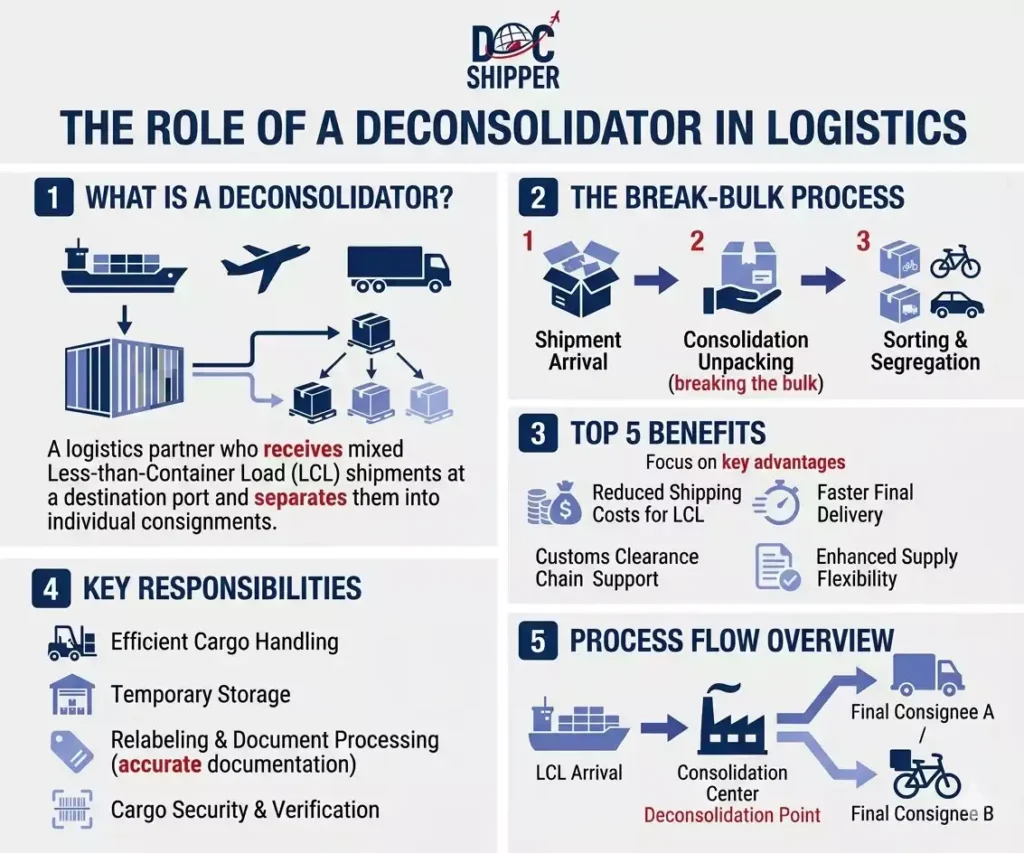
A deconsolidator is a logistics operator that breaks down consolidated shipments (LCL or groupage) into individual consignments for final delivery to respective consignees. This process occurs at destination ports or distribution centers, enabling cost-effective international shipping for small-volume importers while maintaining supply chain efficiency and traceability.
Introduction
Many importers face confusion when their cargo arrives at a destination port as part of a consolidated container. Who separates the shipments? How is individual accountability maintained? The deconsolidator answers these questions by serving as the critical link between bulk ocean freight and last-mile delivery.
In international trade, shipping small volumes via full container loads (FCL) is economically unfeasible. Instead, multiple shippers combine cargo into Less than Container Load (LCL) shipments. Upon arrival, a specialized operator must reverse this process—this is where the deconsolidator becomes essential.
Key characteristics of deconsolidation services include:
- Cargo segregation: Physical separation of goods belonging to different consignees from a single container
- Documentation verification: Matching bills of lading, packing lists, and customs declarations to physical cargo
- Damage inspection: Recording any transit damage before individual delivery arrangements
- Storage coordination: Temporary warehousing until customs clearance and final delivery scheduling
- Regulatory compliance: Ensuring each shipment meets destination country import requirements
Deconsolidation Process & Expertise
The deconsolidation operation begins when a consolidated container reaches the destination terminal. The master bill of lading (MBL) covers the entire container, while individual house bills of lading (HBL) identify each shipper’s cargo within that container.
Upon container delivery to the deconsolidation facility, operators follow a systematic workflow. First, they verify the container seal number against shipping documents to ensure no unauthorized access occurred during transit. Next, they unload cargo while cross-referencing each package against the cargo manifest.
The tally sheet becomes the critical document during this phase. Operators record package counts, weights, dimensions, and visible condition. Any discrepancies trigger immediate notifications to the freight forwarder and insurance parties. This documentation protects all stakeholders in potential claims scenarios.
Customs procedures add complexity to deconsolidation. In the European Union, deconsolidators must comply with Union Customs Code regulations, particularly regarding temporary storage declarations. The U.S. requires deconsolidators to submit ISF 10+2 filings and maintain bonded warehouse status for certain cargo categories. Reference: U.S. Customs and Border Protection – Entry Summary.
At DocShipper, we manage the entire deconsolidation process for our clients, coordinating directly with terminal operators to expedite cargo release and minimize storage fees. Our systems track each shipment from container unloading through final delivery, providing real-time visibility to importers.
Technology integration distinguishes professional deconsolidators. Modern facilities use warehouse management systems (WMS) with barcode scanning to maintain accuracy. These systems automatically generate delivery notifications and integrate with customs brokerage platforms for seamless clearance processing.
Practical Examples & Data
Understanding deconsolidation economics helps importers optimize their supply chains. Consider a typical scenario involving three importers sharing a 20-foot container from Shanghai to Rotterdam.
| Importer | Cargo Volume (CBM) | Ocean Freight Share | Deconsolidation Fee | Total Cost |
|---|---|---|---|---|
| Company A | 8 CBM | €640 | €120 | €760 |
| Company B | 12 CBM | €960 | €150 | €1,110 |
| Company C | 5 CBM | €400 | €95 | €495 |
In this example, deconsolidation fees represent 15-19% of total freight costs. Without this service, each company would need to book a full container at €2,800-€3,200, making small-volume imports economically impossible.
Case Study: A U.S. electronics retailer imports smartphone accessories from Shenzhen monthly. Their average shipment volume is 6 CBM. By using LCL services with professional deconsolidation at Los Angeles port, they reduce logistics costs by 68% compared to FCL booking, while maintaining weekly replenishment cycles.
Industry data reveals deconsolidation efficiency benchmarks:
- Processing time: Professional operators complete deconsolidation within 24-48 hours of container arrival
- Accuracy rate: Leading facilities maintain 99.7% cargo matching accuracy through automated systems
- Storage duration: Average dwell time is 3-5 days before final delivery or customs clearance
- Cost structure: Deconsolidation fees typically range from €80-€200 per shipment depending on volume and complexity
- Market concentration: Top 10 deconsolidators handle approximately 60% of global LCL volume at major ports
Geographic considerations impact deconsolidation operations significantly. Asian ports like Singapore and Hong Kong process deconsolidation within 18-24 hours due to advanced infrastructure. European ports average 36-48 hours, while some African and South American facilities may require 5-7 days due to capacity constraints.
Conclusion
The deconsolidator serves as an indispensable intermediary in modern supply chains, enabling cost-effective international shipping for businesses of all sizes. Understanding this process helps importers optimize logistics strategies and anticipate potential delays.
Need assistance with consolidated shipments or deconsolidation coordination? Contact DocShipper for expert guidance on your international logistics requirements.
📚 Quiz
Test Your Knowledge: Deconsolidator
Q1 — What is the primary role of a deconsolidator in international logistics?
Q2 — A common misconception is that a deconsolidator and a freight forwarder perform the same function. What is the key distinction?
Q3 — A U.S. electronics retailer imports 6 CBM of smartphone accessories from Shenzhen monthly. Which shipping approach best suits their needs?
🎯 Your Result
📞 Free Quote in 24hFAQ | Deconsolidator: Definition, Role & Practical Examples in Logistics
A freight forwarder arranges transportation, while a deconsolidator specifically handles the physical separation of consolidated cargo at destination. Many freight forwarders operate their own deconsolidation facilities or partner with specialized operators.
Standard deconsolidation requires 24-48 hours at major ports with modern facilities. Delays may occur due to customs inspections, documentation issues, or high container volumes during peak seasons.
Deconsolidation fees are typically charged to the consignee (importer) as part of destination charges. These costs are usually outlined in the freight quotation under "destination handling" or similar terms.
Not all ports offer professional deconsolidation facilities. Major commercial ports have dedicated container freight stations (CFS) with proper equipment and licensing. Smaller ports may require cargo transfer to nearby facilities.
Operators document all visible damage on arrival tally sheets. If damage occurs during deconsolidation, the facility's liability insurance covers claims. Importers should inspect cargo immediately upon delivery and note any issues on delivery receipts.
Hazardous materials, perishables, and high-value goods may require specialized deconsolidation facilities with appropriate certifications. Some countries prohibit consolidation of certain product categories for security reasons.
Each shipment within a consolidated container requires individual customs clearance. Deconsolidators coordinate with customs brokers to ensure proper documentation and facilitate inspection access when required by authorities.
A CFS is a bonded facility where consolidation and deconsolidation operations occur. These facilities are licensed by customs authorities and equipped with material handling equipment, storage areas, and documentation systems.
Professional deconsolidators provide tracking updates when cargo is unloaded, tallied, and ready for delivery. Modern systems send automated notifications at each processing stage, similar to parcel tracking services.
Essential documents include the house bill of lading, commercial invoice, packing list, and arrival notice. Additional paperwork may include certificates of origin, import permits, or product-specific documentation depending on cargo type.
For shipments under 15 CBM, LCL with deconsolidation typically costs 40-60% less than booking a full container. The break-even point varies by trade lane, with longer routes favoring consolidation for smaller volumes.
Licensed facilities maintain CCTV surveillance, controlled access zones, and cargo tracking systems. Many hold certifications like C-TPAT (USA) or AEO (EU) demonstrating compliance with international security standards.
Need Help with
Logistics or Sourcing ?
First, we secure the right products from the right suppliers at the right price by managing the sourcing process from start to finish. Then, we simplify your shipping experience - from pickup to final delivery - ensuring any product, anywhere, is delivered at highly competitive prices.


Fill the Form
Prefer email? Send us your inquiry, and we’ll get back to you as soon as possible.
Contact us




