


In short ⚡
Direct-to-Store (DTS) Delivery is a logistics distribution method where products are shipped directly from manufacturers or suppliers to individual retail locations, bypassing traditional distribution centers. This streamlined approach reduces handling time, minimizes inventory holding costs, and accelerates product availability on store shelves.
Introduction
Retailers constantly face a critical challenge: how to get products from suppliers to shelves faster while controlling logistics costs. Traditional distribution models involving multiple warehousing stages create delays, increase handling expenses, and complicate inventory management.
Direct-to-Store delivery addresses these pain points by creating a direct pipeline between production facilities and retail outlets. This model has become essential for businesses managing perishable goods, high-velocity products, or time-sensitive promotional campaigns.
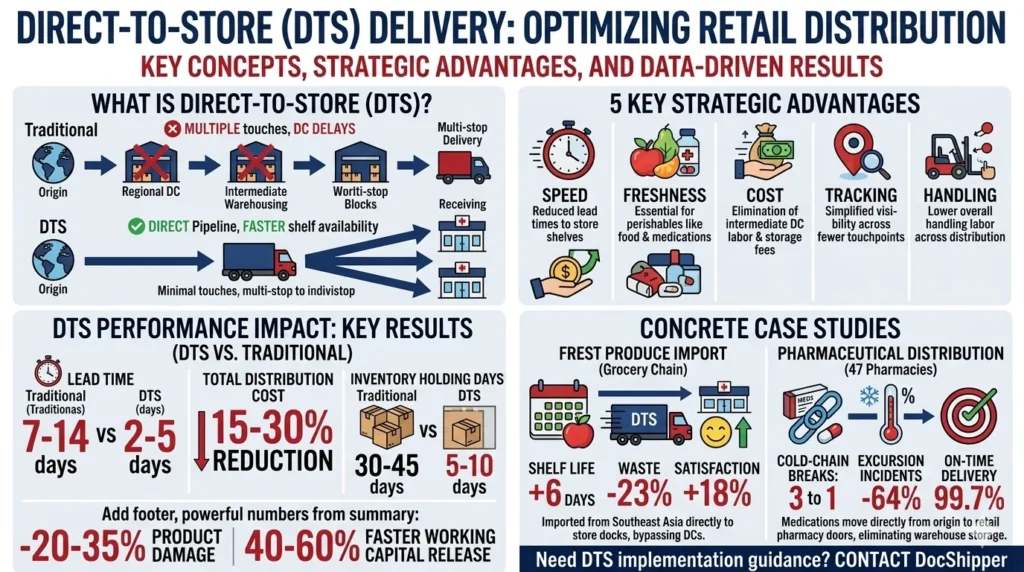
- Elimination of intermediate warehousing: Products move directly from origin to final destination
- Reduced lead times: Faster shelf replenishment compared to traditional hub-and-spoke models
- Enhanced product freshness: Critical for food, pharmaceuticals, and seasonal merchandise
- Simplified inventory tracking: Fewer touchpoints mean clearer supply chain visibility
- Lower handling costs: Reduced labor and storage expenses across the distribution network
DTS Mechanisms & Strategic Implementation
Direct-to-Store delivery operates on consolidated shipment principles. Suppliers aggregate orders from multiple retail locations into single truckloads, then execute multi-stop routes delivering to each store sequentially. This requires sophisticated route optimization software to maximize efficiency.
The order-to-delivery cycle begins when retailers transmit purchase orders directly to manufacturers or distributors. Unlike traditional models where products first enter regional distribution centers, DTS shipments are prepared for immediate store delivery. Suppliers must coordinate precise delivery windows that align with store receiving schedules.
Cross-docking techniques sometimes complement pure DTS models. Products arriving from international suppliers may pass through minimal-touch consolidation facilities where shipments are sorted by destination store without entering long-term storage. This hybrid approach maintains DTS speed advantages while enabling import consolidation.
Regulatory compliance becomes more complex in DTS operations. Each delivery location may have different receiving hour restrictions, unloading equipment availability, and documentation requirements. According to U.S. Department of Commerce guidelines, international DTS shipments must include complete customs clearance documentation at the point of entry, with individual store delivery instructions clearly specified.
Technology integration is fundamental to DTS success. Real-time tracking systems, automated proof-of-delivery capture, and electronic data interchange (EDI) enable seamless coordination between suppliers, carriers, and retailers. At DocShipper, we implement end-to-end visibility platforms that track each shipment from factory gate to store receiving dock, ensuring our clients maintain complete control over their DTS operations.
Concrete Examples & Performance Data
Performance metrics demonstrate DTS delivery’s tangible advantages. Industry research shows that companies implementing DTS strategies typically achieve 15-30% reduction in total distribution costs compared to traditional warehousing models, primarily through eliminated storage fees and reduced handling labor.
| Distribution Model | Average Lead Time | Handling Touchpoints | Inventory Holding Days |
|---|---|---|---|
| Traditional DC Model | 7-14 days | 4-6 touchpoints | 30-45 days |
| Direct-to-Store Delivery | 2-5 days | 2-3 touchpoints | 5-10 days |
Case Study: Fresh Produce Import
A European grocery chain importing organic vegetables from Southeast Asia switched from warehouse distribution to DTS delivery. Products previously spent 8 days in distribution centers before reaching stores. With DTS implementation, customs-cleared shipments moved directly to refrigerated trucks for immediate store delivery. Result: shelf life increased by 6 days, waste decreased by 23%, and customer satisfaction scores improved by 18%.
Pharmaceutical Distribution Example
A pharmaceutical importer managing temperature-sensitive medications implemented DTS for 47 retail pharmacy locations. By eliminating warehouse storage, the company reduced cold-chain breaks from 3 to 1, achieved 99.7% on-time delivery performance, and cut temperature excursion incidents by 64%. Regulatory compliance improved significantly due to simplified chain-of-custody documentation.
Key Performance Indicators:
- Order fill rate: DTS operations typically achieve 96-99% accuracy versus 92-95% for traditional models
- Delivery window compliance: Successful DTS programs maintain 95%+ on-time delivery within scheduled windows
- Damage rates: Reduced handling decreases product damage by approximately 20-35%
- Carbon footprint: Consolidated routing reduces transportation emissions by 12-18% per unit delivered
- Cash flow improvement: Faster inventory turnover releases working capital 40-60% faster
Conclusion
Direct-to-Store delivery represents a fundamental shift in retail logistics, offering measurable improvements in speed, cost efficiency, and product quality. Companies that successfully implement DTS strategies gain competitive advantages through superior inventory management and customer satisfaction.
Need expert guidance on implementing DTS delivery for your international shipments? Contact DocShipper for customized logistics solutions tailored to your distribution requirements.
📚 Quizz
Test Your Knowledge: Direct-to-Store (DTS) Delivery
Q1 — What is the defining characteristic of Direct-to-Store (DTS) delivery?
Q2 — A retailer claims that DTS delivery and drop shipping are essentially the same thing. Is this correct?
Q3 — A European grocery chain imports organic vegetables from Southeast Asia. Which scenario best illustrates a successful DTS implementation?
🎯 Your Result
📞 Free Quote in 24hFAQ | Direct-to-Store (DTS) Delivery: Definition, Process & Practical Examples
Perishable goods, high-turnover consumer products, seasonal merchandise, and items requiring temperature control benefit most. Products with predictable demand patterns and sufficient order volumes to justify dedicated routing work best for DTS models.
DTS involves bulk shipments from suppliers to multiple retail locations in consolidated routes. Drop shipping sends individual orders directly to end consumers. DTS maintains B2B characteristics while drop shipping is B2C focused.
Economic viability typically begins at 15-20 store locations within reasonable geographic proximity. Consolidated truckloads serving multiple stores in efficient routes justify the logistics coordination costs involved in DTS operations.
Yes, international DTS requires customs clearance at port of entry, then direct distribution to stores. Importers must ensure all regulatory documentation is complete before initiating store deliveries to avoid delays at individual locations.
Transportation Management Systems (TMS), route optimization software, real-time GPS tracking, electronic proof-of-delivery systems, and EDI integration between suppliers and retailers are essential for coordinating complex multi-stop delivery routes.
Retailers establish scheduled delivery windows, allocate dock space, and coordinate staffing based on advance shipping notices. Suppliers must adhere strictly to appointment times to prevent receiving dock congestion and operational disruptions.
Coordination complexity across multiple delivery points, strict delivery window requirements, variable store receiving capabilities, and the need for sophisticated routing technology represent primary implementation challenges. Supplier-retailer communication must be seamless.
Small chains with 5-10 locations can implement DTS if stores are geographically clustered and order volumes justify consolidated shipments. Partnering with third-party logistics providers often makes DTS accessible to smaller retail operations.
DTS requires real-time inventory visibility and automated replenishment triggers. Retailers must integrate point-of-sale data with supplier ordering systems to maintain optimal stock levels without the buffer traditionally provided by distribution centers.
Cargo insurance must cover goods throughout the entire journey from origin to final store delivery. Policies should address multiple delivery points, varied unloading conditions, and potential delays at individual locations during multi-stop routes.
Yes, DTS typically reduces total transportation miles through optimized routing and eliminates warehouse energy consumption. Studies show 12-18% emission reductions per unit delivered when properly implemented with efficient route planning.
Returns require separate collection routes or coordination with forward delivery schedules. Some DTS operations incorporate return pickups during delivery runs, though this adds complexity to route planning and vehicle capacity management.
Need Help with
Logistics or Sourcing ?
First, we secure the right products from the right suppliers at the right price by managing the sourcing process from start to finish. Then, we simplify your shipping experience - from pickup to final delivery - ensuring any product, anywhere, is delivered at highly competitive prices.


Fill the Form
Prefer email? Send us your inquiry, and we’ll get back to you as soon as possible.
Contact us




