


In short ⚡
A discrepancy is any inconsistency, error, or non-compliance detected between documents submitted in international trade transactions and the terms specified in the letter of credit or purchase agreement. Discrepancies often cause payment delays, additional bank fees, and shipment holds, making their identification and resolution critical for smooth import/export operations.
Introduction
In international trade, documentary precision is non-negotiable. Banks, customs authorities, and buyers scrutinize every detail of commercial invoices, bills of lading, and certificates of origin. A single typo in a product description or an expired inspection certificate can trigger what professionals call a “discrepancy.”
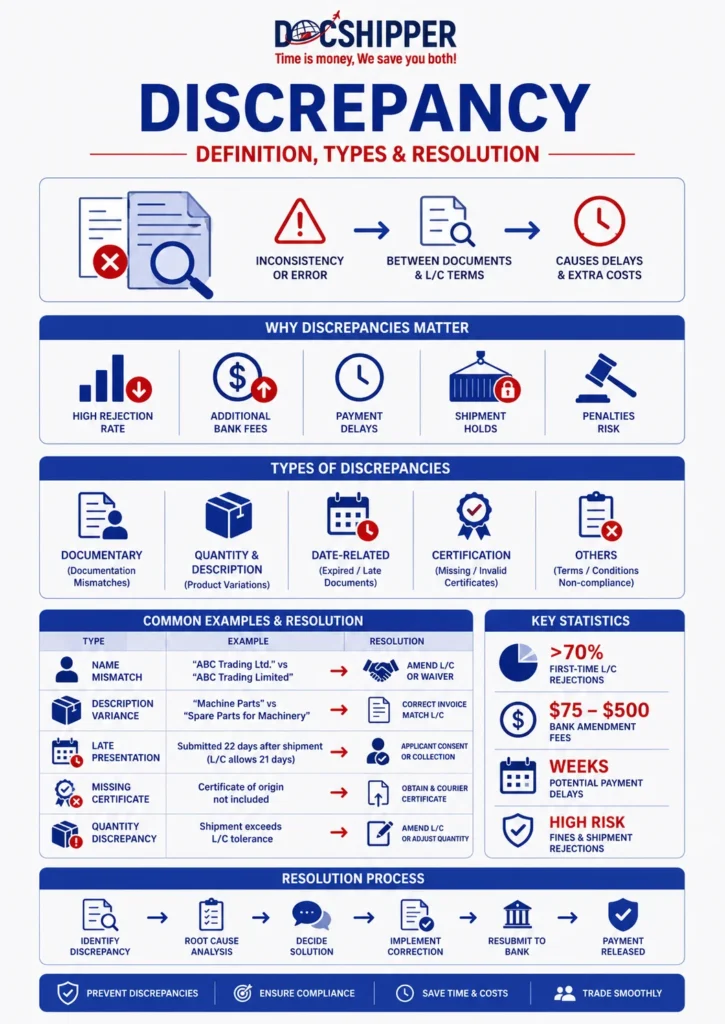
Discrepancies account for rejection rates exceeding 70% in first-time letter of credit presentations, according to the International Chamber of Commerce. The financial impact is significant: banks charge amendment fees ranging from $75 to $500 per correction, and payment delays can extend for weeks.
Understanding discrepancies is essential for:
- Exporters seeking timely payment under letters of credit
- Importers ensuring cargo release without customs holds
- Freight forwarders maintaining document accuracy across shipments
- Banks assessing compliance before honoring payment obligations
- Compliance officers preventing regulatory penalties and shipment rejections
Types & Impact of Discrepancies
Discrepancies fall into several categories, each carrying distinct consequences. The ICC Uniform Customs and Practice for Documentary Credits (UCP 600) defines strict documentary standards. Banks examine documents solely based on their face value, rejecting presentations that fail to comply with stated terms.
Documentary discrepancies involve mismatches between submitted documents and letter of credit requirements. Common issues include incorrect beneficiary names, missing signatures, or expired documents. These trigger immediate rejection unless the applicant waives the discrepancy.
Quantity and description discrepancies occur when invoiced goods differ from purchase order specifications. Even minor variations—such as “cotton shirts” versus “shirts made of cotton”—constitute discrepancies under strict compliance rules. Banks have zero tolerance for creative interpretations.
Date-related discrepancies include expired letters of credit, late shipment dates, or bills of lading issued after presentation deadlines. Time-sensitive industries like perishable goods trade face heightened risk, where a one-day delay can invalidate entire transactions.
Certification discrepancies arise when required third-party documents—such as phytosanitary certificates, certificates of origin, or inspection reports—are missing or non-compliant. Customs authorities may refuse clearance, resulting in demurrage charges and storage fees.
At DocShipper, we conduct pre-shipment document audits to identify potential discrepancies before bank presentation. Our compliance team cross-references all commercial documents against L/C terms, reducing rejection rates by over 85% for our clients.
Common Examples & Resolution Strategies
Real-world discrepancies often stem from preventable errors. Understanding typical scenarios helps traders implement effective mitigation strategies.
| Discrepancy Type | Example | Resolution Method |
|---|---|---|
| Name Mismatch | Invoice shows “ABC Trading Ltd.” but L/C states “ABC Trading Limited” | Request L/C amendment or obtain waiver from applicant |
| Description Variance | L/C requires “machine parts” but invoice lists “spare parts for machinery” | Issue corrected invoice matching exact L/C wording |
| Late Presentation | Documents submitted 22 days after shipment (L/C allows 21 days) | Negotiate acceptance on collection basis or seek applicant consent |
| Missing Certificate | Certificate of origin required but not included in document set | Obtain and courier original certificate to bank immediately |
| Quantity Discrepancy | L/C allows 5% tolerance but shipment exceeds by 7% | Ship compliant quantity or amend L/C before shipment |
Use Case: Electronics Shipment from China to Germany
A German importer opened a $150,000 letter of credit for tablet computers. The Chinese exporter’s documents showed “tablet PCs” instead of the required “tablet computers.” The advising bank rejected the presentation, citing description discrepancy.
The resolution cost $450 in amendment fees and delayed payment by 12 days. The exporter incurred $800 in additional warehouse costs during the dispute period. Had the commercial invoice used exact L/C terminology, the transaction would have cleared in 3 banking days.
DocShipper’s document review service would have flagged this variance during pre-shipment verification. Our team ensures terminology alignment across all commercial documents, eliminating costly post-shipment corrections. Need help avoiding documentary discrepancies? Contact our trade compliance specialists.
Conclusion
Discrepancies remain the leading cause of payment delays and financial losses in letter of credit transactions. Meticulous document preparation and proactive compliance checks are essential for minimizing rejection risk and maintaining smooth trade flows.
Facing recurring discrepancy issues or need expert document verification? Reach out to DocShipper’s compliance team for comprehensive trade documentation support.
📚 Quiz
Test Your Knowledge: Discrepancy
What is a discrepancy in international trade?
A commercial invoice shows "tablet PCs" while the letter of credit requires "tablet computers." What is the bank's correct action?
An exporter discovers their shipping documents contain a discrepancy after cargo has already departed. What is the most prudent course of action?
🎯 Your Result
📞 Free Quote in 24hFAQ | Discrepancy: Definition, Types & Resolution in International Trade
According to ICC studies, approximately 70-75% of initial letter of credit presentations contain at least one discrepancy. This high rate stems from strict compliance standards under UCP 600, where banks examine documents based solely on their face value without considering intent or context.
Banks cannot unilaterally accept discrepant documents. They must contact the applicant for a waiver. If the applicant refuses, the bank will reject the presentation and return documents to the beneficiary. Some applicants pre-authorize acceptance of specific minor discrepancies to expedite processing.
Resolution timeframes vary widely. Simple waivers may process in 2-3 business days if the applicant responds quickly. Complex discrepancies requiring document amendments or re-presentation can extend resolution to 2-4 weeks, particularly when overseas parties are involved.
The beneficiary (exporter) typically pays initial discrepancy handling fees charged by banks, usually $75-$500 per occurrence. However, commercial contracts may allocate these costs differently. Some buyers agree to reimburse sellers for fees caused by ambiguous letter of credit wording.
Description discrepancies rank as the most frequent issue, where goods descriptions on commercial invoices don't match letter of credit specifications exactly. Even synonyms or abbreviated terms trigger rejections under strict documentary compliance rules governing international trade finance.
Yes. Customs authorities conduct independent document reviews. Discrepancies between bills of lading, commercial invoices, and packing lists can trigger cargo inspections, clearance delays, or outright rejections. Consistent documentation across all shipment paperwork is critical for customs compliance.
Professional freight forwarders review shipping documents before bank presentation, cross-checking commercial invoices, packing lists, and transport documents against letter of credit terms. They identify potential mismatches and advise exporters on corrections before costly rejections occur.
Shipping with unresolved discrepancies is high-risk. The bank will likely reject payment, leaving the exporter with goods in transit and no immediate revenue. The importer may refuse delivery, forcing the exporter to arrange return shipment or distressed sale at significant loss.
Yes. Textile trades frequently face description discrepancies due to complex fabric specifications. Agricultural exports encounter certification discrepancies related to phytosanitary requirements. Electronics shipments often have serial number and model specification issues. Understanding sector-specific risks helps traders implement targeted controls.
Digital trade platforms and automated document checking systems significantly lower discrepancy rates. Blockchain-based letters of credit enable real-time document validation against smart contract terms. AI-powered compliance tools flag inconsistencies before submission, reducing human error in complex multi-document transactions.
Under UCP 600, exporters can request specific identification of all discrepancies, challenge unreasonable rejections, and negotiate acceptance terms. If banks cite invalid discrepancies, exporters may escalate disputes through ICC Banking Commission opinions or pursue legal remedies for wrongful dishonor.
Repeated discrepancies damage exporter credibility with banks and buyers. Financial institutions may increase fees, require additional security, or decline future letter of credit services to habitual offenders. Maintaining strong documentary compliance records enhances trade finance access and negotiating power for better terms.
Need Help with
Logistics or Sourcing ?
First, we secure the right products from the right suppliers at the right price by managing the sourcing process from start to finish. Then, we simplify your shipping experience - from pickup to final delivery - ensuring any product, anywhere, is delivered at highly competitive prices.


Fill the Form
Prefer email? Send us your inquiry, and we’ll get back to you as soon as possible.
Contact us




