


In short ⚡
DRFS (Dedicated Refrigerated Freight System) is a specialized logistics solution providing exclusive temperature-controlled transportation for perishable goods. Unlike shared reefer containers, DRFS ensures dedicated capacity, consistent temperature management, and reduced contamination risk throughout the entire supply chain from origin to destination.Introduction
Temperature-sensitive cargo faces constant quality deterioration risks during international shipment. Shared refrigerated containers often compromise product integrity through cross-contamination, inconsistent cooling, and multiple handling touchpoints.
DRFS emerged as the premium solution for pharmaceutical manufacturers, high-value food exporters, and chemical companies requiring uncompromising cold chain control. This dedicated approach transforms temperature-controlled logistics from cost center to competitive advantage.
Key characteristics of DRFS include:
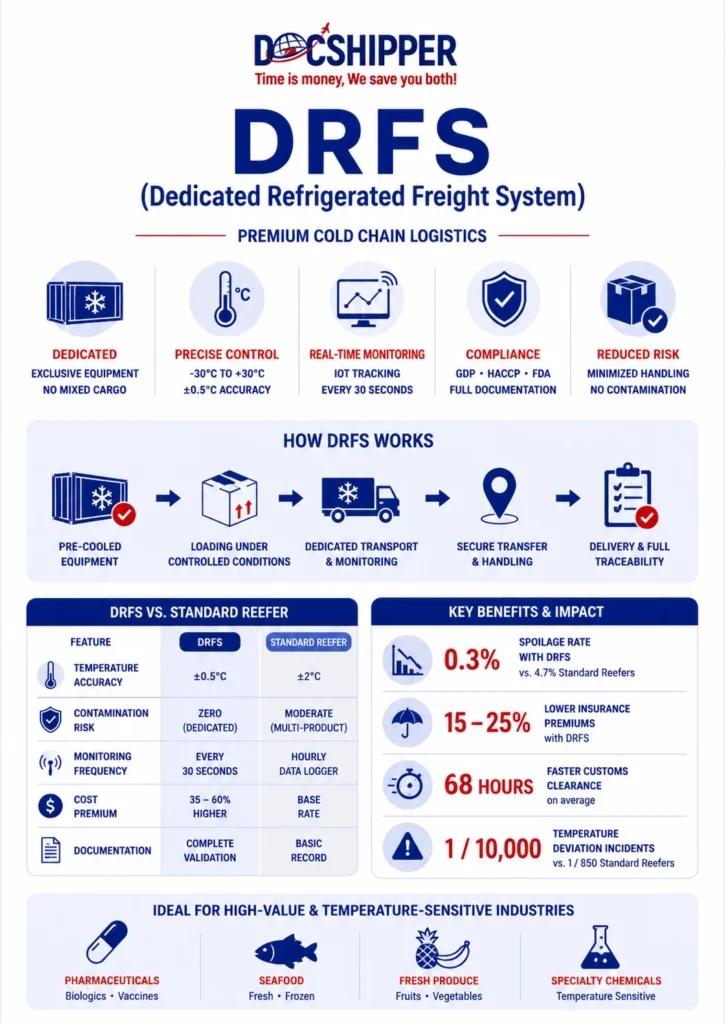
- Exclusive equipment allocation preventing cross-contamination with incompatible products
- Pre-configured temperature zones matching specific cargo requirements (-30°C to +30°C)
- Real-time IoT monitoring providing continuous visibility and automated alerts
- Dedicated handling protocols minimizing temperature excursions during transfers
- Regulatory compliance documentation supporting GDP, HACCP, and FDA validation requirements
Technical Components & Operational Framework
DRFS operates through integrated infrastructure combining specialized equipment, advanced monitoring technology, and trained personnel. The system begins with temperature-qualified containers or trucks reserved exclusively for single shipments or dedicated customer lanes.
Temperature control technology forms the system’s backbone. Modern DRFS units employ precision compressors maintaining ±0.5°C accuracy, essential for biologics and vaccines. Multi-zone configurations allow simultaneous transport of products requiring different temperatures within the same container.
Monitoring and validation systems provide continuous oversight. IoT sensors record temperature, humidity, shock events, and door openings every 30 seconds. This data feeds cloud platforms accessible to shippers, forwarders, and regulatory bodies. At DocShipper, we integrate these monitoring systems directly into our client dashboards for transparent supply chain visibility.
Regulatory compliance frameworks distinguish DRFS from standard reefer shipping. The system maintains complete documentation trails meeting EU GDP guidelines, FDA 21 CFR Part 11, and WHO PQS standards. Pre-qualified routes undergo thermal mapping studies validating temperature stability under extreme conditions.
Dedicated handling procedures minimize cold chain breaks. DRFS protocols specify maximum door-open durations (typically under 15 minutes), climate-controlled transfer facilities, and trained personnel certified in temperature-sensitive cargo management. Unlike consolidation centers handling mixed cargo, DRFS facilities focus exclusively on maintaining thermal integrity.
The IATA Perishable Cargo Regulations provide comprehensive standards governing DRFS operations. Carriers must demonstrate compliance through regular audits and equipment certifications renewed annually.
Real-World Applications & Industry Data
DRFS deployment varies significantly across industries and trade lanes. Pharmaceutical exports represent 43% of global DRFS usage, followed by premium seafood (28%) and exotic fruits (19%) according to 2024 cold chain logistics reports.
Comparative Analysis: DRFS vs. Standard Reefer Container
| Feature | DRFS | Standard Reefer |
|---|---|---|
| Temperature Accuracy | ±0.5°C continuous | ±2°C standard |
| Contamination Risk | Zero (dedicated use) | Moderate (multi-product) |
| Monitoring Frequency | Every 30 seconds (IoT) | Hourly data logger |
| Cost Premium | 35-60% above standard | Base rate |
| Regulatory Documentation | Complete validation package | Basic temperature record |
Use Case: Vaccine Distribution from Belgium to Kenya
A pharmaceutical manufacturer required DRFS for COVID-19 vaccine shipment maintaining 2-8°C across 8,500 kilometers. Standard reefer containers failed pre-qualification due to temperature fluctuations during power transfers at transshipment ports.
The DRFS solution employed:
- Pre-cooled container reaching stable 4°C before cargo loading
- Backup power systems at Brussels Airport and Mombasa Port ensuring uninterrupted cooling
- Continuous GPS tracking with automated temperature alerts to stakeholders
- Climate-controlled truck transfer for final 480km inland delivery
- Complete documentation meeting WHO PQS E003/E004 standards for customs clearance
Results: Zero temperature excursions over 14-day transit, 100% product viability upon arrival, and regulatory approval achieved within 6 hours of port arrival. Standard reefer quotes were 42% cheaper but offered no compliance guarantees.
Industry Benchmarks
Key performance data from 2024 cold chain logistics studies reveal DRFS effectiveness:
- Product loss reduction: DRFS achieves 0.3% spoilage rate versus 4.7% for standard reefers
- Insurance premium difference: Carriers charge 15-25% lower rates for DRFS shipments due to reduced claims
- Customs clearance speed: DRFS documentation reduces inspection delays by average 68 hours
- Temperature deviation incidents: DRFS records 1 event per 10,000 shipment hours compared to 1 per 850 hours for shared containers
At DocShipper, we’ve observed that clients switching to DRFS for high-value pharmaceuticals report ROI achievement within 7-9 shipments despite higher upfront costs, primarily through eliminated product losses and faster market access.
Conclusion
DRFS represents the gold standard for temperature-critical international shipping, transforming cold chain logistics from risk management exercise into strategic capability. The investment premium delivers quantifiable returns through regulatory compliance, product integrity, and supply chain velocity.
Need expert guidance on implementing DRFS for your pharmaceutical, food, or chemical exports? Contact DocShipper for customized cold chain solutions tailored to your specific regulatory and operational requirements.
📚 Quiz
Test Your Knowledge: DRFS (Dedicated Refrigerated Freight System)
What is the primary defining characteristic of DRFS compared to standard refrigerated shipping?
What temperature accuracy can DRFS systems maintain for pharmaceutical-grade shipments?
A pharmaceutical company is choosing between DRFS and standard reefer containers for vaccine exports to Africa. Which statement correctly describes DRFS value proposition?
🎯 Your Result
📞 Free Personalized QuoteFAQ | DRFS (Dedicated Refrigerated Freight System): Definition, Operation & Real-World Examples
DRFS systems reliably maintain temperatures from -30°C (deep-frozen biologics) to +30°C (temperature-stable pharmaceuticals). Advanced units offer multi-zone configurations managing different temperature requirements within single containers. Precision typically reaches ±0.5°C for pharmaceutical-grade shipments, compared to ±2°C for standard reefer containers. The system maintains stability even during power transfers at ports through backup battery systems and thermal insulation rated for 72-hour autonomous operation.
DRFS provides exclusive equipment use, eliminating cross-contamination risks inherent in shared containers that previously carried fish, meat, or chemicals. Dedicated systems undergo pre-trip validation testing, continuous IoT monitoring every 30 seconds, and maintain complete documentation chains meeting GDP and FDA standards. Standard reefers share capacity across multiple shippers, record temperatures hourly rather than continuously, and lack the regulatory validation packages required for pharmaceutical or high-value food exports.
Pharmaceutical manufacturers exporting vaccines, biologics, and temperature-sensitive medications gain critical regulatory compliance advantages. Biotechnology companies shipping cell cultures, diagnostic reagents, and research materials require DRFS contamination-free environments. Premium food exporters (organic berries, Japanese seafood, European cheeses) justify DRFS costs through eliminated spoilage and brand protection. Chemical producers handling temperature-reactive compounds use DRFS for safety compliance and liability reduction across international borders.
DRFS commands 35-60% premium over standard refrigerated shipping, varying by trade lane, duration, and regulatory requirements. A 40-foot reefer container from Rotterdam to Singapore costs approximately $4,200 standard rate versus $6,300 DRFS rate. However, pharmaceutical clients typically recover this premium through reduced product losses (0.3% vs 4.7%), lower insurance premiums (15-25% reduction), and faster customs clearance (average 68 hours saved). High-value cargo often achieves ROI within 7-9 shipments.
IoT sensors embedded in DRFS units transmit temperature, humidity, location, shock events, and door openings every 30 seconds to cloud platforms. Stakeholders receive automated alerts when parameters deviate from preset thresholds (typically within 2 minutes of occurrence). Historical data supports regulatory audits, insurance claims, and continuous improvement analysis. Advanced systems integrate with ERP and WMS platforms, enabling predictive analytics for route optimization and equipment maintenance scheduling across global cold chain networks.
DRFS containers serving pharmaceutical exports must meet EU GDP (Good Distribution Practice) guidelines, FDA 21 CFR Part 11 for electronic records, and WHO PQS (Performance Quality Safety) standards. Equipment undergoes annual qualification testing including thermal mapping studies, calibration verification, and backup system validation. Carriers maintain certification documentation from national medicines agencies, demonstrating container performance under extreme ambient conditions. Some trade lanes require additional certifications like Health Canada's GUI-0069 or Australia's TGA guidelines.
Advanced DRFS units feature partitioned compartments maintaining distinct temperature zones simultaneously. A typical configuration might combine -20°C frozen section, 2-8°C refrigerated zone, and 15-25°C controlled ambient space within one 40-foot container. Each zone operates independently with dedicated sensors, separate air circulation systems, and isolated monitoring. This capability benefits pharmaceutical distributors shipping complete product portfolios or food exporters combining frozen proteins with fresh produce, eliminating split-shipment costs and consolidating customs documentation.
DRFS systems include redundant cooling units, backup power supplies, and immediate alert protocols. Upon deviation detection, automated notifications reach freight forwarders, shippers, and technical support within 2 minutes. Backup compressors activate automatically, while thermal insulation maintains temperatures for 72 hours without power. Critical shipments include contingency plans specifying alternative routes, emergency cold storage facilities at transshipment points, and replacement equipment availability. Insurance policies covering DRFS shipments typically include temperature excursion clauses protecting cargo value up to 110% replacement cost.
DocShipper coordinates DRFS implementation from pre-shipment validation through final delivery. Our services include equipment qualification verification, regulatory documentation preparation, customs clearance acceleration using cold chain priority protocols, and continuous monitoring dashboard access for clients. We pre-position backup equipment at critical transshipment points, maintain relationships with GDP-certified warehouses globally, and provide 24/7 temperature deviation response teams. Integration with our freight forwarding, customs brokerage, and last-mile delivery networks ensures seamless cold chain continuity across complex international routes.
DRFS pharmaceutical exports require comprehensive documentation packages including equipment qualification certificates, pre-shipment temperature mapping reports, continuous monitoring data logs, GDP compliance declarations, and calibration certificates for all sensors. Shipments need temperature excursion investigation reports (even when deviations remain within acceptable ranges), handling protocol confirmations at each transfer point, and validation summaries meeting importing country requirements. Complete documentation typically comprises 40-60 pages supporting customs clearance, regulatory inspections, and audit trail requirements. Modern DRFS platforms generate these documents automatically from IoT sensor data.
Modern DRFS units employ eco-friendly refrigerants (R-452A, R-513A) with 60-70% lower global warming potential than traditional R-404A systems. Precision temperature control reduces energy consumption by 18-25% through optimized compressor cycling and improved insulation. Dedicated routing eliminates unnecessary repositioning trips that empty reefer containers generate. However, DRFS systems require higher initial energy investment for pre-cooling and validation testing. Leading carriers offset DRFS carbon footprints through renewable energy programs, with some achieving carbon-neutral cold chain operations for pharmaceutical clients willing to pay 8-12% sustainability premiums.
Initial DRFS setup for pharmaceutical exports typically requires 8-12 weeks including route qualification studies (2-3 weeks), equipment validation testing (3-4 weeks), regulatory documentation preparation (2-3 weeks), and stakeholder training (1-2 weeks). Established trade lanes with pre-qualified routes reduce implementation to 4-6 weeks. Rush implementations for clinical trial materials or emergency vaccine distribution can compress timelines to 10-14 days using expedited validation protocols and pre-certified equipment pools, though costs increase 40-60%. DocShipper's established DRFS partnerships enable faster deployment through pre-negotiated carrier agreements and template documentation packages.
Need Help with
Logistics or Sourcing ?
First, we secure the right products from the right suppliers at the right price by managing the sourcing process from start to finish. Then, we simplify your shipping experience - from pickup to final delivery - ensuring any product, anywhere, is delivered at highly competitive prices.


Fill the Form
Prefer email? Send us your inquiry, and we’ll get back to you as soon as possible.
Contact us




