


In short ⚡
Driving Time Regulations are legal frameworks that establish maximum driving hours, mandatory rest periods, and break requirements for commercial vehicle operators to prevent fatigue-related accidents and ensure road safety in freight transport operations.Introduction
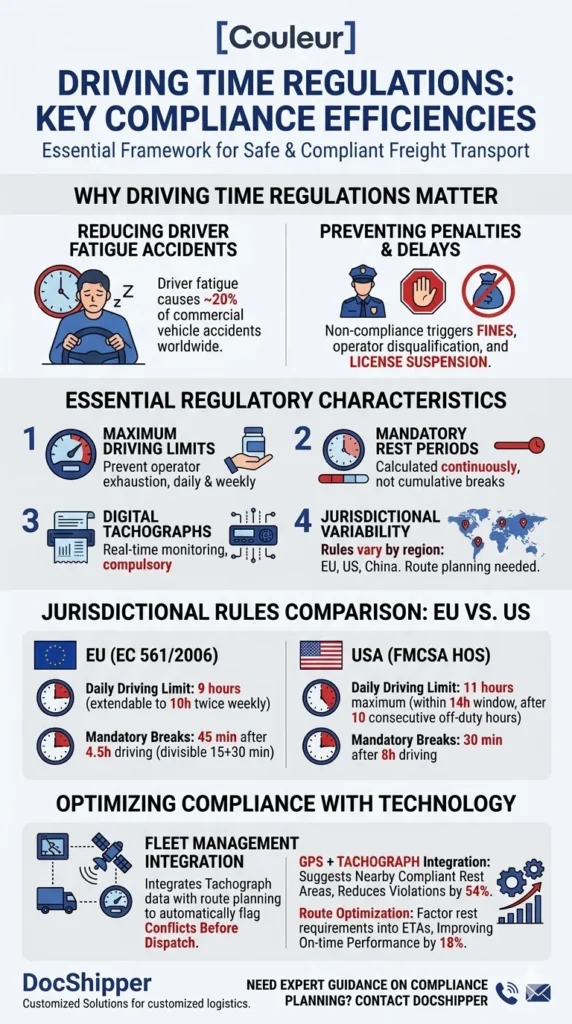
Driver fatigue causes approximately 20% of commercial vehicle accidents worldwide, yet many logistics operators still struggle to interpret complex hour-of-service rules. In international freight transport, non-compliance with driving time regulations triggers penalties ranging from fines to transport license suspension.
These regulations form the backbone of road safety legislation across all major trade corridors. Whether shipping goods from Shanghai to Hamburg or managing domestic distribution networks, understanding these rules prevents costly delays and legal complications.
Key characteristics of driving time regulations include:
- Maximum daily and weekly driving limits preventing operator exhaustion
- Mandatory rest periods calculated in continuous hours, not cumulative breaks
- Digital tachograph requirements for real-time monitoring and compliance verification
- Variable rules by jurisdiction (EU, US, China) requiring route-specific planning
- Severe penalties including vehicle immobilization and operator disqualification
For international shipments, these regulations directly impact transit times, driver scheduling, and relay point locations. Proper compliance planning reduces delivery unpredictability by 30-40% according to European Commission transport data.
Regulatory Framework & Compliance Requirements
The European Union Regulation (EC) 561/2006 establishes the most comprehensive framework, requiring drivers to limit daily driving to 9 hours (extendable to 10 hours twice weekly). Weekly limits cap at 56 hours, with a fortnightly maximum of 90 hours. After 4.5 hours of driving, operators must take a 45-minute break, divisible into 15 + 30-minute segments.
In the United States, the Federal Motor Carrier Safety Administration (FMCSA) enforces different standards through Hours of Service (HOS) rules. Drivers may operate 11 hours maximum after 10 consecutive off-duty hours, within a 14-hour window. Weekly limits reach 60 hours over 7 days or 70 hours over 8 days, with mandatory 34-hour restart periods.
The digital tachograph mandate revolutionized enforcement in 2019 when smart tachographs became compulsory for new EU vehicles. These devices record driving time, speed, distance, and rest periods with tamper-proof encryption. Real-time data transmission enables roadside inspections to detect violations instantly, eliminating paper logbook fraud.
Cross-border complications arise when trucks transit multiple jurisdictions. A vehicle departing Poland for Spain must comply with EU rules throughout, but drivers entering Switzerland face additional cantonal restrictions. At DocShipper, we integrate tachograph data with route planning software to automatically flag regulatory conflicts before dispatch.
Penalties vary dramatically by region. Germany imposes fines up to €30,000 for serious infractions, while France can immobilize vehicles for 72 hours. The UK’s Traffic Commissioner system assigns operator license penalty points, with 12 points triggering license revocation. For detailed EU transport regulations, consult the European Commission Transport Portal.
Emerging markets implement adapted versions. China’s GB 7258-2017 standard limits drivers to 4 hours continuous operation with 20-minute breaks, though enforcement remains inconsistent outside tier-1 cities. India’s Motor Vehicles Act mandates 8-hour daily limits but lacks digital monitoring infrastructure, creating compliance verification challenges.
Practical Examples & Compliance Data
Understanding theoretical limits means little without practical application scenarios. The following table compares how major jurisdictions handle a standard 1,200 km freight corridor:
| Jurisdiction | Daily Driving Limit | Mandatory Breaks | Minimum Transit Time (1,200 km) | Penalty for 2-Hour Violation |
|---|---|---|---|---|
| EU (EC 561/2006) | 9 hours (10h twice/week) | 45 min after 4.5h driving | 16-18 hours (2 drivers) | €1,500-€5,000 + penalty points |
| USA (FMCSA HOS) | 11 hours (within 14h window) | 30 min after 8h driving | 14-16 hours (single driver) | $2,750 driver + $11,000 carrier |
| China (GB 7258-2017) | 8 hours total | 20 min after 4h driving | 20-24 hours (relay required) | ¥5,000-¥20,000 + license suspension |
| Australia (NHVR) | 12 hours (Standard Hours) | 30 min after 5.5h driving | 13-15 hours (single driver) | AUD $6,600 + demerit points |
Use Case: Barcelona to Warsaw Shipment
A 2,100 km route requires strategic planning. Under EU rules, a single driver needs 3 days minimum: Day 1 covers 900 km (10 hours driving + breaks), overnight rest, Day 2 adds 900 km, second overnight rest, Day 3 completes final 300 km. Using a two-driver team reduces this to 28-30 hours total transit, but increases labor costs by 85%. At DocShipper, we calculate the cost-time trade-off by analyzing cargo urgency, driver availability, and client budget constraints.
Violation Statistics: European Transport Safety Council data shows 23% of roadside inspections detect driving time infractions. The most common violations involve insufficient daily rest (38% of cases), exceeded weekly limits (29%), and improper break timing (21%). Digital tachograph manipulation attempts dropped 67% since smart devices became mandatory.
Technology Integration: Modern fleet management systems combine GPS tracking with tachograph data. When a driver approaches hour limits, the system automatically suggests nearby compliant rest areas. This predictive compliance reduces violations by 54% according to a 2023 IRU study. Route optimization algorithms now factor rest requirements into delivery ETAs, improving on-time performance by 18%.
Cost Impact Analysis: Non-compliance carries hidden costs beyond fines. A single serious violation increases insurance premiums 12-15% annually. Operator license points accumulate across fleets, risking entire business operations. Conversely, perfect compliance records qualify carriers for “trusted operator” status in some jurisdictions, enabling expedited border crossings worth 2-4 hours per international transit.
Conclusion
Driving time regulations represent non-negotiable parameters in international logistics planning, directly affecting delivery schedules, operational costs, and legal compliance. Mastering jurisdiction-specific requirements transforms regulatory constraints into competitive advantages through optimized routing and driver deployment.
Need expert guidance on compliance planning for your freight operations? Contact DocShipper for customized solutions that integrate regulatory requirements into your supply chain strategy.
📚 Quiz
Driving Time Regulations
Q1 — What is the primary purpose of Driving Time Regulations in commercial freight transport?
Q2 — Under EU Regulation EC 561/2006, a driver has been on the road for 4.5 hours without stopping. What must happen next?
Q3 — A logistics manager is planning a Barcelona–Warsaw shipment (2,100 km) using a single EU-compliant driver. Which statement best reflects the correct application of driving time regulations?
🎯 Your Result
📞 Free Quote in 24hFAQ | Driving Time Regulations: Definition, Calculation & Practical Examples
Even minor overruns trigger penalties. In the EU, exceeding limits by 30 minutes constitutes a "minor infringement" resulting in fines of €300-€800 depending on the member state. Repeated violations within 28 days escalate to serious infringement status with compounded penalties.
Regulations vary by jurisdiction. EU rules apply to vehicles exceeding 3.5 tons GVW, while lighter commercial vehicles follow national laws. In the UK, vans under 3.5 tons have no statutory driving limits, though employers must ensure driver welfare under Working Time Directive provisions.
EU regulations permit "reduced daily rest" of 9 hours up to three times weekly, but this must be compensated with equivalent rest before the third week ends. Split rest is prohibited—daily rest must be continuous. The US allows sleeper berth splits (8+2 hours) under specific conditions.
Inspectors download tachograph data covering the previous 28 days, analyzing driving patterns, speed profiles, and rest periods. Smart tachographs transmit data wirelessly to enforcement systems. Manual logbooks face intense scrutiny for inconsistencies, with cross-referencing against GPS data and fuel receipts.
EU rules define regular daily rest as 11 continuous hours (reducible to 9 hours thrice weekly). Weekly rest requires 45 continuous hours, though reduced weekly rest of 24 hours is permitted twice in a fortnight. Crucially, rest taken in a moving vehicle doesn't count as valid rest.
Limited exemptions exist for genuine emergencies. EU member states can grant temporary derogations for disaster relief convoys, but these require advance authorization. Medical supply deliveries during health crises may receive extended driving windows, though safety breaks remain mandatory. Commercial urgency alone doesn't qualify.
When trucks use ferry or rail transport, the sea/rail time counts as rest only if drivers have access to sleeping berths and aren't responsible for vehicle security. A 4-hour ferry crossing with proper cabin accommodation qualifies as rest, resetting driving hour calculations upon disembarkation.
Driving time regulations focus specifically on vehicle operation hours, while working time directives cover all employment activities including loading, paperwork, and waiting. EU drivers face both EC 561/2006 (driving limits) and Directive 2002/15/EC (48-hour average working week). Both must be satisfied independently.
Absolutely. Transport operators bear legal responsibility for compliance systems. Repeated driver violations indicate inadequate management controls, triggering operator license reviews. UK Traffic Commissioners can revoke licenses for systemic failures, while EU authorities impose progressive sanctions including temporary operating bans.
Enforcement intensity increases during peak seasons. Summer holiday periods and pre-Christmas logistics surges see doubled roadside inspection rates in most EU countries. Authorities target known congestion points where fatigued drivers pose maximum risk. Winter months add weather-related delays that complicate compliance planning.
Advanced fleet management systems provide real-time alerts when drivers approach hour limits, suggesting optimal rest stop locations. AI-powered route planners integrate traffic predictions with regulatory requirements, automatically adjusting ETAs. Biometric fatigue monitoring systems detect drowsiness patterns, triggering mandatory breaks before legal limits are reached.
Team driving allows continuous vehicle operation but doesn't extend individual driver limits. Each driver must still observe personal daily limits and rest requirements. The advantage lies in reducing total transit time, not increasing individual driving hours. Proper scheduling ensures one driver rests while the other operates, maximizing legal driving windows.
Need Help with
Logistics or Sourcing ?
First, we secure the right products from the right suppliers at the right price by managing the sourcing process from start to finish. Then, we simplify your shipping experience - from pickup to final delivery - ensuring any product, anywhere, is delivered at highly competitive prices.


Fill the Form
Prefer email? Send us your inquiry, and we’ll get back to you as soon as possible.
Contact us




