


In short ⚡
Dry cargo refers to non-liquid goods transported in bulk or packaged form via maritime, air, or land freight. This category includes commodities like grains, coal, minerals, containers, and manufactured products that require no temperature control or specialized liquid handling equipment during transit.Introduction
Many importers confuse dry cargo with simply “non-perishable goods,” missing crucial distinctions that affect shipping costs, documentation, and vessel selection. In international trade, understanding dry cargo categories directly impacts logistics efficiency and regulatory compliance.
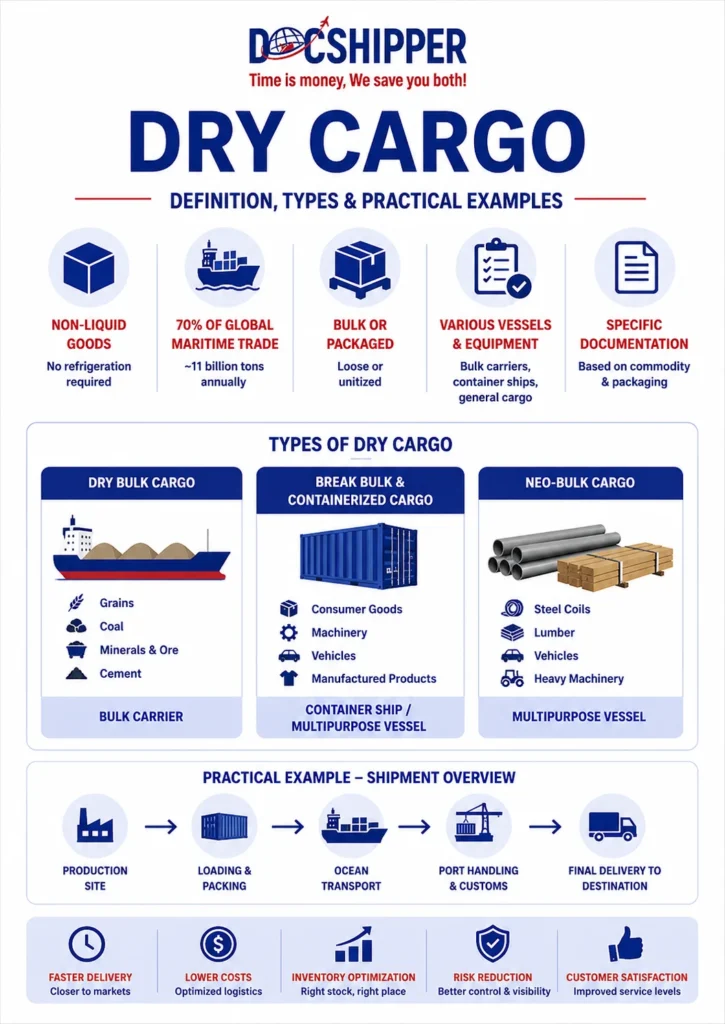
Dry cargo represents approximately 70% of global maritime trade volume. Unlike liquid cargo (oil, chemicals) or specialized cargo (refrigerated goods), dry cargo encompasses the broadest range of commodities moving through supply chains daily.
Key characteristics include:
- Transported without refrigeration or liquid containment systems
- Can be shipped in bulk (loose) or unitized (containers, pallets)
- Subject to different vessel types: bulk carriers, container ships, general cargo vessels
- Requires specific handling equipment depending on cargo nature
- Documentation varies based on commodity classification and packaging method
Types & Classification of Dry Cargo
Dry cargo divides into two primary categories that determine shipping methods, vessel requirements, and handling procedures. Understanding this classification helps optimize logistics strategies and cost management.
Dry bulk cargo consists of unpackaged commodities loaded directly into ship holds. Major dry bulk goods include grains (wheat, corn, soybeans), coal, iron ore, cement, and minerals. These materials move in specialized bulk carrier vessels with capacities ranging from 10,000 to 400,000 deadweight tons.
Break bulk and containerized cargo comprises packaged or unitized goods. This category includes consumer products, machinery, vehicles, and manufactured items. These shipments utilize container vessels (TEU capacity 1,000-24,000) or multipurpose cargo ships.
Neo-bulk cargo represents a hybrid category covering items like steel coils, lumber, vehicles, and heavy machinery that require specialized securing but don’t fit standard container dimensions. Port handling for neo-bulk requires dedicated equipment and storage areas.
According to UNCTAD’s Maritime Transport Review, dry cargo accounts for 11 billion tons annually, with containerized cargo growing at 4-6% yearly while traditional bulk remains stable at 2-3% growth.
Customs classification for dry cargo follows HS codes (Harmonized System), where proper categorization affects duty rates, import licenses, and inspection requirements. At DocShipper, we systematically verify cargo classification to prevent clearance delays and ensure accurate cost calculations from origin to destination.
Practical Examples & Industry Data
Real-world scenarios demonstrate how dry cargo categories impact shipping decisions, costs, and timelines. These examples reflect typical trade lane operations and industry benchmarks.
| Cargo Type | Vessel Type | Typical Volume | Transit Time (Asia-EU) |
|---|---|---|---|
| Iron Ore (Bulk) | Capesize Bulk Carrier | 150,000-400,000 MT | 30-35 days |
| Consumer Electronics (Containerized) | Ultra Large Container Vessel | 500-2,000 TEU | 28-32 days |
| Lumber (Neo-bulk) | Multipurpose Cargo Ship | 3,000-8,000 CBM | 35-40 days |
| Grain (Bulk) | Panamax Bulk Carrier | 60,000-80,000 MT | 25-30 days |
Case Study: Automotive Parts Shipment
A European manufacturer ships 45 TEU of engine components from Shanghai to Rotterdam. Classified as general dry cargo, the shipment requires standard 40′ containers with proper securing to prevent damage. Total transit: 32 days including 3 days port handling. Cost breakdown: ocean freight (65%), port charges (15%), documentation (5%), inland transport (15%).
Cost Comparison Insight: Bulk dry cargo typically costs $15-30 per metric ton for major commodities, while containerized dry cargo ranges $800-2,500 per TEU depending on route and season. Neo-bulk falls between at $40-80 per cubic meter due to specialized handling requirements.
Key operational considerations for dry cargo include moisture control (hygroscopic materials like grain require ventilation), proper securing (lashing for heavy machinery), and documentation accuracy (commercial invoice, packing list, certificate of origin). At DocShipper, our teams coordinate these elements across 300+ trade lanes to ensure compliant, damage-free delivery.
Conclusion
Dry cargo encompasses the majority of global trade volume, requiring precise classification and appropriate vessel selection to optimize costs and transit times. Understanding bulk versus containerized distinctions enables strategic logistics planning.
Need expert guidance on dry cargo shipping strategies? Contact DocShipper for comprehensive freight forwarding solutions tailored to your commodity type and trade lane requirements.
📚 Quiz
Test Your Knowledge: Dry Cargo
What is the defining characteristic of dry cargo in shipping?
A shipper wants to transport 80,000 metric tons of wheat from the US to Egypt. Which vessel type is appropriate?
What distinguishes "neo-bulk cargo" from standard dry bulk or containerized cargo?
🎯 Your Result
📞 Free Personalized QuoteFAQ | Dry Cargo: Definition, Types & Practical Examples in Shipping
Dry bulk cargo consists of unpackaged commodities like grains, coal, or minerals loaded directly into vessel holds. Containerized cargo involves packaged goods sealed in standardized containers (20' or 40' units). Bulk shipments require specialized bulk carriers with large hatch openings, while containerized freight uses standardized container vessels with cell guides for secure stacking.
Bulk carriers (Handysize, Panamax, Capesize) handle dry bulk commodities. Container ships transport unitized dry cargo in TEU containers. Multipurpose vessels carry neo-bulk and break bulk items. General cargo ships accommodate mixed dry cargo loads. Vessel selection depends on cargo volume, packaging, and destination port infrastructure.
Protection methods vary by cargo type. Bulk commodities use hold ventilation systems to control moisture and temperature. Containerized goods benefit from sealed container environments. Neo-bulk items require specialized lashing and securing equipment. Dunnage materials prevent shifting, while proper stowage plans distribute weight to maintain vessel stability throughout the voyage.
Essential documents include the bill of lading, commercial invoice, packing list, and certificate of origin. Bulk commodities often require additional certificates like phytosanitary certificates for agricultural products or quality certificates for minerals. Container cargo needs container packing lists and seal verification documents. Hazardous dry cargo requires MSDS sheets and IMO compliance certificates.
Segregation rules apply strictly. Dry cargo cannot share holds with liquid cargo due to contamination risks. Certain dry commodities require separation from others (foodstuffs away from chemicals). Container vessels can transport mixed dry cargo types simultaneously using different container cells. Compatibility charts and IMDG regulations guide proper cargo segregation planning.
Rate determinants include cargo weight/volume, commodity type, origin-destination pair, seasonal demand, vessel availability, and fuel costs. Bulk cargo rates follow indices like Baltic Dry Index. Container rates fluctuate based on trade lane demand and carrier capacity. Additional surcharges apply for overweight containers, hazardous materials, or specialized handling requirements.
Transit times vary by route and vessel speed. Asia-Europe routes average 28-35 days for container cargo, 30-40 days for bulk. Transpacific shipments require 14-21 days. Intra-Asia routes take 5-12 days. Factors affecting duration include port congestion, weather conditions, canal transits (Suez, Panama), and vessel routing decisions by carriers.
Bulk cargo uses pneumatic systems, conveyor belts, or grab cranes for loading/unloading. Container cargo relies on gantry cranes transferring boxes between vessel and terminal. Neo-bulk requires mobile harbor cranes or ship's gear. Proper handling minimizes cargo damage and reduces port dwell time, typically 2-5 days for containers, 3-7 days for bulk commodities.
Standard containers have maximum gross weight limits: 20' containers at 24,000 kg (including tare weight ~2,200 kg), 40' containers at 30,480 kg (tare ~3,800 kg). SOLAS VGM regulations require verified container weights before vessel loading. Overweight containers incur surcharges and may be rejected at terminals. Road transport regulations further limit container weights in many jurisdictions.
Marine cargo insurance covers dry cargo under Institute Cargo Clauses (A, B, or C). Clause A provides all-risk coverage for most damages. Bulk commodities often use more restricted coverage due to inherent commodity characteristics. Container cargo typically qualifies for comprehensive protection. Coverage excludes inherent vice, improper packing, and delays unless specifically endorsed.
Harmonized System (HS) codes determine duty rates, import restrictions, and inspection requirements. Accurate classification prevents clearance delays and penalty assessments. Bulk commodities face quality inspections and sampling procedures. Containerized goods undergo risk-based examinations. Proper classification also affects eligibility for preferential trade agreements and duty reduction programs.
IMO 2020 sulfur cap limits fuel emissions for all vessels including dry cargo ships. Ballast water management regulations prevent invasive species transfer. Port state control inspections verify environmental compliance. Some commodities face additional restrictions (timber legality verification, conflict mineral regulations). Carbon intensity indicators increasingly influence carrier selection for containerized dry cargo shipments.
Need Help with
Logistics or Sourcing ?
First, we secure the right products from the right suppliers at the right price by managing the sourcing process from start to finish. Then, we simplify your shipping experience - from pickup to final delivery - ensuring any product, anywhere, is delivered at highly competitive prices.


Fill the Form
Prefer email? Send us your inquiry, and we’ll get back to you as soon as possible.
Contact us




