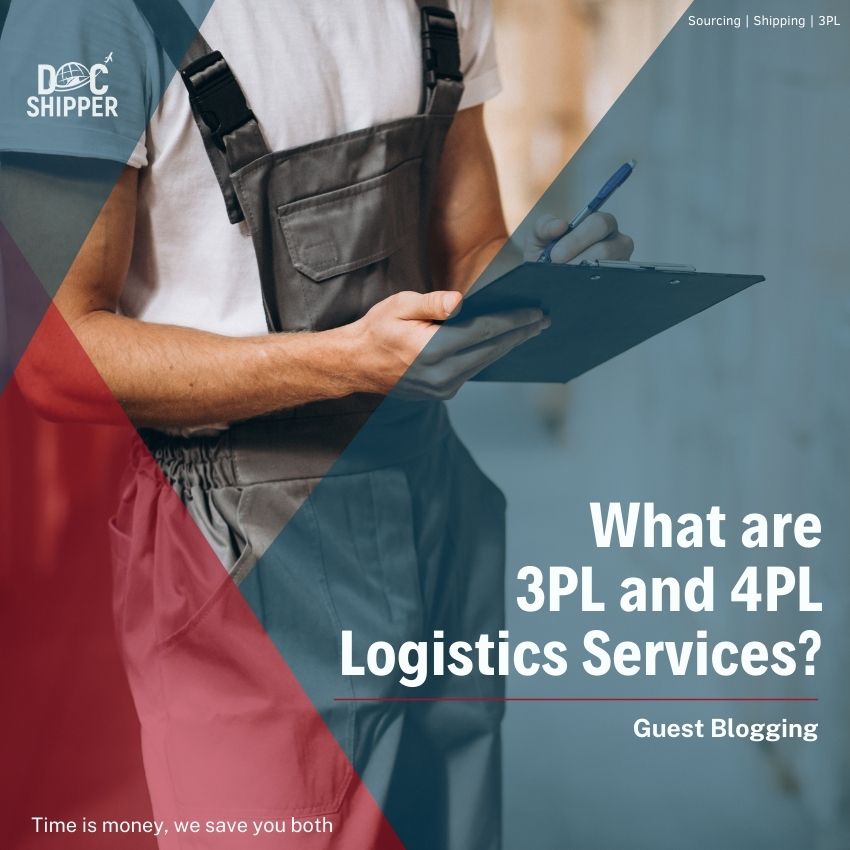
3PL vs 4PL: how to choose the right logistics partner for your growing supply chain

  • admin 18 Min
  • Published on March 10, 2022 Updated on April 9, 2026
img

In short ⚡

In logistics, a 3PL executes day-to-day operations like warehousing, freight booking, shipment tracking, and customs documentation based on your strategy.

A 4PL sits above multiple 3PLs and carriers to design and orchestrate the entire model, governing carrier selection, route optimization, KPIs, and end-to-end performance.

We hope you’ll find this article genuinely useful, but remember, if you ever feel lost at any step, whether it’s finding a supplier, validating quality, managing international shipping or customs,  DocShipper can handle it all for you!

Free shipping quote 24h      I want to talk to a sourcing expert

What do 3PL and 4PL actually mean in modern logistics?

If you’ve been comparing 3pl 4pl options and every provider seems to use the terms differently, you’re not imagining it.

In real-world supply chain management, these labels describe who runs what, who owns the day-to-day logistics execution, and who takes responsibility when lead time slips, customs clearance stalls, or a bill of lading shows the wrong consignee.

Here’s the thing, the labels only matter if they map to your operations, your incoterms, your carrier selection rules, and how you want shipment tracking and exceptions handled.

Checklist, before you even say “we need a 3PL or a 4PL”:

  • Do you need warehousing, cross-docking, or a bonded warehouse, or are you purely moving freight?
  • Are you struggling most with customs clearance (HS code, customs duties, import tariffs, export compliance), or with delivery execution?
  • Do you want one partner to run multimodal transport end-to-end, including drayage and last-mile delivery?
  • Do you need tactical help (freight quote, rate negotiation, freight consolidation) or strategic orchestration (route optimization, load planning, KPI governance)?
  • When a shipment goes wrong, do you want a doer, or an operator-of-operators?

Quick overview of 1PL to 5PL so you see the full picture

To make 3pl 4pl decisions confidently, you need the whole ladder from 1PL to 5PL, because your needs can jump levels as you scale.

You’ll notice fast that the difference isn’t “good vs better”, it’s scope and accountability across freight forwarding, cargo handling, and inventory management.

We’ve seen this play out with importers who start simple, then suddenly add a second origin, a new Incoterms split (FOB for one supplier, DDP for another), and everything breaks.

One client thought they were “doing 1PL” until a supplier shipped under the wrong Incoterms, the packing list didn’t match the cargo manifest, and customs clearance got flagged, that’s when they realized they needed a structured third-party logistics (3PL) layer.

1PL to 5PL in plain terms:

  • 1PL, you move your own goods with your own resources, your trucks, your warehouse, your people, your proof of delivery process.
  • 2PL, you hire an asset-based carrier for a leg, ocean carrier, airline, trucking, rail, typically focused on transport and containerization or palletization.
  • 3PL, a third-party logistics (3PL) partner executes logistics services for you, think warehousing, shipment tracking, freight consolidation, freight brokerage, customs clearance support, and fulfillment activities.
  • 4PL, a lead logistics partner orchestrates multiple 3PLs and carriers, owning the operating model, the data layer, and performance, often with carrier selection, route optimization, and freight invoice control.
  • 5PL, a network-centric, often tech-led approach managing logistics at scale, typically heavy on automation, multi-client optimization, and high-volume procurement of capacity.

From experience, when you’re juggling multimodal transport plus tight transit time commitments, the “level” you need often depends on how many handoffs you can tolerate.

Workflow to identify your current PL level:

Step 1, list who books carriers and issues the delivery order.
Step 2, map who controls documentation, bill of lading, packing list, cargo manifest, freight forwarding contract.
Step 3, mark who handles exceptions, demurrage, drayage scheduling, missing proof of delivery.
Step 4, identify who owns inventory management decisions and service KPIs.

DocShipper Info

Confused about your current logistics level?
Let our experts map your PL structure and identify gaps before they cost you time or margin.

Core definitions of 3PL and 4PL in simple, practical terms

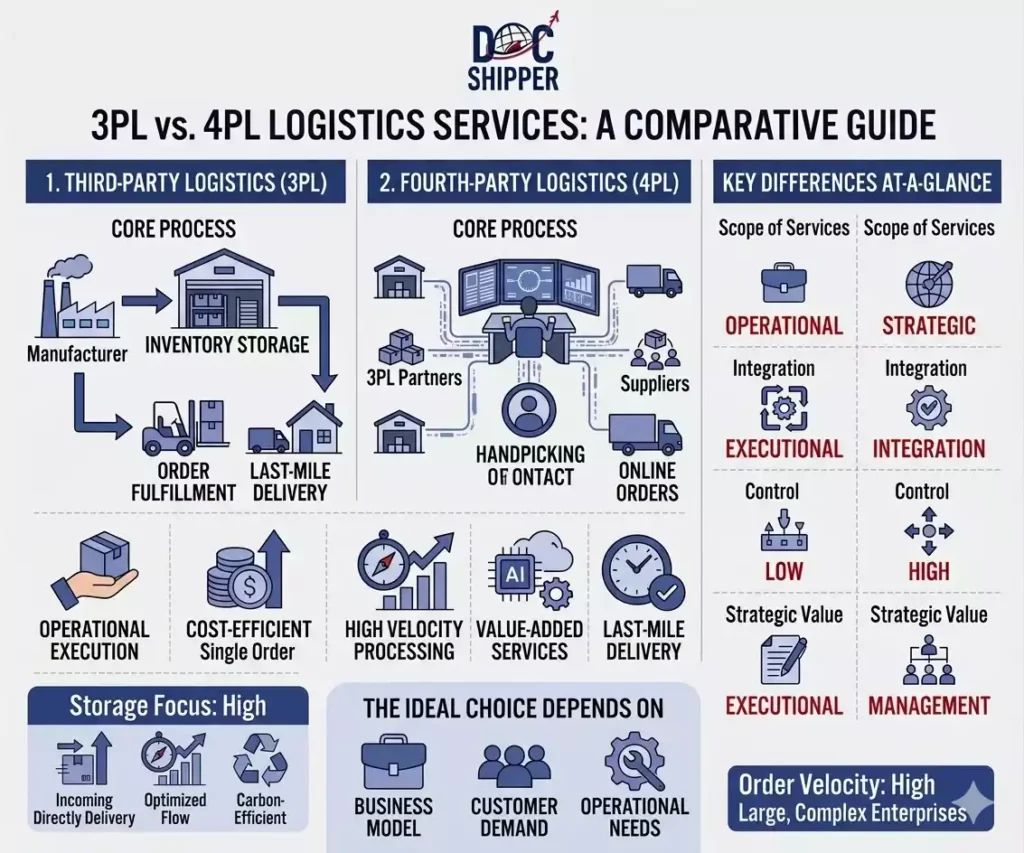
In a 3pl 4pl comparison, here’s the cleanest operational definition, 3PL executes, 4PL orchestrates.

And yes, you can use both at once, that’s common when your supply chain grows faster than your internal team.

With a 3PL, you’re typically buying hands-on logistics execution, warehousing, cross-docking, freight consolidation, pick and pack, carrier booking, shipment tracking, and sometimes customs clearance coordination depending on lane and scope.

You stay closer to the steering wheel, and you decide the operating rules, carrier selection, service levels, and what “on-time” really means for your just-in-time delivery windows.

With a 4PL, you’re buying a management layer that designs and runs your logistics ecosystem, across multiple carriers, forwarders, and warehouses, with governance, dashboards, SOPs, and continuous improvement built in.

In practice, that means one partner can own rate negotiation frameworks, route optimization, load planning, freight insurance policies, and the entire freight invoice and claims process.

Quick micro-story we see a lot, you’re importing containers monthly, then sales spikes and you add LCL plus air freight for the same SKU, and suddenly drayage appointments, containerization rules, and warehouse slotting collide.

A solid 3PL can execute pieces, but a 4PL stops the chaos by aligning lead time targets, transit time buffers, and escalation paths across every provider.

For formal vocabulary, the Council of Supply Chain Management Professionals often frames 3PL around outsourced logistics services, while 4PL extends to integrator-style end-to-end supply chain responsibility, that’s exactly how it feels on the ground.

Dimension 3PL (third-party logistics) 4PL (lead logistics partner)
Primary role Execute operations, warehousing, transport, cargo handling Design and run the whole model, manage multiple providers
Typical deliverables Freight booking, shipment tracking, cross-docking, inventory management, POD KPI governance, carrier selection strategy, route optimization, freight invoice control
Docs & compliance Helps handle bill of lading, packing list, delivery order, customs clearance support Standardizes trade compliance, HS code logic, audit trails, exception playbooks
What you manage You manage strategy and often multi-provider coordination You manage business goals, the 4PL manages orchestration and execution layers

DocShipper Advice

Not sure whether execution or orchestration fits best?
Talk to our team to design a 3PL, 4PL, or hybrid model aligned with your growth pace.

Key differences between 3PL and 4PL that impact your business

Now we get practical, because the 3pl 4pl gap shows up in your weekly firefighting.

It’s the difference between “we booked the freight” and “we prevented the stockout by redesigning the lane, renegotiating rates, and tightening the handoffs from supplier to last-mile delivery.”

Checklist, the differences you’ll actually feel day to day:

  • Who owns the end-to-end plan, including route optimization and load planning?
  • Who manages trade regulations, export compliance, and customs duties escalation when your HS code gets challenged?
  • Who consolidates shipment tracking signals across modes and providers into one version of truth?
  • Who audits freight invoices, accessorials, detention, demurrage, and fixes the root cause?
  • Who is accountable for improving lead time, not just reporting transit time?

DocShipper Alert

If firefighting is eating your week, your model may be wrong.
Request a logistics audit and uncover where ownership gaps create hidden costs.

Ownership, control, and level of supply chain responsibility
The most important 3pl 4pl difference is ownership, not ownership of trucks, ownership of outcomes.

You can outsource cargo handling and warehousing to a 3PL and still keep control over the supply chain strategy, but with a 4PL you’re delegating more control so you can scale without adding headcount.

In a 3PL setup, you’ll typically approve the freight quote, set the incoterms, decide whether you want freight consolidation, and choose how aggressive you want rate negotiation to be.

The 3PL then executes, books carriers, manages palletization, arranges drayage, and pushes shipments through to proof of delivery.

In a 4PL setup, you give the partner authority to coordinate multiple 3PLs, freight brokers, and forwarders under one operating cadence.

They’ll build the playbook for carrier selection, escalation rules for customs clearance holds, and the KPI structure that keeps everyone honest.

A scenario you’ve probably lived, one supplier ships early, another ships late, and you’re stuck paying storage because the warehouse can’t cross-dock partial receipts efficiently.

We’ve stepped into cases like that where a 4PL model fixed it by changing booking cutoffs, aligning suppliers on packing list formats, and running a tighter inbound schedule, while the 3PL kept the physical operations humming.

From an industry perspective, the World Customs Organization’s focus on compliant data and predictable border processes is a reminder that responsibility isn’t theoretical, when documentation is sloppy, your container sits.

Workflow to decide how much control you should keep:

Step 1, list the decisions you refuse to outsource, incoterms, carrier selection, buffer stock, supplier routing guides.
Step 2, list the decisions draining your time, freight invoice disputes, delivery order follow-ups, customs clearance exception chasing.
Step 3, choose 3PL if you mainly need execution, choose 4PL if you need decision-making and cross-provider control.
Step 4, write the RACI for each task, then validate it in the contract and SOPs.

Technology, data visibility, and strategic decision support

In 3pl 4pl projects, tech is where you either gain control or lose weeks.

A 3PL may give you decent shipment tracking and warehouse scans, but a 4PL should give you a decision cockpit, one dashboard that connects freight forwarding, inventory management, and exception handling.

With a 3PL, visibility often stops at their perimeter, their WMS for warehousing, their TMS for transport, their own status events.

That’s fine until you add multiple origins, multiple carriers, and multimodal transport, then you end up reconciling spreadsheets and chasing milestones like “customs cleared” or “container gated out.”

With a 4PL, you’re paying for data consolidation and governance, normalized milestones, shared SOPs, and performance analytics that lead to strategic decision support.

That’s where you start improving transit time variability, not just monitoring average lead time.

We’ve seen a classic mess, three providers each reported “delivered,” but only one had a usable proof of delivery, and the freight invoice didn’t match the agreed rate card.

In that situation, a 4PL layer doesn’t magically teleport the box, but it does enforce the data standards, claims workflow, and audit trail so you stop leaking margin.

  • Execution visibility (3PL strength): scans, dock events, warehouse movements, shipment tracking milestones.
  • Decision visibility (4PL strength): lane performance, carrier scorecards, cost-to-serve, exception heatmaps, compliance risk flags.

Workflow to test a provider’s visibility before you sign:

Step 1, ask for a sample tracking feed including exceptions, holds, and customs clearance milestones.
Step 2, request a mock freight invoice with accessorial logic and dispute steps.
Step 3, verify documentation fields, bill of lading, HS code, packing list, cargo manifest, delivery order.
Step 4, run a pilot lane and measure data latency, not just on-time delivery.

Looking for a Reliable Shipping & Sourcing Partner?

We handle the entire sourcing process, supplier research, negotiation, production, and inspections, so you can focus on what matters most: growing your business.

When a 3PL is the best fit for your operations

A 3PL is ideal when you need execution power without building your own logistics infrastructure.

You keep strategic control, while your partner handles warehousing, transportation, and fulfillment.

You should consider a 3PL if your business matches one or more of the situations below.

  • You import from China or multiple countries and need freight, customs clearance, and delivery coordination
  • You require storage, pick and pack, labeling, or order fulfillment
  • You sell on ecommerce marketplaces and need fast last mile distribution
  • You want to reduce fixed logistics costs and move to variable cost structures
  • You already manage suppliers yourself but need operational support

In this setup, you remain the supply chain decision maker.

Your 3PL executes based on your forecasts, routing choices, and inventory policies.

Area With 3PL Your Role
Transportation Books freight, manages carriers Select lanes, validate budgets
Warehousing Storage, pick and pack Define stock levels
Customs Handles documentation Provide compliant data
Strategy Limited advisory Full responsibility

At DocShipper, we often position ourselves as a flexible 3PL for importers sourcing in Asia.

You gain operational control with less complexity, while we manage the daily logistics workload.

DocShipper Info

Need stronger execution without adding headcount?
Our 3PL solutions handle freight, warehousing, and customs while you keep strategic control.

When you should move from 3PL to 4PL

You should upgrade to a 4PL when logistics stops being operational and becomes strategic.

This usually happens when your supply chain becomes multi country, multi warehouse, and data driven.

A 4PL acts as your lead logistics integrator.

You delegate orchestration, optimization, and performance management across all 3PLs and carriers.

  • You manage several 3PLs across regions
  • You lack end to end visibility on cost and performance
  • You experience stock imbalances between markets
  • You need network redesign or cost optimization projects
  • You want one single point of accountability

A 4PL does not just move goods, it designs and controls the entire ecosystem.

You shift from execution management to performance governance.

Dimension 3PL 4PL
Scope Operational execution End to end orchestration
Carrier management Direct Strategic oversight
Data analytics Basic reporting Advanced KPI optimization
Network design Limited Full redesign capability

At DocShipper, when clients scale internationally, we progressively shift from 3PL execution to 4PL coordination.

You keep visibility, but we manage the complexity behind the scenes.

DocShipper Advice

Managing multiple providers across regions?
Upgrade to a 4PL structure and centralize performance, data, and carrier strategy under one lead partner.

How to evaluate and select a 3PL or 4PL provider

You should never select a logistics partner based only on price.

You are choosing a supply chain extension of your own company.

Use this checklist before signing any contract.

  • Do they understand your product constraints and Incoterms?
  • Can they handle sourcing countries like China, Vietnam, or India?
  • What KPIs do they track and share?
  • Do they offer scalable warehouse space?
  • Can they manage customs compliance in your destination markets?
  • Is their technology compatible with your ERP or ecommerce platform?
  • Who owns carrier contracts and freight rates?

You should also assess risk management capabilities.

This includes cargo insurance, supplier coordination, inspection processes, and contingency planning.

Evaluation Criteria Why It Matters
Industry expertise Reduces costly operational mistakes
Global network Improves routing flexibility
Technology stack Enhances visibility and forecasting
Financial stability Ensures long term reliability

At DocShipper, we integrate sourcing, quality control, freight, customs, and distribution.

You avoid fragmented communication and gain one accountable partner.

DocShipper Alert

Choosing on price alone can lock you into costly inefficiencies.
Book a strategic consultation to validate KPIs, compliance, and scalability before signing.

Conclusion

You now understand how 3pl 4pl models fit different stages of business growth.

Your choice depends on complexity, control needs, and long term strategy.

  • A 3PL is execution focused and ideal for operational outsourcing
  • A 4PL provides strategic orchestration and full supply chain governance
  • You should move to 4PL when managing multiple partners becomes inefficient
  • Technology, visibility, and KPI management are key decision factors
  • Choosing the right partner directly impacts cost, agility, and scalability

If your supply chain involves international sourcing and multi market distribution, you need more than transportation.

You need structure, visibility, and control, and that is exactly where we step in.

FAQ | 3PL vs 4PL: how to choose the right logistics partner for your growing supply chain

Look for a mix of operational “pain signals” and structural complexity:

  • You manage several 3PLs across regions and spend time coordinating between them
  • You lack a single view of cost, lead time, and stock across your network
  • You’re frequently firefighting stockouts, demurrage, or last‑minute premium freight
  • You’re planning new warehouses, new markets, or multimodal lanes and lack in‑house design capacity
  • Your leadership wants end‑to‑end KPIs (cost‑to‑serve, OTIF, lane performance) rather than siloed reports

If 2–3 of these are true, you’re at the point where a 4PL’s orchestration and network design capabilities usually generate more value than staying purely in a 3PL setup.

Ask us anything!

Need Help with
Logistics or Sourcing ?

First, we secure the right products from the right suppliers at the right price by managing the sourcing process from start to finish. Then, we simplify your shipping experience - from pickup to final delivery - ensuring any product, anywhere, is delivered at highly competitive prices.

Live Chat

Get instant assistance from our team—just click and start chatting!

Live Chat Now
image

Fill the Form

Prefer email? Send us your inquiry, and we’ll get back to you as soon as possible.

Contact us
image

Call us

Reach out to us on WhatsApp for quick, convenient, and personal support.

Call us
image