In short ⚡
Sites like Alibaba for sourcing are B2B platforms and directories that help you discover, verify, and negotiate with suppliers while you manage quality, compliance, and logistics yourself.
They differ mainly by supplier vetting depth, regions covered, order size focus, and how well they support regulated or customized products.
We hope you’ll find this article genuinely useful, but remember, if you ever feel lost at any step, whether it’s finding a supplier, validating quality, managing international shipping or customs, DocShipper can handle it all for you!
What Alibaba is (and why many importers start there)
If you’re searching for sites like Alibaba for sourcing, it helps to understand what Alibaba actually is in operational terms, not just “a big marketplace.”
You’re stepping into a massive B2B e-commerce ecosystem where product discovery, supplier outreach, and deal-making happen fast, sometimes faster than your trade compliance and logistics planning can keep up.
We’ve seen plenty of importers start here because it’s simple, global, and searchable, you can compare factories in minutes, then move straight into sampling, negotiation, and shipping decisions.
How Alibaba’s B2B marketplace model works
Last quarter, we handled a rush project where you could tell the buyer assumed Alibaba was “like Amazon for wholesale,” and that misunderstanding cost them two weeks of supply chain management.
Here’s the thing, Alibaba is mainly a supplier discovery and transaction facilitation layer, while the actual execution still depends on your supplier’s reliability and your freight forwarding setup.
To make the model easy to visualize, here’s the typical workflow you’ll follow when using Alibaba and other sites like Alibaba for sourcing.
- Search products, filter by supplier type, location, and certifications
- Shortlist 10 to 20 suppliers, compare catalogs, response speed, and MOQ
- Request quotes with clear specs, packaging, and Incoterms (EXW, FOB, CIF)
- Order samples, then validate quality, labeling, and packaging durability
- Negotiate price, lead time, payment terms, and penalties for delays
- Place PO, confirm packing list, commercial invoice, and tariff classification inputs
- Book cargo transportation, choose multimodal transport if needed, set shipment tracking
- Customs clearance, customs brokerage, pay customs duty, then delivery order and last mile delivery
What you’ll notice fast is that “cheap” turns expensive when your incoterms aren’t clear and the quote excludes export packing, palletization, or documentation like the bill of lading.
Key advantages and built‑in risks when sourcing from Alibaba
Quick tip: treat every Alibaba supplier page like a lead, not proof, because on sites like Alibaba for sourcing, presentation often looks more mature than the factory’s actual process control.
Alibaba is powerful for speed, variety, and price discovery, but the built-in risk is that you’re still responsible for the supplier qualification and the end-to-end import export execution.
This is the moment most importers get stuck, the quote looks great, then the first shipment hits customs and the customs clearance file is missing details, or the cartons collapse because packing specs were never locked.
To help you weigh it clearly, here’s a simple comparison you can use when deciding whether to stay on Alibaba or explore alternatives.
| What Alibaba does well | Where you can get burned |
| Huge selection, fast supplier outreach, easy price benchmarking | Quality variance, trading companies posing as factories, inconsistent documentation |
| Easy sampling and small pilots (depending on supplier) | MOQs can jump after sampling, or tooling fees appear late |
| Convenient communication tools and some payment features | Disputes get messy if specs, Incoterms, and acceptance criteria weren’t written |
| Works well with standard products | Custom products require tighter QC plans and clearer supply chain responsibilities |
From experience, the risk isn’t “Alibaba,” it’s unclear accountability across freight rates, factory lead times, cargo insurance, and who owns what step in the chain.
For a neutral reference point on why these cross-border frictions happen, you’ll see similar patterns discussed in UNCTAD work on international trade and logistics constraints.
Why you should look for sites like Alibaba for sourcing
Looking for sites like Alibaba for sourcing isn’t about hating Alibaba, it’s about building a sourcing system that survives delays, price spikes, and supplier surprises.
You’ve probably dealt with suppliers who reply fast until you ask for a packing list, a clear HS code suggestion for tariff classification, or real production photos.
We’ve watched buyers get better outcomes simply by widening the funnel and using multiple platforms to cross-check supplier claims and stabilize their freight contract planning.
When Alibaba is not the best fit for your business
We once supported a buyer sourcing a “simple” household item, then discovered the supplier’s quote assumed EXW, and the buyer thought it included export clearance and loading.
That gap created chaos in cargo transportation, plus unplanned charges for export docs, load planning, and truck scheduling.
So when is Alibaba a poor match, even if the listing looks perfect on sites like Alibaba for sourcing?
- You need tight compliance, regulated products, labeling rules, or traceability records
- You require customization with clear tolerances, QC checkpoints, and pre-shipment inspections
- You’re optimizing speed, and cannot absorb production delays or port congestion spot rates
- You want predictable landed cost, but quotes exclude packing, warehousing, or carrier selection
- You need financing structures like letter of credit support and strict document control
In those cases, a more curated platform, direct factory relationships, or a sourcing agent model often reduces risk more than it increases cost.
Benefits of diversifying suppliers and sourcing regions
Why put all your volume in one basket when one late container can wipe out a month of sales and throw your inventory management into panic mode?
Using multiple sites like Alibaba for sourcing helps you triangulate pricing, validate capacity, and build a backup plan for production and shipping.
We’ve seen a classic scenario, one supplier quotes low, a second supplier quotes higher but offers better packing and faster lead times, and the blended strategy wins because your distribution center stays stocked.
To make diversification practical, here’s a quick checklist you can use before you add a second platform or region.
- Define your “must-not-fail” KPI, lead time, defect rate, or on-time delivery
- Map logistics constraints, direct sailings, transit time, cross docking needs, last mile delivery limits
- Compare landed cost, not unit price, include freight rates, customs duty, and cargo insurance
- Set a minimum documentation pack, commercial invoice, packing list, bill of lading fields, proof of delivery
- Plan reverse logistics for defects, returns, or rework scenarios
Once you diversify, you gain negotiation leverage and you can smooth volume across carriers during peak seasons when spot rates spike.
For broader context on multi-sourcing resilience, the World Economic Forum often highlights how supply chain shocks reward redundancy and visibility.
DocShipper Advice
We help you compare suppliers, regions, and freight scenarios to secure predictable landed costs.
How to evaluate any Alibaba alternative before you buy
Any time you test sites like Alibaba for sourcing, you’ll want a repeatable evaluation method, otherwise you’ll fall into “quote chasing” and end up with a fragile supplier base.
We’ve audited enough deals to know the best supplier on paper can still cause expensive problems in customs brokerage, production scheduling, or shipment tracking.
Think of evaluation as three layers, trust, money, and execution.
Supplier verification, payment security, and trade assurance
We’ve seen a buyer pay a “50% deposit” to a bank account that didn’t match the company name, then spend months trying to recover funds.
So here’s a direct rule, before you send money on sites like Alibaba for sourcing, you verify who you’re actually contracting with.
Use this checklist to reduce fraud and misrepresentation risk.
- Company identity, business license details match the beneficiary bank name
- Factory proof, recent production photos, equipment list, and address verification
- Reference documents, past packing list and commercial invoice samples, with consistent entity names
- Payment method, avoid risky transfers when protections exist, define milestone payments
- Contract basics, specs, tolerances, acceptance criteria, and dispute venue in writing
If you’re operating at scale, you’ll also want a basic compliance layer aligned with ISO management standards, even if your product itself isn’t certified.
 Minimum order quantities, pricing, and total landed cost
Direct tip: never compare quotes without pinning down Incoterms and the full landed cost, because “FOB” from one supplier and “EXW” from another aren’t the same deal.
On sites like Alibaba for sourcing, you’ll often see aggressive unit prices paired with high MOQ, limited packaging, and vague freight responsibility.
To keep your analysis clean, follow this step-by-step costing workflow before you commit.
- Step 1: Confirm Incoterms, EXW, FOB, or CIF, and write the named port
- Step 2: Add supplier costs, unit price, tooling, packaging, palletization, labeling
- Step 3: Add origin costs, local trucking, export clearance, documentation
- Step 4: Add main freight, ocean or air, freight consolidation if applicable, plus carrier selection
- Step 5: Add destination costs, customs clearance, customs duty, port fees, delivery order
- Step 6: Add final mile, drayage, warehousing, distribution center receiving, cross docking
This is also where you decide if a bonded warehouse strategy or delayed duty payment makes sense, depending on your country rules and inventory turns.
Communication, lead times, and logistics constraints
What happens when your supplier says “7 days production,” but your forwarder says the next vessel is in 12 days and the port is rolling bookings?
That’s why, when you use sites like Alibaba for sourcing, you measure communication quality like it’s a KPI, because it directly impacts route optimization, load planning, and customer promises.
We’ve seen delays that started as a simple misunderstanding, carton dimensions weren’t confirmed, then the shipment couldn’t be palletized as planned, and the freight tendering had to be redone at higher rates.
To pressure-test execution, ask these questions early.
- Lead time detail, production time vs. material procurement time vs. QC time
- Capacity reality, maximum weekly output and peak-season constraints
- Packaging confirmation, carton size, weight, drop-test expectations, marking
- Shipping readiness, who books, who provides documents, and when the bill of lading data is final
- Tracking and delivery, milestones, proof of delivery, escalation path if exceptions occur
If you want fewer surprises, we typically align supplier timelines with the real-world logistics calendar, factory cutoff dates, port cutoffs, and your inbound warehouse receiving schedule.
DocShipper Alert
Run a structured supplier and cost audit before committing to avoid customs, freight, or documentation surprises.
Major China‑based platforms similar to Alibaba
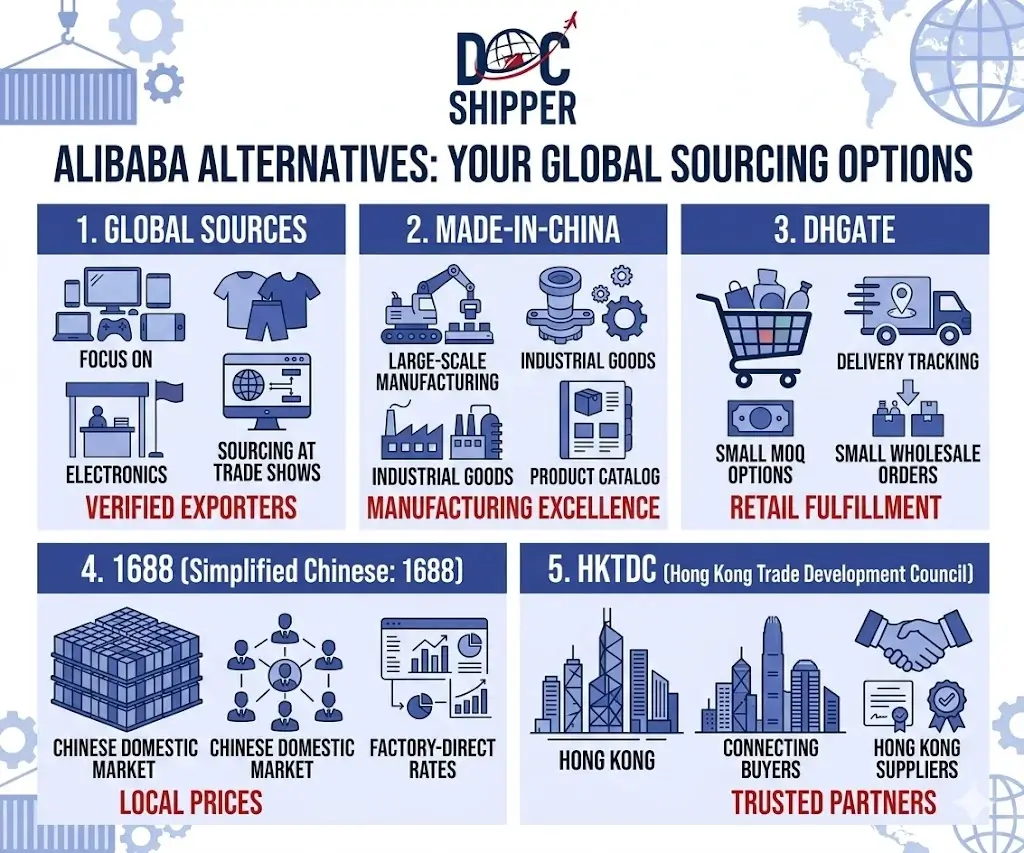
When you broaden beyond Alibaba, the best sites like Alibaba for sourcing in China usually differ in two ways, supplier vetting depth and the type of buyers they attract.
You’ll feel the difference quickly, some platforms are better for factory-grade sourcing, others shine when you’re testing products with smaller orders and faster shipping.
We’ve seen buyers cut risk simply by using two platforms in parallel, one for discovery, one for verification, then using a consistent QC and logistics playbook.
Global Sources and Made‑in‑China for vetted manufacturers
We once helped a buyer who kept getting “factory” claims on one platform, then switched to a more manufacturer-leaning directory and finally got stable documentation for customs clearance.
On sites like Alibaba for sourcing such as Global Sources and Made-in-China, you’ll often find a stronger emphasis on manufacturer profiles, audited info, and trade-show connected suppliers.
Here’s a practical comparison to guide your platform choice for factory sourcing.
| Platform style | Best for | Watch-outs |
| Manufacturer-oriented directories | Custom products, stable suppliers, repeat POs | Still verify factory, don’t assume audits cover your exact SKU |
| Open marketplaces | Fast comparison, wide range, commodity items | Higher variance, more trading companies, uneven QC culture |
For disciplined import planning, this is where you standardize documents early, packing list format, commercial invoice fields, and HS description consistency.
Industry-wise, ICC Incoterms Committee guidance is a good reminder that platform habits don’t replace clear Incoterms in your contracts.
DocShipper Info
Standardize Incoterms, documents, and QC protocols to stay protected across every marketplace.
AliExpress, DHgate, and Taobao for small orders and testing ideas
Direct tip: if you’re validating demand, you can use these platforms to test packaging, customer feedback, and damage rates before scaling on sites like Alibaba for sourcing.
AliExpress and DHgate often fit when you need low quantities, while Taobao can be useful for product discovery, with the trade-off that you’ll handle more complexity around language, payments, and domestic shipping legs.
To keep small-order sourcing from turning into a logistics mess, use this short checklist before you buy.
- Confirm shipping mode, postal, express, or consolidated air, and who controls it
- Check packaging, request extra protection if your product is fragile
- Track costs, include delivery fees, returns, and any value added services
- Plan compliance, labeling, batteries, restricted materials, and documentation needs
- Set expectations, realistic lead times and shipment tracking checkpoints
This approach saves you from scaling a product that only “works” because you got lucky on the first parcel.
Niche Chinese marketplaces for electronics, auto parts, and more
What if the best supplier isn’t on the big platforms at all?
For categories like electronics components, automotive parts, and industrial spares, niche marketplaces and vertical directories can outperform general sites like Alibaba for sourcing, especially when specs and compatibility matter.
We’ve seen an auto parts buyer solve a recurring defect issue simply by switching to a specialized supplier network where traceability and batch control were normal, not “extra.”
Use these criteria to decide if a niche platform is worth your time.
- Spec depth, datasheets, compatibility charts, batch or lot tracking
- Quality signals, testing reports, inspection photos, and traceable materials
- Spare parts continuity, consistent SKUs for repeat orders
- Logistics fit, ability to support freight consolidation and proper export packing
For electronics, pay extra attention to packaging, humidity protection, and damage prevention, because one bad carton can trigger costly reverse logistics.
Global marketplaces like Alibaba that serve multiple regions
If you’re serious about resilience, global sites like Alibaba for sourcing let you spread risk across countries while keeping a similar marketplace workflow.
You’ll also get more bargaining power, because you can benchmark quotes across regions and negotiate with real alternatives in hand.
We’ve watched importers stabilize their freight brokerage plan by sourcing closer to destination when ocean capacity tightens.
eWorldTrade, All.biz, and other multi‑country B2B platforms
We’ve seen a buyer stuck with a single-China strategy during peak season, then pivot to a multi-country platform and secure a backup supplier that kept their distribution on track.
On these sites like Alibaba for sourcing, your main advantage is reach, you can compare suppliers across Asia, Europe, and the Americas without changing your discovery process.
To keep comparisons fair, standardize your RFQ template before you message anyone.
- Product specs, materials, tolerances, and compliance requirements
- Commercial terms, target Incoterms, payment terms, and currency
- Logistics needs, preferred ports, shipment frequency, packing method
- Documentation, packing list, commercial invoice, certificates if needed
For macro context, WTO data and trade policy updates can also influence where suppliers stay competitive, especially when tariffs or trade measures shift.
DocShipper Advice
We design parallel supplier strategies so tariff shifts or capacity shortages do not disrupt your flow.
HKTDC and regional trade portals with verified suppliers
Bold truth: verification on the platform doesn’t replace your own checks, but it can shorten your shortlist dramatically on sites like Alibaba for sourcing.
Regional trade portals like HKTDC often lean toward vetted exhibitors and export-ready suppliers, which helps when you need consistent documentation and professional communication.
We’ve seen buyers reduce back-and-forth by choosing suppliers already used to export packaging, correct incoterms language, and predictable lead times.
Here’s where these portals can shine operationally.
- More export maturity, better document accuracy and fewer surprises at customs clearance
- Clearer product categories, less noise, easier supplier matching
- Trade-show adjacency, suppliers used to international buyers and audits
You still want to confirm production capability, not just trading ability, especially if you plan to scale volume and negotiate a freight contract.
When to use directories instead of all‑in‑one marketplaces
Ever had a “perfect” marketplace deal collapse because the supplier couldn’t support your packing requirements, carton markings, or production ramp?
That’s when directories can be smarter than all-in-one sites like Alibaba for sourcing, because you’re focusing on supplier qualification first, then you control payment, inspection, and logistics execution with your chosen partners.
We usually recommend directories when you want tighter control over the full import workflow, especially for customization and repeat shipments.
To decide quickly, use this simple comparison.
| Option | Use it when | Main trade-off |
| All-in-one marketplace | You need speed, broad selection, and easy outreach | More variance, you must work harder on verification and QC |
| Supplier directory | You want to qualify manufacturers, build long-term supply chain stability | More manual work, you manage more steps outside the platform |
If you want to reduce friction, we can align your sourcing choice with the downstream plan, freight consolidation, carrier selection, customs brokerage, warehousing, and delivery to your distribution center.
Looking for a Reliable Shipping & Sourcing Partner?


DocShipper Platform
One platform. Your entire supply chain
Sourcing, freight, customs & documents — all centralised, all visible, 24/7.
Local and regional Alibaba alternatives by sourcing location
When you explore sites like Alibaba for sourcing, you don’t have to stay focused on China. In many cases, choosing a regional B2B marketplace reduces transit time, customs friction, and regulatory risk.
You’ve probably felt the pain of 45-day sea freight or unexpected compliance issues at destination. Local and regional Alibaba alternatives can simplify your sourcing model, especially if speed and certification matter more than rock-bottom pricing.
US and North American sites for faster shipping and easier compliance
We once supported a US client who shifted part of their sourcing from China to a North American platform after three consecutive delays at the Port of Los Angeles. Within one quarter, their average lead time dropped from 60 days to 12.
If you’re selling in the US or Canada, North American B2B marketplaces like Thomasnet, Faire, or Tundra can act as practical sites like Alibaba for sourcing, but with suppliers already aligned with FDA, CPSIA, or UL standards.
Here’s why this matters for you:
- Shorter logistics chains, often domestic freight instead of ocean shipping
- Simplified compliance with US or Canadian regulations
- Lower risk of customs inspections and document discrepancies
- Easier dispute resolution under local commercial law
The US International Trade Administration regularly highlights how regulatory non-compliance increases import delays. By sourcing locally, you reduce that exposure significantly.
Before committing to a North American supplier, run through this quick checklist.
- Confirm business registration and EIN or BN number
- Request proof of product compliance certificates
- Validate warehouse location and real inventory levels
- Clarify Incoterms, even for domestic shipments
- Check liability insurance coverage
You’ll notice that pricing is higher than Asian platforms. But when you calculate total landed cost, including duties and freight, the gap often shrinks more than expected.
Leading Indian B2B marketplaces for textiles and manufactured goods
Here’s a direct tip. If you’re sourcing garments, home textiles, or leather goods, you should seriously look at Indian platforms like IndiaMART or TradeIndia as sites like Alibaba for sourcing.
India has built strong capabilities in textiles, pharmaceuticals, light engineering, and handicrafts. You benefit from competitive labor costs while diversifying away from China-centric supply chains.
We worked with a European fashion brand that moved 40 percent of its cotton apparel production to India. Not only did they reduce geopolitical risk, they gained access to smaller MOQs and more flexible customization.
When sourcing from Indian marketplaces, pay attention to:
- Export experience and IEC registration of the supplier
- Fabric certifications such as OEKO-TEX or GOTS
- Production capacity during peak seasons
- Port of loading, Mumbai, Chennai, or inland ICD
According to UNCTAD trade data, India continues to expand its share in global textile exports. That trend supports long-term sourcing stability if you build the right supplier relationships.
However, communication rhythm and production timelines may differ from China. You’ll need clear purchase contracts and milestone-based payments to stay in control.
DocShipper Info
Compare total landed cost and cash flow impact before relocating production.
European and other regional platforms for closer‑to‑home sourcing
What if your customers demand “Made in EU” labeling?
In that case, European platforms such as Europages or Mercateo can function as sites like Alibaba for sourcing, but with suppliers operating under EU regulations and CE marking requirements.
Proximity sourcing often gives you faster replenishment and lower minimum order quantities. You also reduce currency volatility when trading within the Eurozone.
We recently assisted a German importer who switched part of their electronics assembly to Eastern Europe. Their unit price increased by 8 percent, but inventory holding costs dropped by 22 percent thanks to shorter lead times.
This comparison will help you think clearly:
| Criteria | Asia-based platforms | European platforms |
| Unit price | Lower | Higher |
| Lead time | 30 to 60 days | 5 to 20 days |
| Compliance alignment | Needs verification | Usually EU-ready |
| MOQ flexibility | Medium to high | Often lower |
You should evaluate not just price, but cash flow impact, stock rotation, and brand positioning.
How to match the right platform to your sourcing strategy
Choosing among sites like Alibaba for sourcing is not about popularity. It’s about alignment with your business model, margin targets, and operational constraints.
This is where most importers get stuck. They compare platforms without defining their sourcing strategy first.
Choosing sites by order size, product type, and customization needs
We once saw a startup try to order 500 customized smartwatches from a marketplace designed for bulk industrial buyers. The result was predictable, endless back-and-forth and inflated prices.
Your choice of sites like Alibaba for sourcing must match your order size and product complexity.
Use this simple decision workflow before selecting a platform:
Step 1, define your target MOQ and annual volume. Step 2, clarify whether you need OEM, ODM, or private label. Step 3, assess certification requirements in your destination market. Step 4, shortlist platforms specialized in your product category. Step 5, request quotations from at least three suppliers per platform.
As highlighted in World Trade Report publications by the WTO, global value chains are increasingly specialized. You’ll gain efficiency when your platform choice reflects that specialization.
For example:
- Small test quantities, try AliExpress or regional wholesalers
- Mid-size private label runs, use verified B2B marketplaces
- High-volume industrial sourcing, focus on manufacturer-direct platforms
Clarity at this stage saves months of correction later.
Balancing price, quality, and speed across multiple marketplaces
You cannot optimize price, quality, and speed simultaneously. You’ll always trade off one against the others.
When you compare different sites like Alibaba for sourcing, build a weighted evaluation model instead of chasing the lowest quote.
Introduce a simple supplier scorecard inside your team.
- Unit price and tooling cost
- Sample quality rating
- Lead time reliability
- Communication responsiveness
- Logistics feasibility and freight cost
We helped a client split production between two marketplaces, one optimized for price, the other for speed. This hybrid model reduced stockouts by 35 percent within six months.
You don’t have to commit to a single platform. Strategic diversification strengthens your supply chain resilience.
Practical tips to source safely on sites like Alibaba
Even the best sites like Alibaba for sourcing won’t protect you from poor due diligence. Platforms connect you with suppliers, but risk management remains your responsibility.
This is where operational discipline makes all the difference.
Shortlisting, sampling, and running small test orders
Last year, we reviewed a case where a buyer skipped sampling to save 300 dollars. The first container arrived with incorrect packaging dimensions, and Amazon FBA rejected the shipment.
When using sites like Alibaba for sourcing, your first objective is validation, not margin maximization.
Follow this practical sourcing sequence:
Step 1, shortlist 5 to 8 suppliers based on profile depth and responsiveness. Step 2, request detailed quotations with Incoterms clearly stated. Step 3, order paid samples, never rely on photos alone. Step 4, conduct third-party inspection before mass production. Step 5, launch a small pilot order before scaling.
According to ISO quality management principles, early-stage validation reduces systemic production errors. In real terms, you avoid expensive surprises.
Before approving mass production, review this checklist carefully.
- Sample matches technical specifications
- Packaging complies with destination regulations
- HS code confirmed with customs broker
- Production timeline documented in contract
- Pre-shipment inspection scheduled
You’ll feel tempted to accelerate. Resist that urge.
Negotiating terms and setting up long‑term supplier relationships
What separates average buyers from professional importers?
It’s not just price negotiation on sites like Alibaba for sourcing. It’s how you structure payment terms, quality clauses, and long-term cooperation.
When negotiating, move beyond unit cost and address:
- Payment structure, 30/70, LC, or escrow
- Clear quality benchmarks and penalty clauses
- Ownership of molds and tooling
- Confidentiality and non-disclosure terms
- Forecast sharing for capacity planning
We’ve seen suppliers prioritize clients who provide rolling forecasts and stable volumes. You become a partner, not just another order.
Under ICC Incoterms rules, clarity in delivery terms directly affects risk transfer. You should always define responsibilities in writing, not in chat messages.
Strong relationships reduce hidden costs, improve communication speed, and increase flexibility during disruptions.
Conclusion
You now understand that sites like Alibaba for sourcing go far beyond one single marketplace. The real advantage comes from choosing the right platform for your product, market, and risk tolerance.
If you remember only a few things, let them be these:
- Diversify geographically to reduce lead time and geopolitical risk
- Evaluate total landed cost, not just unit price
- Match platform type to your order size and customization needs
- Always validate with samples and inspections
- Negotiate structured agreements, not informal promises
Sourcing is not about finding the cheapest supplier. It’s about building a controlled, scalable, and resilient supply chain that supports your growth long term.
When you approach platforms strategically, you stop reacting to problems and start designing your sourcing system with intention.
FAQ | Sites like Alibaba for sourcing: how to find better suppliers, prices, and products
You can filter a lot of “fake factories” remotely by cross‑checking a few simple signals:
- Ask for detailed factory photos and videos: production lines, machines, QC area, warehouse, not just a showroom.
- Request an equipment list and monthly capacity by SKU; traders usually answer vaguely.
- Check if the company address is in an office district vs. an industrial zone (use Google Maps / Baidu Maps).
- Ask for a recent packing list and commercial invoice from another client (with sensitive data hidden) and see if the seller and manufacturer names differ.
- During a call, ask technical questions about processes and materials; traders struggle with detail and keep saying “we need to ask factory.”
If you’re still unsure, hire a low‑cost local auditor or inspection company for a 1–2 hour “factory exists and is operating” check before paying a deposit.
Treat these as “do not proceed” signals:
- Bank account beneficiary name doesn’t match the company name on the invoice or license.
- They refuse video calls, factory photos, or sharing their business license.
- They push hard for 100% payment up front and won’t accept any milestones or escrow.
- They avoid answering questions about Incoterms, packing, or HS codes and just say “don’t worry.”
- Their lead time is unrealistically short compared to other quotes.
- They resist putting specs, tolerances, or penalties into a written contract and want to “confirm on chat.”
If two or more of these are present, assume the risk is higher than the potential margin.
Use a staged validation approach to cap your downside:
- Start with 3–5 suppliers, not one; order paid samples from each.
- Run basic tests on samples, drop tests, fit/compatibility checks, small user testing.
- Choose 1–2 best candidates and place a very small “pilot” order (e.g., 5–10% of your target volume).
- Add a pre‑shipment inspection for the pilot, even if order value is low.
- Ship the pilot using a faster, trackable method (express or LCL) and monitor: damage rate, actual lead time, documentation accuracy, customer feedback.
- Scale volume only with suppliers who pass both sample and pilot performance.
This way, a bad choice costs you a small test order, not a ruined launch.
Build a simple comparison sheet that goes beyond unit price:
- For each supplier, list:
- Incoterm and named port (e.g., FOB Ningbo, EXW Mumbai, FCA Hamburg).
- Unit price + all extras they charge (tooling, packaging, labels, pallets).
- Origin costs you bear (trucking to port, export clearance, docs).
- Main freight cost, transit time, and reliability (ocean vs. air, direct vs. transshipment).
- Estimated duty and taxes by HS code in your country.
- Last‑mile costs, drayage, warehousing, and handling.
- Add “soft” factors: MOQ, defect rate on samples, communication quality, historical on‑time delivery.
- Convert everything to a landed cost per unit and an average lead time.
Often a supplier with a slightly higher unit price but lower duties, faster transit, and fewer defects wins on total margin and cash flow.
Act fast and structure your response so you can salvage value and enforce accountability:
- Document everything: high‑quality photos, videos, and a written defect summary with percentages.
- Cross‑check with your signed PI/contract to show exactly where specs weren’t met.
- Get an independent inspection report (even post‑shipment) if value is significant.
- Propose concrete remedies:
- Partial refund or credit note against next order.
- Free remake of defective quantity.
- Discounted price to keep goods “as is” if you can still sell them.
- Escalate through the platform’s dispute mechanism if available, attaching all evidence.
- If the supplier responds well and compensates, keep them on a tighter QC plan next time; if they deny obvious issues, stop new POs and start qualifying alternatives immediately.
Use this case to refine your contracts, adding clearer acceptance criteria, sampling plans, and penalties.
You can’t eliminate risk, but you can make copying harder and less attractive:
- Register your trademark in your destination market, and in China or other key production countries if budget allows.
- Avoid sending full design files (CAD, tech packs) to many suppliers; only share detailed drawings with shortlisted, vetted factories.
- Split sensitive components across different suppliers when feasible (one for packaging, one for electronics, etc.).
- Use NDAs and IP clauses in your contracts; they’re not magic, but they strengthen your position in a dispute.
- Monitor marketplaces regularly for look‑alike listings using your brand name or photos; report infringing listings to the platform.
- Consider small design “signatures” or features that are hard to copy quickly (custom tooling, unique packaging inserts, etc.).
The goal is to combine legal protection, supplier selection, and product design so copying you is slower, riskier, and less profitable.
Need Help with
Logistics or Sourcing ?
First, we secure the right products from the right suppliers at the right price by managing the sourcing process from start to finish. Then, we simplify your shipping experience - from pickup to final delivery - ensuring any product, anywhere, is delivered at highly competitive prices.


Fill the Form
Prefer email? Send us your inquiry, and we’ll get back to you as soon as possible.
Contact us