In short ⚡
Current procurement and sourcing trends focus on using data and technology to cut total landed cost and reduce risk, while strengthening resilience and sustainability across the supply chain.
They link sourcing with logistics execution, so decisions on suppliers, Incoterms and contracts are aligned with transport, customs and warehousing realities.
We hope you’ll find this article genuinely useful, but remember, if you ever feel lost at any step, whether it’s finding a supplier, validating quality, managing international shipping or customs, DocShipper can handle it all for you!
What are the top 10 procurement and sourcing trends you must act on now?
If you’re searching for the top 10 procurement and sourcing trends, here’s the thing, you’re not really chasing “trends”, you’re chasing control over lead time, freight rates, supplier risk, and margin.
And yes, you’ve probably already felt it, one delayed customs clearance, one surprise spot rate spike in sea freight, and your “good deal” turns into a very expensive lesson.
We’ve seen importers nail a unit price in negotiation, then lose the win on cargo handling, palletization, or a messy bill of lading that triggers rework with customs brokerage.
- Fast takeaway: the best procurement teams now connect sourcing to logistics execution, from Incoterms to distribution and last-mile delivery.
- Operational reality: your supplier strategy is only as strong as your shipping, tracking and tracing, and inventory management plan.
Checklist, are you already aligned with the top 10 procurement and sourcing trends?
- You can explain, in one sentence, which Incoterms you use and why.
- You validate HS code and import export documents before goods leave the factory.
- You track supplier OTIF and logistics KPIs, not just purchase price variance.
- You have a playbook for air freight vs sea freight vs rail freight vs road freight decisions.
- You’ve stress-tested warehousing capacity, cross-docking options, and reverse logistics flows.
A quick snapshot of the 10 trends reshaping procurement and sourcing
The top 10 procurement and sourcing trends for 2023 aren’t abstract, they show up when you’re trying to protect a launch date, keep just-in-time stable, or avoid paying premium transportation because your supplier missed a window.
You’ll notice fast that each trend touches both commercial negotiation and physical flow, order fulfillment, freight consolidation, and warehousing.
Here’s the snapshot you can pin to your wall:
- AI/ML in procurement for spend analytics, forecasting, and supplier intelligence.
- Data-driven decision-making with clean master data and KPI discipline.
- Procurement technologies like e-sourcing, e-auctions, CLM, and P2P automation.
- Digital collaboration platforms to align buyers, suppliers, and logistics partners.
- Sustainability and ESG embedded in supplier selection and transportation choices.
- Globalization rebalanced with multi-sourcing, nearshoring, and regional hubs.
- Cross-department collaboration with supply chain management, finance, and sales.
- Shared services and outsourcing, including procurement ops and logistics outsourcing to 3PL/4PL.
- Strategic supplier relationships with joint planning, quality, and capacity reservations.
- Blockchain and traceability to reduce disputes, improve provenance, and speed audits.
Quick micro-story from our side at DocShipper, you might recognize it.
A buyer negotiated a strong FOB price, but didn’t align packaging specs for container load planning, the supplier shipped “air”, freight rates per unit exploded, and the bonded warehouse had to re-palletize on arrival.
That’s why these top 10 procurement and sourcing trends matter, they protect the end-to-end flow, not just the PO.
Workflow, how to translate these trends into an action list this week:
1) Map your top 20 SKUs by value and volatility, lead time, and transport mode.
2) For each SKU, confirm Incoterms, HS code, packaging, and target service level for order fulfillment.
3) Tag the top 3 risks per lane, supplier capacity, customs clearance, and spot rate exposure.
4) Choose 2 tech upgrades, one for sourcing (e-sourcing/CLM) and one for execution (tracking and tracing/WMS integration).
5) Set a monthly supplier review cadence tied to OTIF, defects, and logistics KPIs.
| Trend cluster | What you improve | What you watch in logistics |
| AI/ML + analytics | Forecast accuracy, supplier scoring, price benchmarking | Lead time variability, route optimization, load planning |
| ESG + resilience | Supplier compliance, sustainable sourcing, continuity | Modal shift (sea to rail), packaging, distribution footprint |
| Collaboration + platforms | Faster decisions, fewer disputes, better execution | Document flow, bill of lading accuracy, customs brokerage handoffs |
How these trends connect to cost, risk, resilience, and innovation
With the top 10 procurement and sourcing trends, you’re balancing four levers at once, cost, risk, resilience, and innovation.
Ignore one, and it shows up somewhere else, usually as expedited shipping, quality claims, or inventory you never planned to store.
Cost isn’t just unit price anymore.
From experience, the “hidden cost” sits in freight rates, demurrage, rework at the warehouse, and the time your team burns fixing documentation before customs clearance.
Risk isn’t only supplier bankruptcy.
It’s also the wrong Incoterms in a contract, a missing export document, or a supplier that ships without confirming HS code, then your cargo gets held and your distribution plan collapses.
Resilience means you can keep fulfilling orders when lanes get noisy.
That can be as practical as having a second factory approved, plus a freight forwarding plan that toggles between sea freight, air freight, and rail freight without reinventing the wheel.
Innovation gets real when you build feedback loops.
If your procurement tech talks to your warehouse management system and tracking and tracing tools, you spot patterns early and renegotiate based on facts, not feelings.
One detail a lot of teams miss, the authority lens.
When you align your processes with guidance from organizations like ISO, supplier audits and ESG reporting get dramatically easier, and disputes with vendors become less “he said, she said”.
Checklist, tie each of the top 10 procurement and sourcing trends to a measurable outcome:
- Cost: landed cost per unit, split by product, freight, duties, and warehousing.
- Risk: % spend with audited suppliers, % shipments with clean documents first-pass.
- Resilience: dual-sourcing coverage, time-to-switch lane or mode, safety stock policy.
- Innovation: cycle time from RFQ to PO, contract compliance rate, automation coverage in P2P.
DocShipper Advice
We help you connect supplier strategy to freight execution, reducing emergency air shipments and margin erosion. Let’s review your lanes.
Trend-by-trend breakdown: how the top 10 procurement shifts impact your organization
Let’s zoom in on the top 10 procurement and sourcing trends in a way that actually helps you run procurement day-to-day.
You’ll see where AI pays off, where ESG becomes a negotiation lever, and where collaboration prevents those painful “it’s stuck at port” moments.
Quick scenario we’ve handled with clients, you might be living this right now.
A supplier promised 30 days lead time, but didn’t reserve capacity, production slipped, the buyer switched to air freight to protect order fulfillment, and the margin disappeared in one invoice.
These trends exist because that pattern keeps repeating.
Checklist, before you act on the top 10 procurement and sourcing trends, confirm your baseline:
- You know your top lanes and modes, sea freight, air freight, road freight, rail freight.
- You’ve mapped where freight consolidation, cross-docking, or contract logistics make sense.
- You have standard operating rules for packaging, palletization, and labeling.
- You’ve defined who owns what between procurement, logistics, and finance.
Digital and AI-powered procurement: automation, analytics, and supplier intelligence
This is the top 10 procurement and sourcing trends item you feel first because it saves time immediately.
But the real win isn’t automation alone, it’s using AI/ML to make supplier performance and landed cost visible, not guesswork.
We once saw a buyer approve a supplier based on price and nice samples.
Then three shipments in, defects spiked, and because the team didn’t link QC results to supplier scorecards, they kept reordering, paying for returns and reverse logistics without noticing the pattern.
Here’s where AI-powered procurement turns into operational leverage:
- Spend classification that doesn’t collapse “freight” into one bucket, you split by lane, mode, and spot rate vs contract.
- Supplier intelligence combining OTIF, defect rates, and responsiveness to document requests.
- Forecast-to-buy alignment to reduce panic buys and last-minute transportation upgrades.
- Contract analytics to flag risky Incoterms, unclear responsibility for cargo handling, or missing packaging specs.
Workflow, deploy AI and procurement tech without breaking everything:
1) Clean your supplier master data, names, sites, bank details, certifications.
2) Standardize Incoterms and logistics fields in RFQs and POs.
3) Connect your P2P tool to shipment tracking and tracing, so delivery performance is measurable.
4) Build a supplier scorecard that includes logistics KPIs, lead time, damage rates, document accuracy.
5) Use insights in negotiation, not just in reporting.
| Tool or capability | What you automate | What it prevents |
| e-Sourcing + RFQ templates | Comparable quotes, packaging and Incoterms captured | “Cheap” offers that hide logistics costs |
| Supplier scorecards (AI-assisted) | Performance signals across quality and delivery | Reordering from the wrong supplier |
| P2P + document control | PO, invoice, shipping docs alignment | Customs clearance delays due to document gaps |
If you want this to work in the real world, you’ll need execution support too.
At DocShipper, we plug procurement decisions into freight forwarding, customs clearance, and warehousing setups, so your “digital procurement” doesn’t stop at the PO, it reaches the dock.
Looking for a Reliable Shipping & Sourcing Partner?


Risk, ESG, and collaboration: building resilient, sustainable supplier ecosystems
This part of the top 10 procurement and sourcing trends often gets treated like a reporting exercise.
In practice, it’s your insurance policy against shutdowns, compliance surprises, and brand damage.
A quick story we’ve seen more than once.
A buyer chose a low-cost supplier, skipped a pre-shipment inspection, and later discovered restricted materials in the packaging, the shipment got flagged, customs brokerage turned into firefighting, and distribution stalled.
ESG and resilience get practical when you wire them into sourcing and logistics decisions:
- Supplier qualification that checks certifications, labor practices, and traceability.
- Lane and mode strategy to reduce emissions and lower disruption risk, sometimes rail freight beats air freight on both.
- Collaboration routines with suppliers on capacity, raw material risk, and lead time buffers.
- Shared visibility through digital collaboration platforms, fewer disputes about shipment readiness or document status.
One authoritative reference that helps you structure this without reinventing the wheel is the World Economic Forum.
Their resilience and ESG frameworks push you to look beyond tier-1 suppliers, which matters the moment a sub-tier disruption hits your inventory management and order fulfillment.
Workflow, build a resilient supplier ecosystem tied to logistics reality:
1) Segment suppliers by criticality and substitution difficulty.
2) Define minimum ESG and compliance requirements per segment.
3) Add logistics clauses to contracts, Incoterms, packaging, labeling, booking windows, documentation SLAs.
4) Run inspections and shipment audits, especially on new suppliers or new SKUs.
5) Set joint business reviews that include procurement, supply chain management, and logistics partners.
Checklist, your ESG and risk program is real if:
- You can trace product origin and key materials, not just the finished goods invoice.
- You’ve defined what happens when a supplier misses lead time, including transport escalation rules.
- You have a plan for bonded warehouse use, quarantine stock, and controlled release after QC.
- You’ve aligned procurement, logistics, and finance on who approves exceptions, like spot rate bookings.
When you’re ready to operationalize this, we can help you go end-to-end.
At DocShipper, we support you with supplier coordination, inspections, freight consolidation, shipping execution across air freight and sea freight, and smooth customs clearance, so your procurement strategy survives contact with reality.
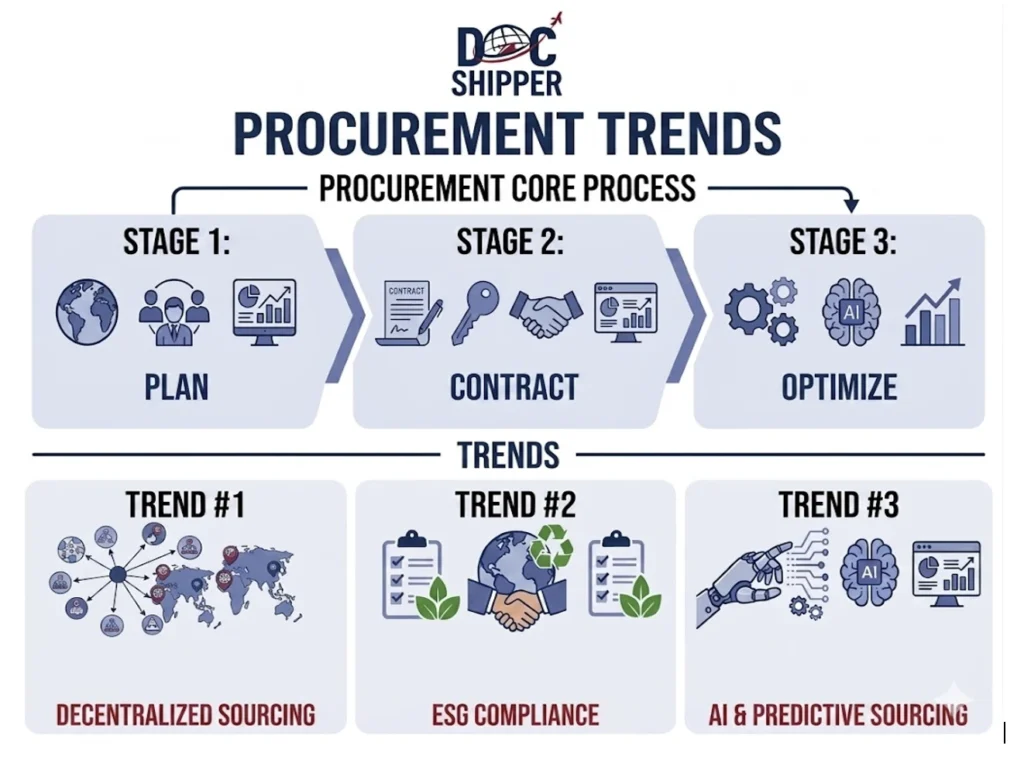
How technology and data change the way you source, negotiate, and pay
Technology is no longer a support function in procurement, it is your competitive edge. If you are not leveraging data across sourcing, negotiation, and payment, you are leaving margin and resilience on the table.
In 2023 and beyond, the top 10 procurement and sourcing trends converge around digital enablement. You must rethink how you collect data, how you analyze it, and how you turn it into negotiation power.
- AI-driven supplier discovery, identify qualified manufacturers in China and beyond using structured and unstructured data.
- Predictive analytics, anticipate price volatility on raw materials before suppliers adjust quotes.
- Automated RFQ platforms, standardize comparison across multiple factories.
- Smart contract and blockchain pilots, increase transparency and traceability.
- Digital payment and financing tools, optimize cash flow and reduce FX exposure.
You should move from reactive buying to predictive sourcing. That shift alone can improve total landed cost by double digits if properly executed.
| Procurement Stage | Traditional Approach | Data-Driven Approach | Impact on Your Business |
| Sourcing | Manual supplier search | AI-powered supplier intelligence | Faster shortlisting, reduced fraud risk |
| Negotiation | Price-focused bargaining | Should-cost models and analytics | Stronger margins, fact-based leverage |
| Contracting | Static contracts | Dynamic clauses linked to indices | Risk mitigation |
| Payment | Manual international transfers | Integrated digital payment platforms | Improved cash flow visibility |
Data is your new negotiation weapon. When you enter a negotiation with benchmark pricing, supplier performance history, and logistics simulations, you shift the power balance.
At DocShipper, we integrate sourcing data, inspection results, and freight cost simulations into a single workflow. You see your total landed cost before you confirm your purchase order.
Use this simple workflow to digitalize your sourcing cycle:
- Define technical specifications and compliance requirements.
- Launch RFQ via structured digital template.
- Run cost breakdown analysis and benchmark pricing.
- Validate supplier with audit and pre-shipment inspection.
- Simulate logistics scenarios under different incoterms.
- Automate payment milestones linked to quality checkpoints.
If you are sourcing in China, this approach reduces miscommunication and protects you against quality drift. Technology does not replace operational control, it strengthens it.
DocShipper Info
Simulate total landed cost before confirming your PO, including freight, duties, and inspections. Request a tailored demo.
Organizational shifts: new skills, new operating models, and supplier partnerships
The tools are evolving, but your organization must evolve with them. Digital procurement fails if your team still thinks in silos.
You now need hybrid profiles. Procurement professionals must understand data analytics, supplier risk assessment, ESG compliance, and international trade mechanics.
- Data literacy, ability to interpret dashboards and cost models.
- Cross-functional collaboration, working with finance, logistics, and quality teams.
- Contract and incoterm expertise, aligning risk transfer with operational reality.
- Supplier development skills, moving from transactional buying to strategic partnership.
Shared service models and procurement outsourcing are also accelerating. You should decide what to keep in-house and what to externalize.
| Operating Model | Best For | Risks | When to Consider It |
| Fully In-House | High strategic control | Limited scalability | Complex proprietary products |
| Shared Services | Multi-entity groups | Internal bureaucracy | Standardized categories |
| Outsourced Sourcing Partner | International expansion | Dependency risk | Sourcing in China or new markets |
Strategic supplier relationships are now a resilience strategy. You should co-develop forecasts, share quality KPIs, and align on capacity planning.
In China, relationship management is not optional. We help you structure factory audits, quarterly business reviews, and corrective action plans that transform suppliers into long-term partners.
Use this checklist to upgrade your supplier ecosystem:
- Segment suppliers by strategic importance and risk exposure.
- Implement dual sourcing for critical components.
- Set measurable ESG and compliance benchmarks.
- Organize quarterly performance reviews with documented KPIs.
- Align payment terms with performance and inspection results.
If your organization remains transactional, you will struggle with volatility. If you build structured partnerships, you gain priority allocation during crises.
DocShipper Advice
Structure audits, KPIs, and capacity planning with our local teams to secure priority allocation and reduce disruption risk.
Conclusion
The top 10 procurement and sourcing trends are not theoretical. They are operational levers you must activate now.
- Leverage AI and analytics to strengthen sourcing decisions.
- Use data to negotiate beyond price and protect margins.
- Integrate logistics and incoterms into total landed cost models.
- Develop new procurement skills focused on risk and ESG.
- Build strategic, performance-driven supplier partnerships.
- Adopt digital tools that connect sourcing, quality control, and payment.
If you source in China or expand globally, complexity will increase. At DocShipper, we combine supplier sourcing, quality inspection, and international freight management so you control cost, risk, and performance in one integrated model.
Your supply chain will not future-proof itself. You must design it, digitize it, and manage it strategically.
FAQ | Top 10 procurement and sourcing trends that will future‑proof your supply chain
- Roles are shifting from “price negotiator” to “end‑to‑end value owner” across sourcing, logistics, and risk.
- Buyers now need to:
- Read and challenge Incoterms, HS codes, and logistics clauses.
- Use dashboards and KPIs (OTIF, defect rate, landed cost) to steer decisions.
- Coordinate closely with logistics, finance, and quality on every major SKU.
- Career‑wise, the most in‑demand profiles combine:
- Data literacy (can interpret analytics and should‑cost models).
- Supplier development skills (can build joint plans, not just place POs).
- Understanding of international trade mechanics (documents, customs, freight).
- Start with the data and processes you already have, then layer tools on top:
- Centralize your basic data: supplier list, SKUs, spend by category, main lanes.
- Standardize RFQs and POs: always capture Incoterms, packaging, and delivery terms.
- Use simple automation first:
- Automated 3‑way match (PO / invoice / delivery note).
- Reminder workflows for approvals and expiring contracts.
- Plug in light analytics:
- Track OTIF, defect rate, and document accuracy per supplier.
- Build a basic landed‑cost view: product + freight + duties + warehousing.
- Once this is stable, you can justify:
- E‑sourcing / RFQ tools.
- P2P automation connected to shipment tracking.
- Make ESG visible and measurable inside your sourcing and logistics choices:
- Add clear ESG criteria to RFQs (certifications, labor practices, materials).
- Score suppliers on ESG alongside price, quality, and delivery.
- Include logistics in ESG, e.g.:
- Modal choices (sea/rail vs systematic air freight).
- Packaging optimization (less waste, better cube utilization).
- Link ESG to contracts:
- Clauses on traceability and audits.
- Corrective action plans when issues are detected.
- Operationalize it with a simple routine:
- Segment suppliers by ESG risk and criticality.
- Run periodic checks (audits, documentation, on‑site or third‑party inspections).
- Report ESG performance together with cost and service in supplier reviews.
- Move from one “best price” source to a balanced network:
- Map critical SKUs and their current factories, lanes, and modes.
- Identify where dual‑sourcing or regional hubs would reduce risk.
- Compare total landed cost and risk for:
- Far‑shoring (often cheaper unit price, higher volatility).
- Nearshoring (higher unit price, faster and more flexible logistics).
- Tie procurement choices to logistics options:
- For each region, define preferred modes (sea, rail, air, road) and backup plans.
- Use regional warehouses or cross‑docking to shorten lead times to customers.
- Set clear playbooks for when to switch mode or lane (e.g. when delay > X days).
- Replace siloed work with shared routines and shared KPIs:
- With logistics / supply chain:
- Co‑define Incoterms, packaging rules, and booking windows.
- Review freight performance (transit time, demurrage, damage, customs issues).
- With finance:
- Align on landed cost calculation and payment terms.
- Jointly manage FX, duties, and working capital impact.
- With sales / operations:
- Share demand forecasts and launch calendars early.
- Agree on service levels and what happens when suppliers or carriers slip.
- Formalize it through:
- Cross‑functional S&OP or similar planning meetings.
- Common dashboards for cost, risk, resilience, and innovation metrics.
- Consider shared services / outsourcing when:
- You repeat the same tasks across entities or regions (RFQs, POs, basic vendor setup).
- You lack in‑house expertise in specific areas (e.g. sourcing in China, freight management).
- Typical split that works well:
- Keep in‑house:
- Strategy, category management, supplier segmentation.
- Final decisions on critical suppliers and contracts.
- Centralize or outsource:
- Supplier scouting and initial shortlisting in foreign markets.
- Operational procurement (order placement, follow‑up, document chasing).
- Logistics execution and customs coordination with a specialist partner.
- Key success factors:
- Clear roles and SLAs.
- Transparent cost and performance reporting.
- A single point of contact coordinating between your team and external partners.
- Treat negotiation as an ongoing, data‑driven relationship, not a one‑off event:
- Segment suppliers: strategic vs transactional.
- For strategic ones, set up joint business plans:
- Forecasts, capacity reservations, quality and delivery targets.
- Cost‑down / value‑engineering roadmaps.
- Use data in every review:
- OTIF, defect rate, logistics incidents, document accuracy.
- Landed cost evolution, not just unit price.
- Combine firmness with partnership:
- Tie payment terms and volumes to performance.
- Share some visibility (demand plans, design changes) so they can plan.
- In return, ask for priority production slots, flexibility on MOQ, or better logistics coordination.
Need Help with
Logistics or Sourcing ?
First, we secure the right products from the right suppliers at the right price by managing the sourcing process from start to finish. Then, we simplify your shipping experience - from pickup to final delivery - ensuring any product, anywhere, is delivered at highly competitive prices.


Fill the Form
Prefer email? Send us your inquiry, and we’ll get back to you as soon as possible.
Contact us