In short ⚡
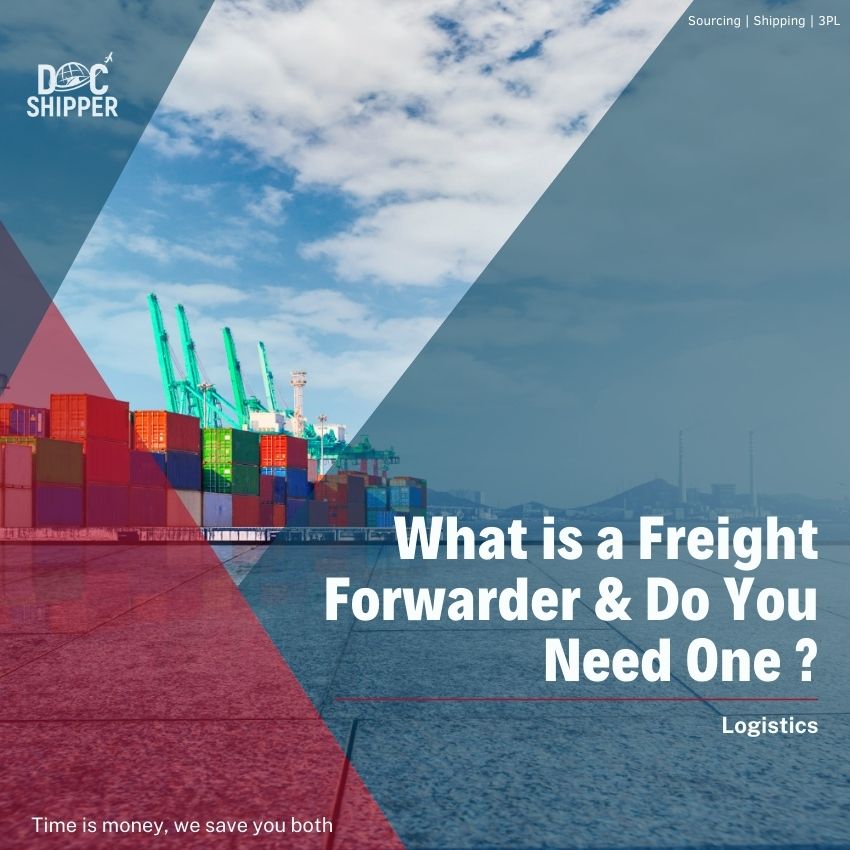
A freight forwarder is a logistics specialist you hire to design, organize and coordinate end‑to‑end international transport between shipper and carriers, across modes such as sea, air, road and rail.
They handle route planning, documentation, customs clearance, warehousing options, risk management and shipment tracking so cargo moves compliantly from pickup to final delivery.
We hope you’ll find this article genuinely useful, but remember, if you ever feel lost at any step, whether it’s finding a supplier, validating quality, managing international shipping or customs, DocShipper can handle it all for you!
What a freight forwarder actually does in your supply chain
If you’re Googling what is a freight forwarder, you’re probably in the middle of a real problem, rising freight rates, messy paperwork, unpredictable lead time, or a supplier who swears “it shipped” but can’t produce a bill of lading.
Here’s the thing, a freight forwarder doesn’t just “book transport.” You use one to stitch together your logistics and supply chain management flow, from factory pickup to final delivery, across carriers, borders, and handoffs.
From experience, you’ll notice fast that international shipping breaks at the seams, consolidation mistakes, missing harmonized system code, a customs clearance hold, or a last mile delivery appointment nobody booked.
That’s where we step in at DocShipper, we manage the moving parts so your distribution network keeps running and your order fulfillment doesn’t stall.
- Upstream impact: pickup coordination, load planning, capacity management, containerization, palletizing.
- Midstream impact: multimodal transport, cross-docking, consolidation and deconsolidation, warehousing.
- Downstream impact: delivery scheduling, proof of delivery, exception handling, reverse logistics.
Quick checklist, what you actually want your freight forwarder to cover:
- Clear route optimization and carrier selection, not “whatever is available.”
- Documentation accuracy, bill of lading or airway bill, commercial invoice, packing list.
- Customs clearance readiness, tariff classification and HS code logic.
- Visibility, shipment tracking plus escalation when it goes quiet.
- Options for warehousing, bonded warehouse, inventory management, distribution.
DocShipper Info
We map and control every handoff, from pickup to final delivery, so your supply chain flows without costly surprises.
Simple definition of a freight forwarder and how it fits between shipper and carrier
A clean answer to what is a freight forwarder is this, you hire a freight forwarding partner to organize your import/export transport end-to-end, even when multiple carriers touch the cargo.
You don’t hand us a truck or a vessel, you hand us a shipment goal, cost, transit time, risk tolerance, Incoterms, and we translate it into an executable transportation plan.
Think of your forwarder as the operating layer between you (the shipper or consignee) and the carriers (airlines, shipping lines, truckers, rail operators).
In practice, that means we orchestrate freight brokerage style decisions, negotiate freight rates, secure space, and coordinate cargo handling across handoffs.
Micro-story, you’ll recognize this.
Your supplier in Shenzhen tells you “FOB Yantian,” but they quietly deliver late to the terminal, the cutoff is missed, and your container rolls to the next sailing.
We’ve seen that single slip blow up a just-in-time launch, so we confirm responsibilities under Incoterms, lock the pickup window, and build buffer into the route design when your KPI is on-time delivery.
Industry note: You’ll often see forwarders align processes with FIATA standards and terminology, especially around documentation and roles, which helps when multiple countries and agents get involved.
Workflow, where the freight forwarder sits:
1. You share product, timelines, Incoterms, pickup point, delivery point, constraints.
2. We plan the route, choose modes, and coordinate the carrier network.
3. We prepare and validate shipping documents and compliance data.
4. We manage milestones, tracking, and exceptions until proof of delivery.
| Role | What you rely on them for | What they usually don’t do |
| Freight forwarder | Transportation planning, route optimization, documentation, coordination across carriers, risk management | Own every vehicle or plane used (sometimes they do, often they don’t) |
| Carrier | Physically moves cargo on a leg, issues transport documents | Design your full multimodal plan or manage your customs strategy |
| Freight broker | Matches loads with trucking capacity (common in domestic legs) | Handle full international paperwork and cross-border compliance end-to-end |
Core services: transport planning, documentation, customs, warehousing and insurance
When you ask what is a freight forwarder in operational terms, the real answer is the bundle of services that keeps your cargo moving and compliant.
You’re not just buying transport, you’re buying execution across transportation planning, customs clearance, and the admin stack that makes the shipment legally shippable.
- Transport planning: multimodal transport, route optimization, consolidation, deconsolidation, load planning, capacity management.
- Docs and compliance: bill of lading, airway bill, commercial invoice checks, packing list logic, export filings, HS code validation, tariff classification.
- Customs clearance: import/export entries, duty and tax coordination, document presentation, hold resolution.
- Warehousing: bonded warehouse options, cross-docking, inventory management, palletizing, labeling.
- Risk management: cargo insurance guidance and claims support when damage hits.
Micro-story, the “easy” one that turns painful.
Your supplier sends cartons with mixed SKUs, no palletizing plan, and you discover at origin that your airline requires specific dimensions and labeling for consolidation.
We’ve handled that by switching to a controlled consolidation, repalletizing at the warehouse, then pushing an airway bill that matches the physical freight, so the shipment tracking events actually make sense later.
Quick checklist, before cargo leaves origin:
- HS code and description match what customs expects, not what the factory guessed.
- Incoterms responsibilities are crystal clear (who pays, who clears, who insures).
- Carton count, weights, and dimensions match the paperwork.
- Freight rates and surcharges are confirmed in writing, including peak season risk.
- Contingency plan exists for rolled bookings or port congestion.
DocShipper Advice
Let us bundle transport, customs, warehousing and insurance into one controlled workflow that prevents origin mistakes.
Key responsibilities of a freight forwarder step by step
If what is a freight forwarder is the definition, this is the part that saves you money and headaches, the step-by-step responsibilities that protect your lead time and your cash flow.
You’re juggling procurement, demand forecasting, and supplier follow-up already, so you need a partner who runs the logistics execution like a playbook.
We treat freight forwarding as operational supply chain management, plan, book, document, clear, track, deliver, then measure against KPIs you actually care about.
And yes, we mean the unglamorous work too, the phone calls, cutoffs, and “why is this container stuck?” investigations.
Workflow, how the responsibilities flow end-to-end:
1. Define shipment specs and constraints (product, volume, time, Incoterms, compliance).
2. Design route and choose mode(s) and carriers.
3. Coordinate pickup, cargo handling, consolidation, and export steps.
4. Prepare documents, submit filings, and align customs clearance data.
5. Track milestones, resolve exceptions, confirm proof of delivery.
6. Close shipment, reconcile invoices, and review KPIs for the next cycle.
One checklist you can use for every shipment handover:
- Pickup date and cargo ready time confirmed with supplier, in writing.
- Carrier space and cutoffs confirmed, including backup sailing or flight.
- Document set validated before departure (invoice, packing list, B/L or AWB data).
- Customs data prepared, HS code, value, origin, and permits if needed.
- Delivery plan aligned, last mile delivery appointment, unloading constraints, POD process.
DocShipper Info
We run your shipments with KPI tracking, milestone control, and post shipment review to protect cash flow.
Route design, carrier selection and multi‑modal coordination
At the core of what is a freight forwarder is decision-making, you need the right route design, the right carrier selection, and tight coordination across multimodal transport.
One weak link, a transshipment with no buffer, a cheap trucker with poor appointment discipline, and your “good” plan collapses.
We start with your real constraint, cost, speed, reliability, or a compliance lane that can’t fail.
Then we map options across ocean, air, rail, and trucking, including consolidation vs direct, and whether cross-docking improves flow or adds risk.
- Carrier selection: capacity, service record, schedule integrity, claims behavior, port pairs.
- Route optimization: transit time vs variability, cutoffs, congestion patterns, seasonality.
- Load planning: container utilization, palletizing strategy, weight distribution, packaging constraints.
- Network coordination: origin trucking, terminal handling, main leg, destination delivery.
Micro-story, a classic mistake.
You choose the cheapest routing with two transshipments during peak season, then a feeder vessel slips three days and your container misses the mother vessel.
We’ve avoided that exact mess by paying slightly more for a cleaner string, fewer handoffs, better schedule integrity, and the result was a predictable lead time that protected your production plan.
Industry note: When we evaluate carriers and lanes, we often benchmark service patterns using market intelligence approaches commonly referenced by IATA in air cargo contexts, especially around capacity constraints and documentation discipline.
DocShipper Alert
We stress test carriers and transshipments before booking, so peak season does not derail your production plan.
Paperwork, customs clearance, tracking and problem resolution
If you want the practical side of what is a freight forwarder, it’s paperwork plus problem resolution, because customs clearance and shipment tracking don’t forgive sloppy details.
You can have perfect transportation planning, then lose days because the invoice wording doesn’t match tariff classification logic.
We validate documents before they become expensive mistakes.
That includes bill of lading or airway bill data, shipper and consignee details, Incoterms, declared value, and the harmonized system code rationale.
- Paperwork control: document consistency checks, export requirements, import entry prep.
- Customs clearance support: HS code review, duty and tax estimation, hold response, inspections coordination.
- Shipment tracking: milestone monitoring, exception alerts, ETA updates tied to your KPIs.
- Problem resolution: rolled bookings, damages, shortages, demurrage and detention mitigation.
Micro-story, the one that hurts your cash the most.
Your goods arrive, customs asks for a clarification on material composition, and your supplier sends a vague one-liner that triggers a longer review.
We’ve handled this by preparing a tighter product narrative upfront, matching it to the HS code logic, and getting the right supporting docs ready, so you don’t watch storage charges stack up in a bonded area while your customer waits.
Step-by-step workflow for “shipment stuck” situations:
1. Identify where it stopped, carrier, terminal, customs, warehouse, last mile.
2. Pull the document set and compare against what the authority or carrier requests.
3. Fix the root cause, amend data, provide missing proof, or refile as required.
4. Escalate with timestamps and names, then confirm release in tracking.
5. Re-plan delivery, appointments, cross-docking, or distribution to recover lead time.
DocShipper Alert
We pre validate HS codes, values and narratives to avoid bonded storage fees and painful customs holds.
Main types of freight forwarders and how they differ from brokers and carriers
When you ask what is a freight forwarder, you also need to understand that not all forwarders operate the same way. Your risk exposure, pricing structure and legal responsibility will depend on the type you choose.
In international trade, you mainly deal with agent forwarders, commission forwarders and integrated forwarders. Each one interacts differently with carriers and customs authorities.
| Type | Acts in whose name | Legal responsibility | Revenue model |
| Agent forwarder | On behalf of the shipper | Limited liability as intermediary | Commission or service fee |
| Commission forwarder | In its own name | Stronger contractual liability | Margin between buy and sell rate |
| Integrated forwarder | Often in own name | End to end responsibility | Bundled logistics pricing |
| Freight broker | Matches shipper and carrier | Very limited operational control | Brokerage fee |
| Carrier | Provides physical transport | Liable for cargo during transport leg | Freight rate |
An agent forwarder negotiates with carriers for you but the transport contract is usually between you and the carrier. A commission forwarder contracts in its own name and then subcontracts the transport, which increases its operational responsibility.
A broker simply connects you to a trucking company or shipping line. A carrier physically moves your cargo by sea, air, rail or road but does not manage your global supply chain strategy.
- You hire a carrier to move goods.
- You hire a broker to find a carrier.
- You hire a freight forwarder to design, coordinate and secure the entire international flow.
At DocShipper, we operate as a fully managed forwarder, meaning you rely on one accountable partner from supplier pickup to final delivery.
Looking for a Reliable Shipping & Sourcing Partner?


Benefits and limitations of using a freight forwarder for your business
If you import or export regularly, you quickly realize that international logistics is not just about booking freight. It is about risk control, compliance and cost optimization.
A freight forwarder gives you leverage, visibility and operational expertise. But you also need to understand the trade offs.
| Benefits | Concrete impact for you |
| Carrier network access | Better rates and space allocation in peak season |
| Customs expertise | Reduced clearance delays and penalties |
| Multi modal coordination | Optimized transit time and cost balance |
| Risk management | Insurance advice and claims handling support |
| Operational outsourcing | You focus on sales and procurement |
However, using a forwarder also means you delegate part of your logistics control. The wrong partner can create opacity in pricing or communication.
- You depend on their network performance.
- You must clearly define Incoterms responsibilities.
- You need transparent cost breakdowns.
- You should verify licenses and financial stability.
The key advantage is strategic simplification. Instead of managing five service providers across borders, you centralize coordination under one logistics architect.
With us at DocShipper, you gain end to end visibility, sourcing support in China, supplier audits and controlled shipping execution under one roof.
DocShipper Advice
Choose a forwarder who provides end to end visibility, clear cost breakdowns and proactive control across sourcing and shipping.
Conclusion
Now you clearly understand what is a freight forwarder and why this role is central in global trade. The right partner transforms logistics from a constraint into a competitive advantage.
- A freight forwarder coordinates transport, documentation and compliance.
- Agent and commission forwarders differ in legal responsibility and contractual structure.
- Brokers connect parties, carriers move goods, forwarders manage the full chain.
- Using a forwarder reduces risk, improves cost control and simplifies operations.
- Choosing the right forwarder protects your margins and your supply chain stability.
If you want structured, compliant and optimized international shipping, you need more than a transporter. You need a freight forwarder who thinks like a supply chain partner, and that is exactly how we operate at DocShipper.
FAQ | What is a freight forwarder and how can one simplify your global shipping?
A freight forwarder is responsible for turning your shipping objectives into an executable transport plan and then running it end‑to‑end. In practice, that usually means:
- Planning routes and choosing the right modes (air, sea, rail, road) and carriers.
- Coordinating pickup, loading, containerization or palletizing at origin.
- Managing documentation (commercial invoice, packing list, bill of lading/airway bill, export filings).
- Preparing customs data (HS codes, values, origin, permits) and supporting clearance.
- Tracking milestones and solving issues like rolled cargo, delays or missing documents.
- Orchestrating final delivery, proof of delivery and post‑shipment invoicing and KPIs.
Using a freight forwarder gives you both leverage and expertise you don’t get by going carrier‑by‑carrier. Typical advantages include:
- Cost: they aggregate volumes, which often means better rates and space during peak season.
- Time: you outsource the time‑consuming work of comparing routes, negotiating and chasing updates.
- Compliance: they know customs rules, HS logic and local practices that keep you out of trouble.
- Control: instead of managing several providers in different countries, you manage a single accountable partner.
- Risk management: they help you design routes with buffers, choose insurance and react fast when something goes wrong.
Freight is simply goods moved in bulk by different modes of transport. A “typical” international shipment can look like this:
- Origin leg: truck collection from factory or warehouse to port or airport.
- Main leg:
- Ocean freight in containers (FCL/LCL) on a shipping line, or
- Air freight on a cargo or passenger aircraft, sometimes rail on specific corridors.
- Destination leg: truck or rail from port/airport to your warehouse, 3PL or final customer.
- Along the way, cargo can be consolidated/deconsolidated, cross‑docked, stored in bonded warehouses, or re‑labeled and palletized depending on the plan.
International shipping has many potential failure points, and a forwarder’s job is to anticipate and fix them. Common challenges include:
- Delays: weather disruptions, port congestion, rolled bookings, overbooked flights or missed cut‑off times.
- Documentation errors: mismatched HS codes, invoice descriptions, weights or values that trigger customs holds.
- Customs issues: missing permits, unclear product descriptions, or under/over‑valuation leading to inspections.
- Operational complexity: multiple carriers, modes and handovers where information can be lost.
- Cost leaks: demurrage, detention, storage and re‑handling charges when plans go off‑track.
Both are freight forwarders, but their legal and operational roles differ:
- Agent forwarder:
- Acts on your behalf; the transport contract is usually between you and the carrier.
- Has limited liability, mainly for its own mistakes as an intermediary.
- Earns a commission or service fee.
- Commission forwarder:
- Contracts in its own name, then subcontracts carriers.
- Takes stronger contractual responsibility for the transport as a whole.
- Earns a margin between the buy rate (from carriers) and the sell rate (to you).
Evaluate a forwarder the same way you’d assess a key supplier or logistics partner:
- Capability fit: modes offered (air/sea/rail/road), key trade lanes, customs expertise in your main markets.
- Transparency: clear quotes, breakdown of surcharges, visibility tools and escalation paths.
- Compliance strength: knowledge of HS codes, Incoterms, local regulations and required certifications.
- Network and reliability: access to carrier capacity, track record on on‑time performance and issue resolution.
- Strategic value: ability to support warehousing, sourcing, supplier coordination and long‑term cost optimization, not just “spot bookings.”
Need Help with
Logistics or Sourcing ?
First, we secure the right products from the right suppliers at the right price by managing the sourcing process from start to finish. Then, we simplify your shipping experience - from pickup to final delivery - ensuring any product, anywhere, is delivered at highly competitive prices.


Fill the Form
Prefer email? Send us your inquiry, and we’ll get back to you as soon as possible.
Contact us