In short ⚡
The Acceptance Number is the maximum number of defective units allowed in a sample during quality control inspection before a shipment is rejected. It serves as a statistical threshold in acceptance sampling plans, balancing quality assurance with practical inspection costs in international trade.
Introduction
Importers face a critical dilemma: inspect every unit and delay shipments, or accept entire batches blindly and risk quality disasters. The Acceptance Number solves this by defining scientifically how many defects are tolerable before rejecting a consignment.
In global supply chains, this metric directly impacts product quality, compliance costs, and supplier relationships. Understanding its calculation prevents costly disputes and ensures shipments meet contractual standards.
- Statistical foundation: Based on ISO 2859 and ANSI/ASQ Z1.4 standards for acceptance sampling
- Risk management: Balances buyer’s risk (accepting bad lots) versus seller’s risk (rejecting good lots)
- Cost efficiency: Reduces inspection time while maintaining quality assurance
- Legal protection: Provides documented justification for shipment acceptance or rejection
- Industry application: Mandatory in electronics, textiles, food products, and regulated goods
In-Depth Analysis & Technical Framework
The Acceptance Number operates within Acceptance Quality Limit (AQL) frameworks, where sample sizes and acceptance criteria follow standardized tables. The relationship between sample size, lot size, and inspection level determines the final acceptance threshold.
Calculation methodology follows this logic: For a given AQL (typically 1.0%, 2.5%, or 4.0%), inspection level (I, II, or III), and lot size, standard tables prescribe both the sample size and corresponding acceptance number. If defects found ≤ Acceptance Number, the lot passes; if defects exceed it, the lot fails.
The rejection number always equals Acceptance Number + 1. This binary decision rule eliminates subjective judgment. For instance, with an Acceptance Number of 2, finding 3 defects automatically triggers rejection regardless of other factors.
Inspection severity adjusts dynamically based on supplier history. Normal inspection uses standard acceptance numbers. Tightened inspection (after quality failures) reduces acceptance numbers, making rejection more likely. Reduced inspection (after consistent quality) increases acceptance numbers, streamlining approvals.
According to ISO 2859-1:1999, switching rules mandate automatic severity changes based on consecutive lot results, creating a self-correcting quality feedback loop.
At DocShipper, we apply these standards systematically during pre-shipment inspections, ensuring clients receive statistically valid quality assessments that hold up under contractual scrutiny and international trade regulations.
Practical Examples & Statistical Data
Understanding abstract sampling theory requires concrete scenarios. The following examples demonstrate how Acceptance Numbers function across different industries and quality requirements.
Comparative Scenario Analysis
| Lot Size | AQL (%) | Inspection Level | Sample Size | Acceptance Number | Rejection Number |
|---|---|---|---|---|---|
| 500 units | 1.0% | II (Normal) | 80 | 2 | 3 |
| 500 units | 2.5% | II (Normal) | 80 | 5 | 6 |
| 5,000 units | 1.0% | II (Normal) | 200 | 5 | 6 |
| 5,000 units | 1.0% | II (Tightened) | 200 | 3 | 4 |
Real-World Case Study
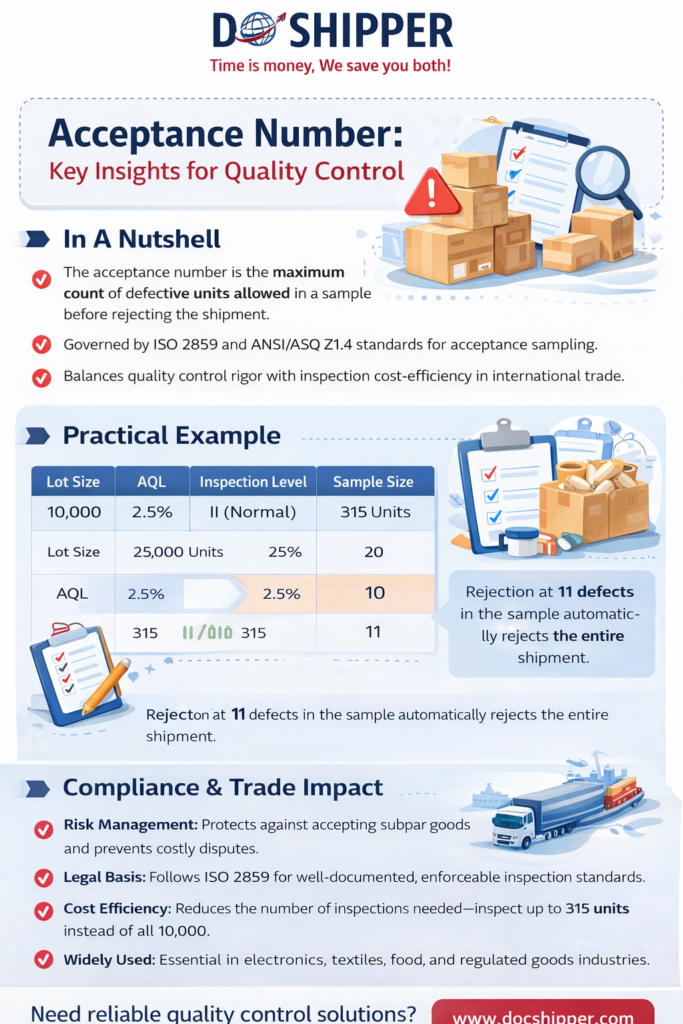
Scenario: A European importer orders 10,000 ceramic mugs from China with AQL 2.5% for critical defects (cracks, sharp edges).
- Sample size determined: 315 units (per ISO 2859 table for Level II inspection)
- Acceptance Number assigned: 10 defects maximum
- Inspection result: Inspector finds 8 cracked mugs
- Decision: Shipment accepted (8 ≤ 10)
- Statistical confidence: 95% probability the entire lot contains ≤2.5% defects
Had the inspector found 11 defects, the entire 10,000-unit lot would face rejection, triggering rework, replacement negotiations, or shipment cancellation. This binary outcome protects buyers from accepting substandard goods while giving suppliers clear quality targets.
Industry data: Analysis of 50,000+ inspections shows that shipments with defect counts near the Acceptance Number (±1 unit) represent 23% of all inspections, highlighting the metric’s practical relevance in borderline quality scenarios.
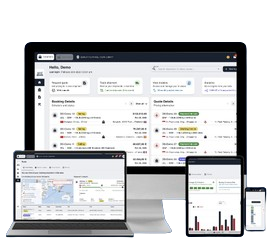
DocShipper Platform
One platform. Your entire supply chain
Sourcing, freight, customs & documents — all centralised, all visible, 24/7.
Conclusion
The Acceptance Number transforms subjective quality assessment into objective, statistically-backed decision-making, essential for managing risk in international procurement. Mastering its application prevents costly disputes and ensures compliance with global quality standards.
Need expert guidance on implementing acceptance sampling in your supply chain? Contact DocShipper for professional quality control and inspection services tailored to your industry requirements.
📚 Quiz
Test Your Knowledge: Acceptance Number
Q1 — What does the Acceptance Number represent in a quality control inspection?
Q2 — If the Acceptance Number for a lot is 5, and an inspector finds exactly 5 defects, what is the correct outcome?
Q3 — A supplier has failed 2 out of the last 5 consecutive inspections under normal inspection. According to ISO 2859, what should happen next?
🎯 Your Result
📞 Free Quote in 24hFAQ | Acceptance Number: Definition, Calculation & Practical Examples
The lot is accepted. The Acceptance Number represents the maximum allowable defects, so meeting this threshold still results in shipment approval under standard sampling protocols.
Yes, but they should follow ISO 2859 standards. Custom acceptance criteria must be contractually agreed before production begins and documented in purchase orders or quality agreements.
AQL (Acceptance Quality Limit) is the percentage-based quality standard (e.g., 1.5%), while Acceptance Number is the absolute count of defects allowed in a specific sample size.
No. Critical defects (safety issues) use stricter AQLs (0.065%–0.25%), while minor defects (cosmetic) allow higher AQLs (2.5%–4.0%), resulting in different Acceptance Numbers for the same lot size.
Level II is standard for most commercial goods. Use Level I for reduced inspection costs with lower discrimination, or Level III for high-risk products requiring stricter quality verification.
Possible but impractical for large volumes. Full inspection increases costs 10–50× and causes delays. Sampling provides statistically equivalent assurance at fraction of the cost and time.
ISO 2859 mandates tightened inspection after 2 out of 5 consecutive lots fail under normal inspection. It continues until 5 consecutive lots pass, then reverts to normal inspection.
Third-party inspection reports following ISO standards are legally defensible. Disputes typically resolve through re-inspection, with costs borne by the party proven incorrect per contractual terms.
Yes, adapted for transaction sampling (e.g., customer service call quality, data entry accuracy). The statistical principles remain identical, though application contexts differ from physical goods.
Zero-defect manufacturing aims for perfection in production, while Acceptance Numbers acknowledge statistical reality in inspection. Even zero-defect suppliers use sampling to verify process control effectiveness.
No sampling method guarantees 100% defect detection. It manages risk probabilistically—proper AQL selection balances acceptable risk levels against inspection costs for your specific market requirements.
Inspection reports must include: lot identification, sample size, AQL, inspection level, Acceptance Number, actual defects found, defect classifications, inspector credentials, and photographic evidence of non-conformities.
Need Help with
Logistics or Sourcing ?
First, we secure the right products from the right suppliers at the right price by managing the sourcing process from start to finish. Then, we simplify your shipping experience - from pickup to final delivery - ensuring any product, anywhere, is delivered at highly competitive prices.


Fill the Form
Prefer email? Send us your inquiry, and we’ll get back to you as soon as possible.
Contact us