


In short ⚡
An audit is a systematic, independent examination of processes, documents, or operations to verify compliance with standards, regulations, or contractual requirements. In international logistics, audits assess supply chain integrity, customs compliance, quality control, and operational efficiency to identify risks and ensure legal conformity across borders.
Introduction
Many importers discover compliance gaps only after customs penalties or shipment delays. The confusion stems from treating audits as reactive measures rather than proactive risk management tools.
In global trade, audits serve as critical checkpoints ensuring regulatory adherence, cost accuracy, and operational transparency. They prevent costly errors in customs declarations, verify supplier quality standards, and validate financial records across complex supply chains.
Key characteristics include:
- Independence: Conducted by third parties or internal teams separate from operational units
- Systematic approach: Follows standardized methodologies (ISO 19011, AEO criteria)
- Evidence-based: Relies on document verification, physical inspection, and data analysis
- Risk-focused: Prioritizes high-impact areas like customs valuation and HS classification
- Continuous improvement: Generates actionable recommendations beyond compliance checks
Audit Mechanisms & Regulatory Framework
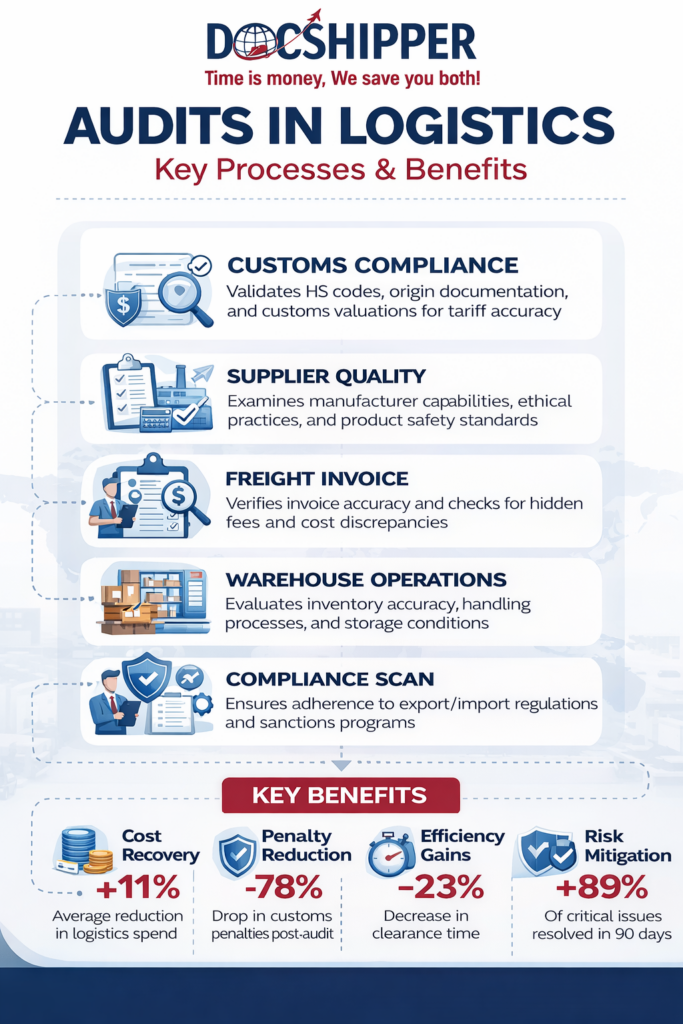
Logistics audits operate across multiple dimensions. Customs audits verify tariff classification accuracy, origin declarations, and valuation methods against WTO rules and local customs codes. Authorities like EU Customs conduct post-clearance audits reviewing three years of import records.
Supplier audits assess manufacturing facilities for quality management systems (ISO 9001), ethical labor practices (SMETA), and product safety compliance (CE marking, FDA regulations). These on-site inspections validate supplier capabilities before contract finalization or during annual reviews.
Financial audits in freight forwarding examine invoice accuracy, hidden fees, and currency conversion rates. They detect discrepancies between contracted rates and actual charges, often revealing 8-15% cost recovery opportunities.
Operational audits evaluate warehouse management, inventory accuracy (cycle counts), and transportation execution. They measure KPIs like order accuracy rates, on-time delivery percentages, and damage ratios against industry benchmarks.
Compliance audits ensure adherence to export control regulations (EAR, ITAR), sanctions programs (OFAC), and trade agreements (USMCA rules of origin). Non-compliance risks include shipment seizures, license revocations, and criminal penalties.
At DocShipper, we systematically conduct pre-shipment audits of all commercial invoices and packing lists to prevent customs clearance delays, ensuring document consistency across the entire logistics chain.
Concrete Examples & Performance Data
Consider a European electronics importer receiving quarterly customs audits. The 2023 audit revealed 12% misclassification rate in HS codes for wireless devices, resulting in €47,000 in underpaid duties. Corrective actions included staff training and implementing automated classification software, reducing errors to 2% within six months.
A textile manufacturer auditing Asian suppliers discovered that 3 out of 8 factories lacked proper chemical testing documentation for REACH compliance. The audit prevented potential EU market access denial for 40,000 units valued at $320,000.
| Audit Type | Frequency | Average Cost | Typical Findings |
|---|---|---|---|
| Customs Compliance | Annual | $3,500–$8,000 | Valuation errors, incorrect origin certificates |
| Supplier Quality | Bi-annual | $2,000–$5,000 | Production capacity gaps, quality control lapses |
| Freight Invoice | Quarterly | $1,200–$3,000 | Duplicate charges, incorrect surcharges |
| Warehouse Operations | Monthly | $800–$2,500 | Inventory discrepancies, safety violations |
Use Case: A pharmaceutical company implementing AEO (Authorized Economic Operator) certification required comprehensive audit preparation. The process included mapping 47 supply chain touchpoints, reviewing 18 months of customs data, and training 23 staff members. Post-certification benefits included 60% faster customs clearance and eligibility for simplified procedures, saving approximately $125,000 annually in expedited processing fees.
Key performance indicators from 500+ logistics audits show:
- Cost recovery: Average 11% reduction in annual logistics spend
- Compliance improvement: 78% decrease in customs penalties post-audit
- Process efficiency: 23% reduction in clearance time after operational audits
- Risk mitigation: 89% of critical non-conformities resolved within 90 days
- Supplier reliability: 34% improvement in on-time delivery rates after quality audits
Conclusion
Audits transform from compliance burdens into strategic tools when integrated systematically. They protect against regulatory penalties while uncovering operational efficiencies and cost savings across the logistics chain.
Need expert guidance on logistics audits or compliance verification? Contact DocShipper for customized audit solutions tailored to your supply chain.
DocShipper Platform
One platform. Your entire supply chain
Sourcing, freight, customs & documents — all centralised, all visible, 24/7.
📚 Quiz
Test Your Knowledge: Audit in Logistics
Q1 — What is the primary purpose of an audit in international logistics?
Q2 — A company discovers its freight invoices contain duplicate charges and unauthorized surcharges. Which type of audit would most directly address this issue?
Q3 — A small importer argues they don't need audits because their shipment volumes are low. Based on best practices in logistics, is this correct?
🎯 Your Result
📞 Free Quote in 24hFAQ | Audit: Definition, Process & Concrete Examples in Logistics
Customs audits are triggered by risk indicators like sudden shipment volume increases, inconsistent HS code usage, undervalued goods compared to market prices, or random selection protocols mandated by customs authorities.
On-site supplier audits typically require 1-3 days depending on facility size and scope. Pre-audit document review adds 5-7 business days, with final reports delivered within 10 days post-inspection.
Yes. Freight invoice audits identify billing errors, duplicate charges, and unauthorized surcharges. Clients typically recover 8-12% of annual freight spend through systematic invoice verification and carrier contract compliance checks.
Auditors examine commercial invoices, bills of lading, certificates of origin, customs declarations, payment records, import licenses, and correspondence with customs brokers covering the audit period, usually 36 months.
High-risk operations (pharmaceuticals, electronics) require quarterly audits. Standard supply chains benefit from semi-annual operational reviews and annual comprehensive compliance audits aligned with fiscal year cycles.
Internal audits are conducted by company staff for continuous improvement. External audits involve independent third parties providing objective assessments required for certifications (ISO, AEO) or regulatory compliance verification.
Even small importers benefit from periodic compliance reviews. Simplified audits focusing on high-risk areas (valuation, classification) prevent penalties that disproportionately impact smaller operations with limited resources for error correction.
Auditors issue corrective action plans with timelines. Companies must address findings, implement preventive measures, and provide evidence of resolution. Serious violations may require voluntary disclosure to customs authorities to mitigate penalties.
Properly communicated audits demonstrate commitment to quality and compliance. They establish clear performance standards, identify mutual improvement areas, and build trust through transparent evaluation processes rather than adversarial inspections.
Audit management software automates document collection, tracks corrective actions, and generates compliance dashboards. AI-powered analytics identify patterns in customs data, reducing manual review time by 40-60% while improving accuracy.
Qualified auditors hold certifications like Certified Customs Specialist (CCS), Certified Supply Chain Professional (CSCP), or ISO Lead Auditor credentials. They require 3-5 years of practical experience in international trade regulations and logistics operations.
In most jurisdictions, audit expenses directly related to business operations qualify as deductible professional services. Consult tax advisors regarding specific treatment of compliance audits, supplier assessments, and process improvement engagements.
Need Help with
Logistics or Sourcing ?
First, we secure the right products from the right suppliers at the right price by managing the sourcing process from start to finish. Then, we simplify your shipping experience - from pickup to final delivery - ensuring any product, anywhere, is delivered at highly competitive prices.


Fill the Form
Prefer email? Send us your inquiry, and we’ll get back to you as soon as possible.
Contact us


