


In short ⚡
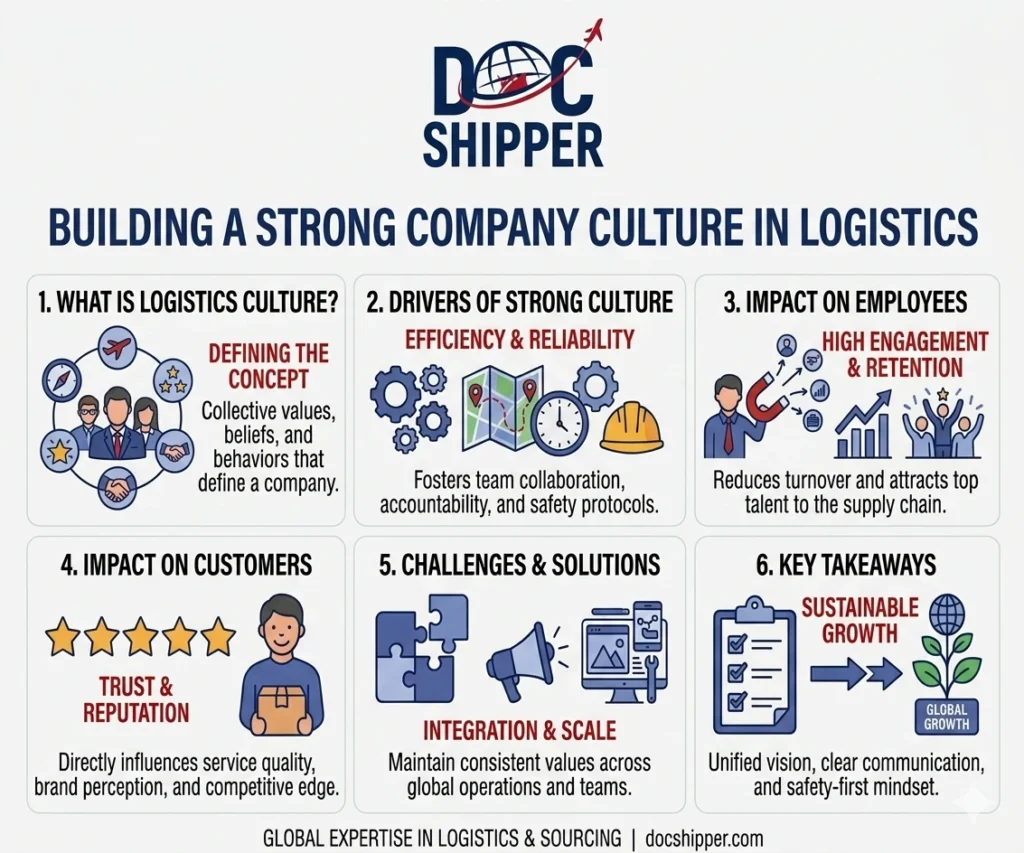
Company culture is the set of shared values, beliefs, behaviors, and practices that shape how employees interact, make decisions, and work toward common goals. It influences recruitment, retention, productivity, and overall business performance in international logistics operations.Introduction
Many logistics companies struggle with high turnover, operational inefficiencies, and poor customer service—often rooted in weak or misaligned company culture. In international freight forwarding, where coordination across time zones, cultures, and regulatory frameworks is essential, a strong organizational culture becomes a competitive differentiator.
Company culture directly impacts how teams handle customs delays, communicate with clients, resolve conflicts, and adapt to market changes. For businesses like DocShipper operating across continents, cultural alignment ensures consistency in service quality regardless of geographic location.
Key characteristics of effective company culture in logistics include:
- Transparency: Open communication channels between operations, sales, and management teams
- Accountability: Clear ownership of tasks from booking to final delivery
- Adaptability: Flexibility to respond to regulatory changes, supply chain disruptions, or client emergencies
- Customer-centricity: Decision-making frameworks prioritizing client needs and long-term relationships
- Continuous improvement: Systems encouraging feedback, training, and process optimization
In-Depth Analysis & Strategic Impact
Company culture in logistics extends beyond office perks or mission statements. It encompasses the operational philosophy guiding daily decisions, the leadership style modeling expected behaviors, and the reward systems reinforcing desired outcomes. In freight forwarding, culture determines whether a team proactively alerts clients about potential delays or waits for complaints.
The recruitment and onboarding process serves as the first cultural touchpoint. Companies with strong cultures hire for values alignment as much as technical skills. At DocShipper, we prioritize candidates demonstrating problem-solving abilities and client advocacy, ensuring new hires naturally integrate into our service-first approach.
A critical cultural element is cross-functional collaboration. Logistics operations require seamless coordination between procurement, warehousing, customs brokerage, and transport teams. Siloed departments create bottlenecks; collaborative cultures reduce errors and accelerate shipment processing. According to research from the International Chamber of Commerce, companies with integrated operational cultures report 23% fewer documentation errors in cross-border trade.
Regulatory compliance culture is non-negotiable in international logistics. Organizations must embed compliance into everyday workflows rather than treating it as a checkbox exercise. This means training teams on Incoterms, customs regulations, and trade sanctions, while creating systems where compliance questions are welcomed, not penalized.
Finally, technology adoption culture determines how quickly firms leverage digital tools. Companies resistant to change struggle with manual processes, while tech-forward cultures streamline operations through automation, real-time tracking, and data analytics. The cultural willingness to experiment with new platforms directly correlates with operational efficiency gains.
Concrete Examples & Comparative Data
To illustrate how company culture manifests in logistics operations, consider these comparative scenarios:
| Cultural Attribute | Weak Culture Example | Strong Culture Example | Business Impact |
|---|---|---|---|
| Communication | Client learns about delay after deadline | Proactive notification 48h in advance with solutions | +35% client retention rate |
| Problem-Solving | Team escalates every issue to management | Frontline staff authorized to resolve standard issues | -40% response time |
| Training Investment | Minimal onboarding, learn on the job | Structured 90-day program with certifications | -50% error rate in first year |
| Feedback Loops | Annual surveys ignored by leadership | Monthly reviews with documented action plans | +28% employee satisfaction |
| Technology Use | Manual Excel tracking, email-based updates | Integrated TMS with client portal access | +60% operational efficiency |
Case Study: A mid-sized freight forwarder handling 500 TEUs monthly implemented a cultural transformation focused on accountability and transparency. They introduced daily stand-up meetings, real-time shipment visibility tools, and empowered operations staff to make decisions up to $500 without approval. Within 12 months, on-time delivery rates improved from 78% to 94%, and customer complaints dropped by 62%.
Another example involves a logistics provider expanding into new markets. Instead of imposing headquarters’ culture, they conducted cultural assessments in each region and adapted practices to local norms while maintaining core values. This hybrid approach reduced staff turnover in new offices from 45% to 18% annually.
At DocShipper, our culture emphasizes client advocacy and operational excellence. When a client’s urgent shipment faced customs delays in Vietnam, our team worked overnight to resolve documentation issues, coordinate with authorities, and arrange expedited clearance—demonstrating how cultural values translate into tangible service differentiation.
Conclusion
Company culture is not a soft concept—it’s a strategic asset determining operational efficiency, client satisfaction, and competitive positioning in international logistics. Organizations that intentionally build and maintain strong cultures outperform competitors in retention, compliance, and adaptability.
Need support aligning your logistics operations with a high-performance culture? Contact DocShipper for expert guidance on building service excellence into your supply chain.
📚 Quiz
Test Your Knowledge: Company Culture
Q1 — What is the most accurate definition of "company culture" in an international logistics context?
Q2 — A logistics company notices its staff always escalates every minor issue to senior management, clients are notified about delays only after deadlines are missed, and annual employee surveys are never acted upon. What does this most likely indicate?
Q3 — A freight forwarder is expanding into Southeast Asia. Instead of imposing its headquarters' culture on new offices, it conducts regional cultural assessments and adapts local practices while keeping its core values intact. What is the most likely outcome of this approach?
🎯 Your Result
📞 Free Quote in 24hFAQ | Company Culture: Definition, Impact & Concrete Examples
Culture shapes employee behaviors, decision-making speed, and service quality. Strong cultures reduce errors, improve communication, and enhance client relationships through consistent, values-driven actions across all touchpoints.
Yes, through employee engagement scores, turnover rates, customer satisfaction metrics, compliance audit results, and operational KPIs like on-time delivery and error rates. Regular cultural assessments identify gaps between stated and actual values.
High staff turnover, frequent customer complaints, blame-shifting between departments, resistance to process improvements, lack of transparency in operations, and consistent failure to meet deadlines or regulatory requirements.
Meaningful change typically requires 18-24 months. Quick wins appear within 3-6 months through leadership modeling and policy changes, but embedding new behaviors across all levels demands sustained effort, training, and reinforcement systems.
Both matter, but cultural alignment often predicts long-term success better than technical skills alone. Skills can be taught; core values and work ethics are harder to change. Prioritize candidates demonstrating problem-solving, adaptability, and client focus.
Through clear core values, standardized training programs, regular cross-regional collaboration, consistent leadership messaging, and local adaptation of practices that respect regional norms while upholding company principles.
Leaders set the tone through their actions, priorities, and responses to challenges. They model expected behaviors, reward aligned actions, address cultural violations, and communicate values consistently across all organizational levels.
Remote work requires intentional culture-building through virtual team meetings, clear communication protocols, digital collaboration tools, and regular check-ins. Physical distance can weaken culture without proactive management and technology support.
Compliance-focused cultures embed regulatory awareness into daily workflows, encourage questions about unclear regulations, provide ongoing training, and create systems where compliance is everyone's responsibility rather than a single department's task.
Merging different operational philosophies, reconciling conflicting values, integrating disparate systems, retaining key talent from both organizations, and maintaining service quality during transition periods require careful cultural due diligence and integration planning.
Define core values early, hire initial team members who embody those values, document cultural expectations in onboarding materials, celebrate behaviors reflecting desired culture, and regularly assess alignment as the organization grows.
No. Technology enhances efficiency but cannot replace human judgment, client relationships, or ethical decision-making. Strong culture determines how technology is adopted, used responsibly, and integrated into service delivery without losing personal touch.
Need Help with
Logistics or Sourcing ?
First, we secure the right products from the right suppliers at the right price by managing the sourcing process from start to finish. Then, we simplify your shipping experience - from pickup to final delivery - ensuring any product, anywhere, is delivered at highly competitive prices.


Fill the Form
Prefer email? Send us your inquiry, and we’ll get back to you as soon as possible.
Contact us




