


In short ⚡
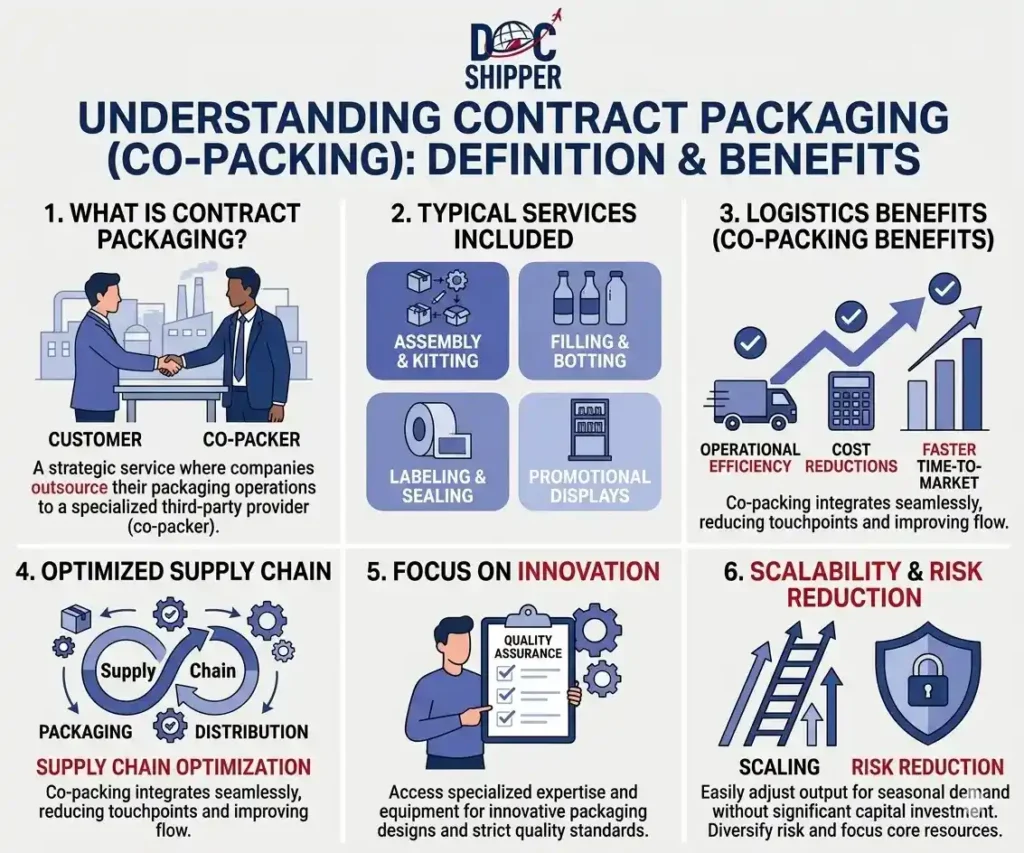
Contract packaging is a service where specialized third-party companies handle the packaging, labeling, and preparation of products for distribution on behalf of manufacturers or brands. This outsourcing solution enables businesses to optimize costs, access specialized equipment, and scale operations without investing in dedicated packaging infrastructure.
Introduction
Many businesses struggle with packaging bottlenecks that slow down product launches and increase operational costs. Managing in-house packaging requires substantial capital investment, specialized labor, and compliance expertise across multiple markets.
Contract packaging addresses these challenges by transferring packaging operations to experienced providers. This model is particularly valuable in international trade where packaging requirements vary significantly by destination market.
Key characteristics of contract packaging include:
- Flexibility: Scale production volumes up or down without fixed infrastructure costs
- Compliance expertise: Navigate complex labeling regulations across different countries
- Specialized equipment: Access to advanced packaging technologies and materials
- Speed to market: Reduce time between production and distribution
- Quality control: Professional inspection and testing protocols
In-Depth Analysis & Expertise
Contract packaging encompasses a wide range of services beyond simple box filling. Providers offer primary packaging (direct product contact), secondary packaging (retail-ready boxes), and tertiary packaging (palletization for transport).
The contractual framework typically includes detailed specifications covering materials, labeling requirements, quality standards, and delivery schedules. Service Level Agreements (SLAs) define performance metrics such as defect rates, turnaround times, and inventory management protocols.
Regulatory compliance represents a critical dimension. Contract packagers must adhere to standards like FDA regulations for food and pharmaceuticals, EU directives for consumer products, and customs labeling requirements for international shipments. According to the European Commission Customs Union, proper labeling can reduce clearance times by 40-60%.
Kitting and assembly services add value by combining multiple components into single retail units. This is particularly relevant for promotional bundles, subscription boxes, or multi-component products requiring assembly before sale.
The cost structure typically includes per-unit fees, setup charges for new SKUs, and material costs. Most contracts operate on a variable cost model, making it economically attractive for businesses with fluctuating demand or seasonal products.
At DocShipper, we coordinate contract packaging services with international shipping to ensure seamless transitions between production, packaging, and export. Our integrated approach eliminates coordination gaps that often cause delays in global supply chains.
Comparative Analysis by Industry
| Industry | Typical Services | Average Cost Savings | Primary Benefit |
|---|---|---|---|
| Cosmetics | Blister packing, labeling, shrink wrapping | 25-35% | Regulatory compliance across markets |
| Food & Beverage | Bottling, canning, portion control packaging | 30-40% | Food safety certifications (HACCP, BRC) |
| Pharmaceuticals | Blister packs, tamper-evident sealing, serialization | 20-30% | FDA/EMA compliance and traceability |
| E-commerce | Pick-and-pack, custom kitting, direct-to-consumer packaging | 35-45% | Scalability during peak seasons |
| Electronics | Anti-static packaging, foam inserts, retail clamshells | 15-25% | Product protection and presentation |
Use Case: International Product Launch
A European skincare brand launching in five Asian markets faced complex labeling requirements. Each country mandated different languages, ingredient disclosures, and warning statements.
Challenge: The brand lacked infrastructure to produce five packaging variants simultaneously while meeting tight launch deadlines.
Solution: A contract packager created country-specific packaging runs with compliant labels, reducing the brand’s capital investment by €180,000 and accelerating market entry by 8 weeks.
Results:
- 100% regulatory compliance across all markets
- 45% reduction in per-unit packaging costs versus in-house production
- Flexibility to adjust order volumes based on initial market response
- Consolidated shipping from a single location, reducing freight complexity
Key Performance Indicators
Industry data shows that businesses using contract packaging achieve:
- Operational efficiency: 30-50% reduction in packaging-related labor costs
- Inventory optimization: 20-35% decrease in packaging material waste
- Time savings: 6-12 weeks faster time-to-market for new products
- Quality improvement: Defect rates typically below 0.5% with professional packagers
- Scalability: Ability to handle 200-500% volume fluctuations without infrastructure changes
Conclusion
Contract packaging transforms a potential operational bottleneck into a strategic advantage, enabling businesses to focus on core competencies while ensuring professional, compliant packaging. This approach is particularly valuable for companies engaged in international trade where market-specific requirements demand specialized expertise.
Need assistance coordinating contract packaging with your international shipping operations? Contact DocShipper for integrated logistics solutions tailored to your business needs.
📚 Quizz
Test Your Knowledge: Contract Packaging
Q1 — What best defines contract packaging?
Q2 — A common misconception about contract packaging is that it only covers putting products into boxes. What does it actually include?
Q3 — A European skincare brand needs to launch simultaneously in five Asian markets, each requiring different languages and ingredient disclosures on packaging. What is the most strategic approach?
🎯 Your Result
📞 Free Quote in 24hFAQ | Contract Packaging: Definition, Process & Concrete Examples
Contract packaging works for nearly any product category including food, beverages, cosmetics, pharmaceuticals, electronics, and consumer goods. The key consideration is whether your volume justifies outsourcing versus in-house operations.
MOQs vary widely by provider and complexity. Simple operations may start at 5,000-10,000 units, while specialized pharmaceutical packaging might require 50,000+ units. Many packagers offer flexibility for new product launches.
Essential certifications include ISO 9001 (quality management), GMP (Good Manufacturing Practices) for food/pharma, and industry-specific standards like BRC, HACCP, or FDA registration depending on your product category.
Initial setup typically takes 4-8 weeks including specification development, material sourcing, equipment configuration, and trial runs. Rush projects can sometimes be accommodated in 2-3 weeks with premium fees.
Yes, experienced providers specialize in managing regulatory compliance across multiple markets. They maintain databases of country-specific requirements and can produce market-ready packaging for simultaneous international launches.
Contract packaging typically reduces costs by 20-40% when considering total expenses including labor, equipment depreciation, facility costs, and compliance management. Savings are highest for businesses with variable demand.
Professional packagers implement multi-stage quality control including incoming material inspection, in-process checks, and final product verification. Most maintain statistical process control systems and provide detailed quality reports.
Reputable packagers welcome facility tours and audits. This transparency allows you to verify cleanliness standards, equipment capabilities, security measures, and overall operational professionalism before committing.
Contracts should clearly define liability and recall procedures. Most packagers carry product liability insurance and maintain lot traceability systems enabling rapid identification and isolation of affected products.
Flexibility varies by provider. Established relationships typically allow for iterative design refinements and new SKU introductions with 2-4 week lead times. Some packagers offer rapid prototyping services for testing concepts.
Many contract packagers offer integrated services including short-term storage, inventory management, and order fulfillment. This consolidation can simplify logistics coordination and reduce handling transitions.
Prepare product specifications, target volumes, packaging materials preferences, labeling requirements, quality standards, delivery timelines, and any regulatory certifications needed. Detailed specifications yield more accurate pricing.
Need Help with
Logistics or Sourcing ?
First, we secure the right products from the right suppliers at the right price by managing the sourcing process from start to finish. Then, we simplify your shipping experience - from pickup to final delivery - ensuring any product, anywhere, is delivered at highly competitive prices.


Fill the Form
Prefer email? Send us your inquiry, and we’ll get back to you as soon as possible.
Contact us




