


In short ⚡
Contract warehousing is a long-term storage agreement between a shipper and a logistics provider, typically spanning 1 to 5 years. Unlike public warehousing, it offers dedicated space, customized services, and predictable costs, making it ideal for businesses with stable inventory volumes and specific operational requirements.Introduction
Many importers struggle with unpredictable storage costs and lack of control over their inventory. Public warehouses charge variable rates, while owning facilities requires massive capital investment. Contract warehousing bridges this gap, offering a middle ground that combines flexibility with long-term stability.
In international trade, reliable warehousing determines order fulfillment speed and customer satisfaction. Contract warehousing has become essential for companies managing consistent product flows across borders, particularly in e-commerce, manufacturing, and retail sectors.
- Fixed monthly costs based on contracted space and services
- Customized operations including specialized handling and packaging
- Dedicated resources such as equipment, staff, and technology systems
- Flexible contract terms ranging from 12 months to multi-year agreements
- Scalability options allowing seasonal volume adjustments within contract parameters
Strategic Advantages & Operational Framework
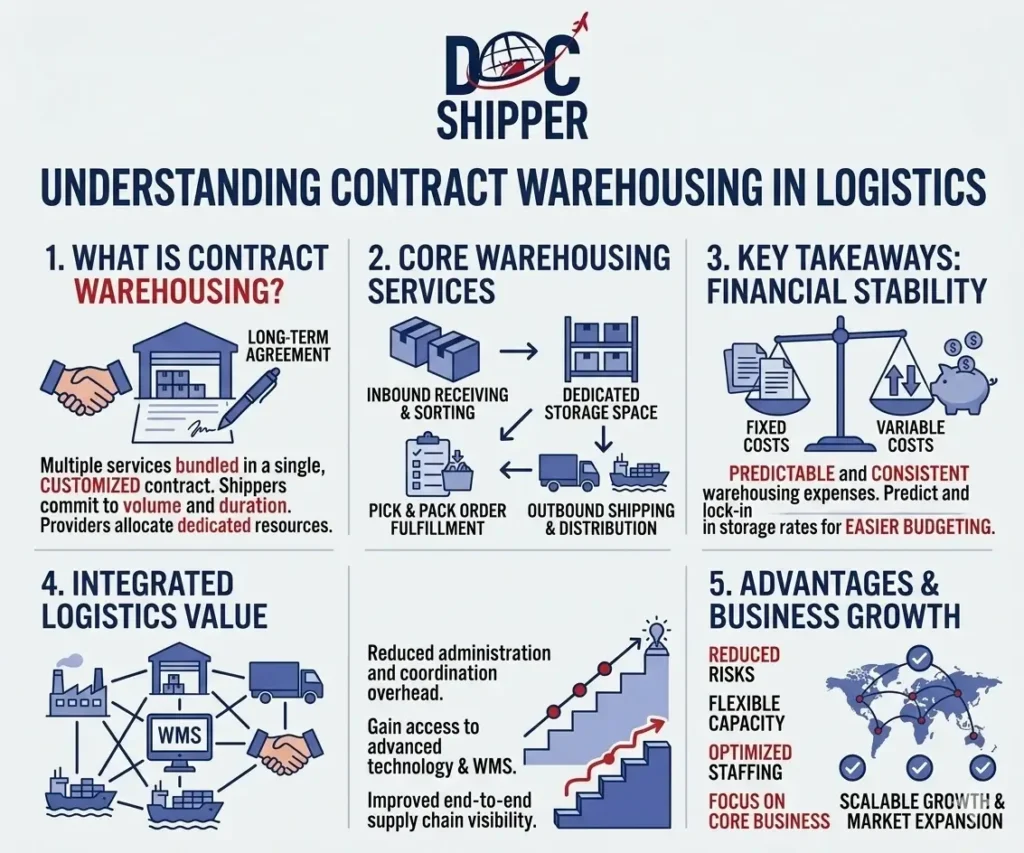
Contract warehousing operates on a dedicated allocation model. The provider reserves specific square footage exclusively for your inventory, unlike shared public warehouse space. This arrangement guarantees availability during peak seasons and allows for customized racking configurations tailored to your product dimensions.
The service level agreement (SLA) defines performance metrics such as order accuracy rates, shipping turnaround times, and inventory cycle count frequencies. Typical SLAs mandate 99.5% picking accuracy and same-day order processing for requests received before cutoff times. These contractual guarantees provide operational predictability that public warehousing cannot match.
From a cost structure perspective, contract warehousing typically includes base storage fees plus transaction-based charges for inbound receiving, order picking, packing, and outbound shipping. The base fee covers rent, utilities, insurance, and dedicated labor. Variable costs scale with activity levels but remain more predictable than spot-market public warehouse rates.
Technology integration represents a major differentiator. Contract warehouse providers often implement warehouse management systems (WMS) with real-time inventory visibility, automated replenishment alerts, and integration with your ERP or e-commerce platforms. According to the Council of Supply Chain Management Professionals, companies using integrated WMS in contract warehouses reduce order processing time by 30-40%.
Regulatory compliance becomes streamlined through contract warehousing. Providers handling FDA-regulated products, hazardous materials, or bonded goods maintain necessary certifications and documentation. At DocShipper, we verify that contract warehouse partners hold appropriate licenses for temperature-controlled storage, customs bonding, or specialized handling before recommending facilities to clients.
Cost Comparison & Real-World Applications
Understanding the financial implications requires comparing contract warehousing against alternatives. The following analysis demonstrates typical cost structures for a mid-sized importer storing 50,000 square feet of inventory:
| Warehousing Type | Monthly Base Cost | Variable Costs | Annual Total |
|---|---|---|---|
| Private Ownership | $35,000 | $8,000 | $516,000 |
| Contract Warehousing | $22,000 | $12,000 | $408,000 |
| Public Warehousing | $0 | $28,000 | $336,000 |
Case Study: Electronics Importer – A consumer electronics company importing from Asia faced seasonal demand spikes during Q4. They transitioned from public warehousing to a 3-year contract warehouse agreement. Results included 22% cost reduction during peak months, 40% faster order processing through dedicated pick zones, and elimination of inventory allocation delays that previously caused stockouts.
Pharmaceutical Distribution Scenario – A healthcare products distributor required FDA-compliant cold chain storage. Contract warehousing provided temperature-controlled zones (2-8°C) with continuous monitoring, validated storage protocols, and dedicated pharmaceutical-trained staff. The 5-year contract included quarterly compliance audits and guaranteed capacity during flu season surges.
E-commerce Fulfillment Model – An online retailer processing 5,000 daily orders implemented contract warehousing with integrated shipping carrier systems. The arrangement included pick-and-pack services, branded packaging, and direct carrier pickup. Average order fulfillment time decreased from 48 hours to 6 hours, improving customer satisfaction scores by 35%.
Automotive Parts Distribution – An aftermarket parts supplier utilized contract warehousing with cross-docking capabilities. Incoming containers were unloaded, sorted by SKU, and immediately loaded onto regional delivery trucks without long-term storage. This reduced handling costs by 18% and improved inventory turnover from 8x to 12x annually.
Seasonal Product Management – A sporting goods company negotiated flexible space allocation allowing 30% expansion during summer months (April-August) and contraction during winter. The contract included tiered pricing: base rate for 40,000 sq ft year-round, plus discounted overflow rates for seasonal increases, optimizing costs across demand cycles.
Conclusion
Contract warehousing delivers operational control and cost predictability essential for growing international trade operations. It eliminates the capital burden of facility ownership while providing service consistency that public warehousing cannot guarantee.
Need expert guidance on contract warehousing solutions for your import operations? Contact DocShipper for customized warehousing strategies tailored to your supply chain requirements.
📚 Quiz
Test Your Knowledge: Contract Warehousing
Q1 — What best defines contract warehousing?
Q2 — A common misconception about contract warehousing is that it offers no flexibility. What does the article say about volume adjustments?
Q3 — A pharmaceutical distributor needs FDA-compliant cold chain storage with continuous temperature monitoring and dedicated trained staff. Which warehousing model is most appropriate?
🎯 Your Result
📞 Free Quote in 24hFAQ | Contract Warehousing: Definition, Benefits & Practical Examples
Most providers require 12-month minimum commitments, though some offer 6-month trial periods. Multi-year contracts (3-5 years) typically secure better pricing and service guarantees.
Contract warehousing focuses specifically on storage with fixed-term agreements, while 3PL encompasses broader services including transportation, freight forwarding, and supply chain management, often with more flexible arrangements.
Early termination clauses vary by provider. Standard contracts include 90-180 day notice requirements and may impose penalties equal to 3-6 months of base fees, though negotiable terms exist.
Most agreements include overflow provisions charging premium rates (typically 15-25% above base rates) for temporary excess storage, or allow contract amendments with adjusted pricing tiers.
Basic facility insurance covers building and provider liability, but cargo insurance for your inventory typically requires separate coverage. Some providers offer bundled cargo insurance at competitive group rates.
Implementation timelines range from 2-6 weeks depending on complexity. Simple storage requires minimal setup, while customized operations involving specialized equipment or system integrations need 4-6 weeks.
Standard packages include web-based WMS portals with real-time inventory visibility, reporting dashboards, and order management. Advanced tiers offer API integrations, automated reorder triggers, and predictive analytics.
Many contract warehouse providers operate bonded facilities allowing duty deferral until goods enter commerce. Verify the provider holds appropriate customs bonds and Foreign Trade Zone authorizations if required.
Essential KPIs include order accuracy rates (target: 99.5%), shipping turnaround times, inventory accuracy (target: 99%), damage rates (target: <0.5%), and system uptime guarantees (target: 99.9%).
Tiered pricing structures offer volume discounts: 0-25,000 sq ft at base rate, 25,001-50,000 sq ft at 8-12% discount, and >50,000 sq ft at 15-20% discount, encouraging consolidation.
Contract warehousing availability depends on market demand. Major logistics hubs (ports, rail terminals, population centers) offer extensive options, while rural areas may have limited providers or higher costs.
Value-added services include kitting/assembly, labeling, quality inspections, returns processing, cross-docking, and e-commerce fulfillment. Specialized handling covers hazmat storage, temperature control, and high-security vaults.
Need Help with
Logistics or Sourcing ?
First, we secure the right products from the right suppliers at the right price by managing the sourcing process from start to finish. Then, we simplify your shipping experience - from pickup to final delivery - ensuring any product, anywhere, is delivered at highly competitive prices.


Fill the Form
Prefer email? Send us your inquiry, and we’ll get back to you as soon as possible.
Contact us




