


In short ⚡
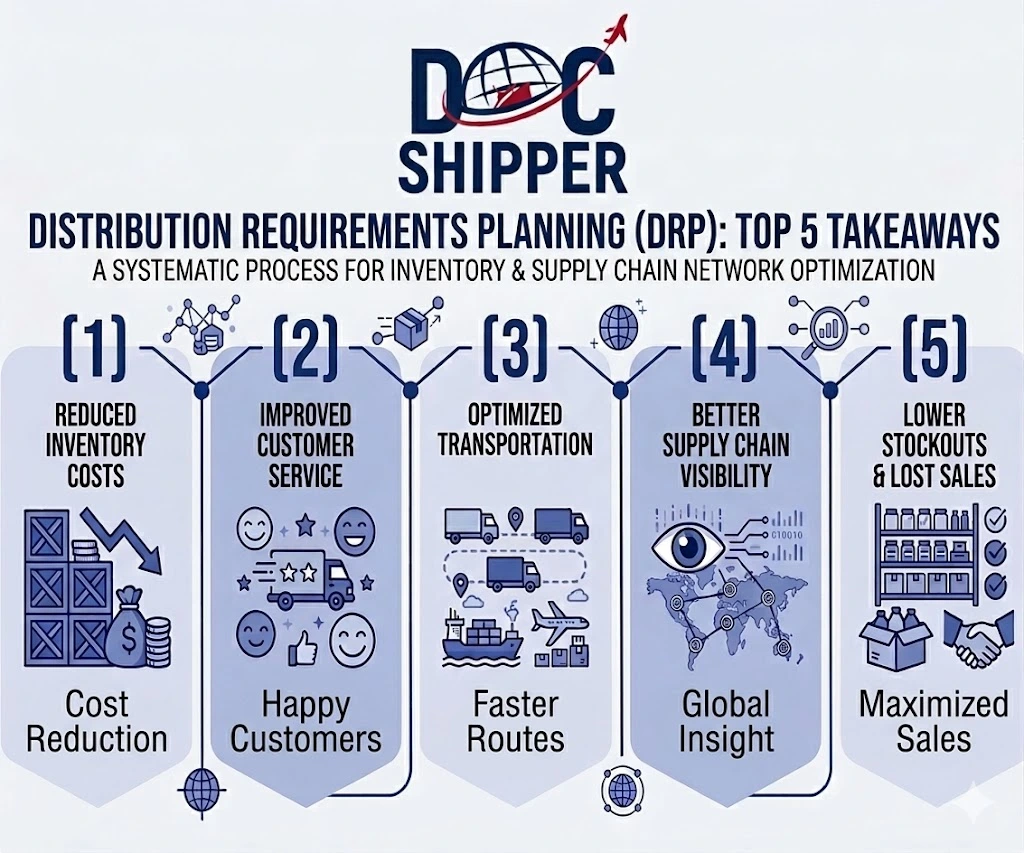
Distribution Requirements Planning (DRP) is a systematic inventory management method that determines product quantities and timing for distribution across multiple locations. It uses time-phased planning to coordinate supply chain movements from warehouses to end customers, ensuring optimal stock levels while minimizing costs and preventing stockouts.Introduction
Many importers struggle with a critical challenge: products arrive at the port, but distribution to regional warehouses becomes chaotic. Overstocking in one location while experiencing shortages in another creates unnecessary costs and lost sales opportunities.
Distribution Requirements Planning (DRP) addresses this problem by creating a coordinated roadmap for inventory movement. In international logistics, where lead times span weeks and transportation costs are substantial, DRP becomes essential for maintaining competitive advantage.
Key characteristics of effective DRP systems include:
- Time-phased planning: Schedules inventory movements based on forecasted demand at each location
- Multi-echelon coordination: Links central warehouses with regional distribution centers and retail points
- Demand-driven replenishment: Triggers orders based on actual consumption patterns rather than arbitrary schedules
- Safety stock optimization: Calculates buffer inventory levels accounting for demand variability and lead time uncertainty
- Transportation consolidation: Groups shipments to maximize container utilization and reduce freight costs
DRP Mechanisms & Strategic Expertise
DRP operates through a cascading planning logic that starts at the customer-facing locations and works backward through the distribution network. Each distribution point generates requirements that become demand signals for upstream facilities.
The gross requirements represent forecasted demand plus any planned shipments to downstream locations. These are offset by scheduled receipts (inbound shipments already in transit) and projected available balance (current inventory). When projected inventory falls below the safety stock threshold, the system generates a planned order.
A critical DRP component is the distribution bill of materials (DBOM), which maps the network structure. Unlike manufacturing BOMs that show component relationships, DBOMs illustrate the hierarchical flow from central warehouses through regional hubs to final delivery points. This structure enables the system to aggregate requirements and coordinate replenishment timing.
The time bucket granularity significantly impacts DRP effectiveness. Weekly buckets suit most distribution environments, balancing planning precision with computational efficiency. Daily buckets may be necessary for high-velocity products or perishable goods, while monthly buckets suffice for slow-moving items with stable demand.
Lead time management requires careful consideration of transportation modes and customs clearance. For international shipments, DocShipper systematically incorporates transit time, port processing, and inland delivery when calculating planned order release dates, ensuring materials arrive when needed without excessive safety stock.
According to the U.S. Department of Commerce logistics guidelines, companies implementing DRP typically achieve 15-25% inventory reduction while improving service levels by 10-20%. The system’s power lies in its ability to position inventory strategically rather than reactively.
Practical Examples & Quantified Data
Consider a European electronics importer distributing products from a Rotterdam central warehouse to five regional distribution centers (DCs) across Germany, France, Spain, Italy, and Poland. Each DC serves local retailers with varying demand patterns.
Use Case: Multi-Country Distribution Scenario
Product: Consumer electronics component (Model XR-450)
Central warehouse: Rotterdam (Netherlands)
Planning horizon: 12 weeks
Order quantity: Economic Order Quantity (EOQ) = 5,000 units
Safety stock: 2 weeks of average demand per location
| Distribution Center | Weekly Demand | Lead Time (weeks) | Safety Stock | Reorder Point |
|---|---|---|---|---|
| Germany DC | 800 units | 1 week | 1,600 units | 2,400 units |
| France DC | 650 units | 1 week | 1,300 units | 1,950 units |
| Spain DC | 500 units | 2 weeks | 1,000 units | 2,000 units |
| Italy DC | 450 units | 2 weeks | 900 units | 1,800 units |
| Poland DC | 350 units | 2 weeks | 700 units | 1,400 units |
| Total Network | 2,750 units/week | — | 5,500 units | — |
The DRP system aggregates weekly requirements from all five DCs, generating a consolidated demand signal for the Rotterdam central warehouse. When combined requirements indicate inventory will fall below safety levels, the system triggers a replenishment order from the Asian supplier.
Comparative Analysis: DRP vs. Traditional Reordering
| Metric | Traditional Method | DRP Implementation | Improvement |
|---|---|---|---|
| Average Inventory | 18,500 units | 14,200 units | -23.2% |
| Stockout Incidents (quarterly) | 12 occurrences | 3 occurrences | -75% |
| Transportation Costs | €47,000/month | €39,500/month | -16% |
| Order Fulfillment Rate | 91.5% | 97.8% | +6.3 points |
| Inventory Carrying Cost | €222,000/year | €170,400/year | -23.2% |
These results demonstrate DRP’s capacity to synchronize inventory flows across complex distribution networks. At DocShipper, we integrate DRP principles when designing distribution strategies for clients managing multi-country operations, ensuring inventory positioning aligns with actual demand patterns.
Key implementation factors include:
- Forecast accuracy: DRP effectiveness correlates directly with demand prediction quality; 85%+ accuracy recommended
- System integration: Real-time data exchange between warehouse management and DRP modules prevents planning errors
- Lead time reliability: Consistent supplier and carrier performance reduces safety stock requirements
- Exception management: Automated alerts for demand spikes or supply disruptions enable rapid response
- Performance monitoring: Regular tracking of inventory turns, fill rates, and carrying costs validates DRP benefits
Conclusion
Distribution Requirements Planning transforms inventory management from reactive firefighting into proactive coordination. By synchronizing supply with demand across multiple locations, companies reduce costs while improving customer service.
Need expert guidance on implementing DRP for your international distribution network? Contact DocShipper for customized logistics solutions.
📚 Quiz
Test Your Knowledge: Distribution Requirements Planning (DRP)
Q1 — What is the primary purpose of Distribution Requirements Planning (DRP)?
Q2 — A common misconception about DRP is that it works best by pushing inventory from central warehouses outward. What does DRP actually do?
Q3 — A European importer distributes electronics from Rotterdam to five regional DCs. The Spain DC has a 2-week lead time and weekly demand of 500 units. Under DRP logic, what is its correct reorder point?
🎯 Your Result
📞 Free Quote in 24hFAQ | Distribution Requirements Planning (DRP): Definition, Calculation & Concrete Examples
Material Requirements Planning (MRP) focuses on manufacturing component needs, while DRP manages finished goods distribution across locations. MRP drives production scheduling; DRP coordinates inventory positioning throughout the supply chain network.
DRP systems incorporate seasonal forecasting patterns, adjusting safety stock levels and order timing based on historical demand cycles. The system increases inventory in anticipation of peak periods and reduces stock during slower seasons.
Yes. Even businesses with 2-3 warehouses benefit from DRP's coordinated planning. The principles scale effectively, and modern cloud-based systems offer affordable DRP functionality without requiring enterprise-level investments.
Essential inputs include demand forecasts by location, current inventory levels, scheduled receipts, lead times, safety stock policies, order quantities, and the distribution network structure (which locations supply which others).
Most organizations run DRP weekly, aligning with transportation schedules and ordering cycles. High-velocity environments may require daily updates, while stable, slow-moving products can use bi-weekly or monthly planning cycles.
Safety stock buffers against demand variability and supply uncertainty. DRP calculates optimal safety levels for each location based on demand volatility, lead time reliability, and desired service levels, typically covering 1-4 weeks of demand.
By coordinating order timing across locations, DRP enables shipment consolidation. Instead of sending partial loads to individual sites, the system groups requirements to fill containers or trucks, reducing per-unit transportation costs by 15-30%.
Modern DRP systems integrate with e-commerce platforms through APIs, pulling real-time sales data to update demand forecasts and inventory positions. This integration enables omnichannel distribution strategies with unified inventory visibility.
Key challenges include inaccurate demand forecasts, poor data quality, inadequate system integration, resistance to process changes, and insufficient training. Successful implementations address these through phased rollouts, data cleansing initiatives, and comprehensive user education.
DRP systems incorporate product lifecycle management, prioritizing older inventory for shipment (FIFO logic) and generating alerts when stock approaches expiration. The system can also plan phase-out strategies for discontinued products.
Key performance indicators include inventory turnover ratio, fill rate percentage, stockout frequency, inventory carrying costs, transportation cost per unit, forecast accuracy, and order cycle time. Tracking these metrics validates DRP benefits.
DRP accounts for extended international lead times, customs clearance durations, and multi-modal transportation. The system coordinates container shipments from origin countries with regional distribution, optimizing inventory flow across borders while minimizing duties and storage costs.
Need Help with
Logistics or Sourcing ?
First, we secure the right products from the right suppliers at the right price by managing the sourcing process from start to finish. Then, we simplify your shipping experience - from pickup to final delivery - ensuring any product, anywhere, is delivered at highly competitive prices.


Fill the Form
Prefer email? Send us your inquiry, and we’ll get back to you as soon as possible.
Contact us

:%20Definition,%20Calculation%20&%20Concrete%20Examples)