


In short ⚡
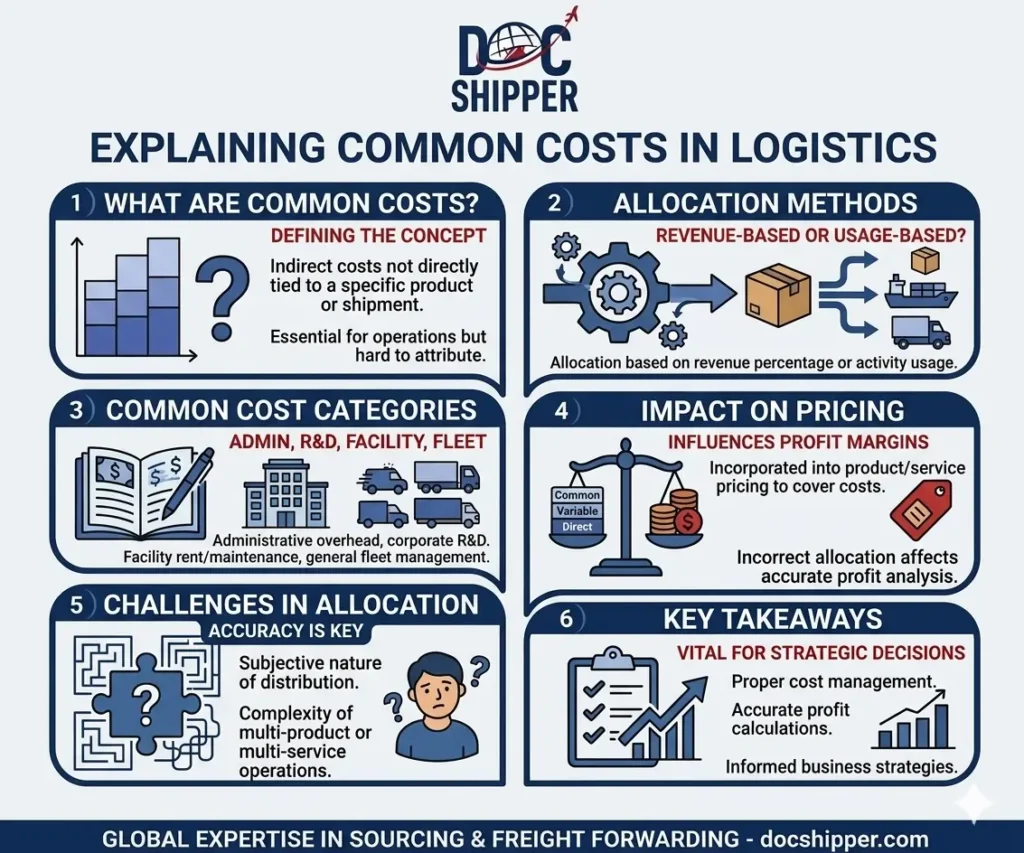
Common cost refers to expenses shared across multiple products, services, or departments that cannot be directly attributed to a single cost object. These indirect costs—such as facility rent, utilities, or administrative salaries—require allocation methods to distribute expenses fairly across business units for accurate financial reporting and pricing decisions.Introduction
Many businesses struggle to determine the true profitability of individual products or services. The culprit? Common costs that benefit multiple operations simultaneously but resist simple division.
In international logistics and supply chain management, understanding common costs becomes critical for accurate pricing, compliance reporting, and strategic decision-making. Misallocating these expenses can distort profit margins by 15-30% according to cost accounting studies.
Key characteristics of common costs include:
- Indivisibility: Cannot be traced to a single product or service without arbitrary assignment
- Joint consumption: Multiple cost objects benefit simultaneously from the same resource
- Allocation dependency: Require systematic distribution methods for financial accuracy
- Fixed nature: Often remain constant regardless of production volume changes
- Strategic impact: Influence pricing strategies, outsourcing decisions, and profitability analysis
Understanding Common Costs & Allocation Methods
Common costs arise whenever shared resources support multiple operations. In logistics, a warehouse serving various product lines exemplifies this challenge—rent, security systems, and management salaries benefit all inventory categories.
The fundamental distinction separates common costs from direct costs (traceable to specific outputs) and joint costs (arising from a single production process yielding multiple products). Common costs specifically involve shared facilities or services used across distinct operations.
Five primary allocation methods address this challenge:
Direct labor hours: Distributes costs proportionally to workforce time consumed by each department. A product requiring 40% of total labor hours absorbs 40% of common administrative expenses.
Revenue-based allocation: Assigns costs according to sales generated. If Product A generates 60% of revenue, it carries 60% of shared marketing costs. The European Commission’s transfer pricing guidelines recognize this method for certain intercompany transactions.
Square footage: Allocates facility costs based on physical space occupied. A department using 25% of warehouse space receives 25% of rent and utilities charges.
Activity-Based Costing (ABC): Links costs to specific activities driving resource consumption. This sophisticated approach identifies cost drivers—order processing, quality inspections, shipment handling—providing granular expense attribution.
Stand-alone cost method: Calculates what each unit would pay independently, then proportionally reduces totals to actual shared cost levels. This prevents cross-subsidization between departments.
At DocShipper, we systematically analyze common cost structures when developing customs valuation strategies, ensuring clients correctly classify expenses for duty calculation purposes and avoid compliance issues during audits.
Regulatory frameworks like OECD Transfer Pricing Guidelines mandate arm’s-length allocation of common costs in multinational operations, making proper methodology selection legally critical beyond internal accounting.
Practical Examples & Data-Driven Scenarios
Consider a logistics provider operating a consolidation center handling electronics, textiles, and perishables. Annual facility costs total $480,000, broken down as follows:
| Expense Category | Annual Amount | Allocation Basis |
|---|---|---|
| Warehouse Rent | $240,000 | Square Footage |
| Utilities & Maintenance | $96,000 | Square Footage |
| Management Salaries | $120,000 | Revenue Generated |
| Security Systems | $24,000 | Equal Distribution |
Allocation calculation scenario:
Electronics occupy 2,500 sq ft (50%), textiles 1,500 sq ft (30%), perishables 1,000 sq ft (20%). Revenue breakdown: Electronics $600,000 (50%), Textiles $420,000 (35%), Perishables $180,000 (15%).
Electronics department allocation:
- Rent: $240,000 × 50% = $120,000
- Utilities: $96,000 × 50% = $48,000
- Management: $120,000 × 50% = $60,000
- Security: $24,000 ÷ 3 = $8,000
- Total common costs: $236,000
This translates to $0.39 per revenue dollar ($236,000 ÷ $600,000), directly impacting pricing competitiveness. A 10% misallocation would shift $23,600 between departments, potentially making unprofitable lines appear viable.
International trade scenario: A freight forwarder handles air and ocean shipments. Customs brokerage software ($50,000 annually) serves both modes. Allocating by shipment volume (Air: 3,000 shipments, Ocean: 2,000 shipments) assigns Air $30,000 and Ocean $20,000. This affects per-shipment pricing and service profitability analysis.
Industry data shows companies using ABC methods achieve 12-18% better cost accuracy compared to traditional allocation, according to the Institute of Management Accountants. This precision becomes critical when margins compress below 5% in competitive logistics markets.
Conclusion
Common costs represent unavoidable complexity in multi-product operations, but systematic allocation transforms them from accounting obstacles into strategic insights. Choosing appropriate distribution methods directly impacts pricing accuracy, profitability assessment, and regulatory compliance in international trade.
Need expert guidance on cost allocation for customs valuation or transfer pricing compliance? Contact DocShipper for specialized logistics consulting.
📚 Quiz
Test Your Knowledge: Common Cost
Q1 — Which of the following best defines a "common cost"?
Q2 — A company outsources its warehouse operations. What happens to the common costs previously associated with that facility?
Q3 — A logistics provider allocates $240,000 in annual warehouse rent across three product lines using square footage. Electronics occupy 50% of the space. How much rent is allocated to Electronics?
🎯 Your Result
📞 Free Quote in 24hFAQ | Common Cost: Definition, Allocation & Practical Examples
Common costs arise from shared facilities serving separate operations, while joint costs result from a single production process yielding multiple products simultaneously. Common costs involve allocation choices; joint costs require split-off point analysis.
Outsourcing transforms common costs into direct variable expenses but doesn't eliminate them—they transfer to the service provider's pricing. Total cost may increase due to vendor margins and coordination overhead.
Customs authorities require transaction value to include proportionate common costs like R&D, tooling, or royalties when determining dutiable value. Incorrect allocation can trigger valuation adjustments and penalties during audits.
Activity-Based Costing delivers superior accuracy by linking costs to consumption drivers, though it requires detailed data collection. Simpler methods suffice when cost distortion risk remains low relative to implementation effort.
Most common costs exhibit fixed behavior—warehouse rent remains constant regardless of throughput. However, allocated amounts per unit decrease as volume increases, creating economies of scale effects.
Annual reviews align with budget cycles, but significant operational changes—new product lines, facility expansions, automation—warrant immediate reassessment to maintain allocation relevance and fairness.
Multinational enterprises must allocate common costs like headquarters expenses across subsidiaries using arm's-length principles. Tax authorities scrutinize these allocations to prevent profit shifting and ensure proper tax base allocation.
Advanced tracking systems transform some common costs into traceable expenses. IoT sensors measuring energy consumption per production line convert utilities from common to direct costs, improving cost object accuracy.
Decisions must consider whether common costs truly disappear with outsourcing. Facility overhead persists unless entire operations cease, making incremental cost analysis more relevant than full absorption costing.
Maintain allocation methodology documentation, calculation worksheets, and basis justification (square footage measurements, labor hour logs, revenue reports). Consistent application across periods demonstrates good-faith compliance.
Allocated common costs establish minimum pricing floors for long-term sustainability. However, short-term decisions may price below full absorption if incremental revenue exceeds variable costs and doesn't set precedent.
Fixed common costs contribute to total break-even point but don't affect contribution margin per unit. Segment-level break-even requires careful treatment of avoidable versus unavoidable common costs.
Need Help with
Logistics or Sourcing ?
First, we secure the right products from the right suppliers at the right price by managing the sourcing process from start to finish. Then, we simplify your shipping experience - from pickup to final delivery - ensuring any product, anywhere, is delivered at highly competitive prices.


Fill the Form
Prefer email? Send us your inquiry, and we’ll get back to you as soon as possible.
Contact us

Lorem ipsum dolor sit amet, consectetur adipiscing elit. Ut elit tellus, luctus nec ullamcorper mattis, pulvinar dapibus leo.



