


In short ⚡
Global Positioning System (GPS) is a satellite-based navigation system operated by the U.S. Department of Defense that provides real-time positioning, navigation, and timing data to users worldwide. Comprising 24+ satellites orbiting Earth, GPS enables precise location tracking with accuracy ranging from 5 to 10 meters for civilian use, revolutionizing logistics, transportation, and international trade operations.Introduction: Why GPS Matters in International Logistics
Imagine shipping a container from Shanghai to Rotterdam without knowing its exact location for 30 days. This was standard practice before GPS revolutionized supply chain visibility.
Modern international logistics depends entirely on real-time tracking capabilities. GPS technology eliminates the traditional “black box” problem in freight transportation, where goods disappeared from monitoring between departure and arrival points.
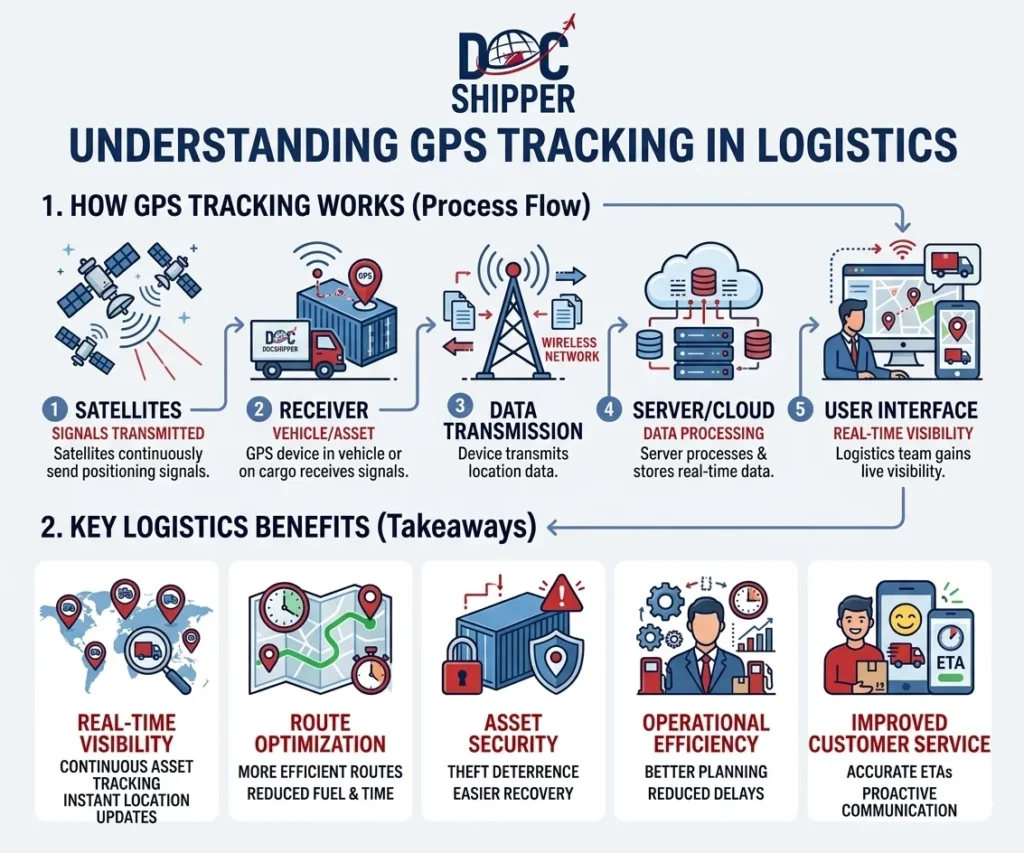
The system delivers critical advantages for import/export operations:
- Real-time shipment tracking across ocean, air, and land routes
- Automated ETA calculations enabling better inventory planning
- Route optimization reducing fuel costs by 10-15%
- Theft prevention through geofencing and alert systems
- Customs compliance with precise movement documentation
For freight forwarders and shippers, GPS has transformed from luxury technology to operational necessity.
GPS Technology & Logistics Integration
The Global Positioning System operates through trilateration, where receivers calculate position by measuring distance from multiple satellites simultaneously. A minimum of four satellites is required for three-dimensional positioning with time synchronization.
In logistics applications, GPS integrates with complementary systems to create comprehensive tracking solutions. Telematics platforms combine GPS coordinates with vehicle diagnostics, driver behavior data, and communication networks. This convergence enables predictive maintenance and performance optimization.
Differential GPS (DGPS) enhances accuracy to 1-3 meters by correcting atmospheric interference using ground-based reference stations. Port operations and intermodal terminals employ DGPS for precise container positioning and automated stacking systems.
The technology faces limitations in signal obstruction environments. Urban canyons, dense forests, and indoor warehouses create GPS “dead zones” where satellite signals cannot penetrate. Hybrid systems combining GPS with cellular triangulation, Wi-Fi positioning, and inertial sensors compensate for these gaps.
Legal frameworks govern GPS data usage across jurisdictions. The European Union’s GDPR classifies location tracking as personal data requiring explicit consent. Cross-border shipments must comply with multiple data sovereignty regulations simultaneously.
At DocShipper, we integrate GPS tracking into all multimodal shipments, providing clients with 24/7 visibility through our proprietary dashboard. This systematic monitoring prevents cargo delays and enables proactive issue resolution.
Concrete Applications & Performance Data
GPS technology delivers measurable improvements across logistics operations. Comparative analysis reveals significant performance advantages for GPS-enabled supply chains.
| Metric | Without GPS | With GPS | Improvement |
|---|---|---|---|
| ETA Accuracy | ±3 days | ±4 hours | 94% reduction |
| Cargo Theft Rate | 2.1% | 0.3% | 86% reduction |
| Fuel Efficiency | Baseline | +12% savings | $1,800/truck/year |
| Customer Inquiries | 47/shipment | 8/shipment | 83% reduction |
| Insurance Premiums | Standard rate | -15% discount | $2,300/year savings |
Case Study: Trans-Pacific Container Shipment
A European electronics importer shipping from Shenzhen to Hamburg faced recurring issues with delayed customs clearance. By implementing GPS tracking with automated milestone notifications, the company achieved:
- Advance notice of vessel arrival 72 hours before docking
- Pre-clearance documentation submission reducing port dwell time by 40%
- Real-time deviation alerts when the vessel rerouted due to weather
- Complete audit trail for regulatory compliance
- Annual logistics cost reduction of €87,000
Pharmaceutical Cold Chain Monitoring
Temperature-sensitive pharmaceuticals require unbroken monitoring throughout transit. GPS-enabled IoT sensors combine location tracking with environmental data. When a refrigerated container in Southeast Asia experienced temperature excursion, GPS coordinates enabled immediate intervention before cargo spoilage.
Just-In-Time Manufacturing
Automotive manufacturers using GPS for inbound parts logistics reduced safety stock levels by 35%. Precise arrival predictions eliminated buffer inventory while maintaining production continuity. One German automaker calculated savings of €4.2 million annually across their European supply network.
Conclusion
GPS technology has evolved from military navigation tool to indispensable logistics infrastructure, delivering quantifiable improvements in visibility, security, and operational efficiency. Modern supply chains cannot function competitively without real-time positioning capabilities.
Need expert guidance implementing GPS tracking for your international shipments? Contact DocShipper for comprehensive logistics solutions with integrated tracking technology.
📚 Quiz
Test Your Knowledge: Global Positioning System (GPS)
What is the primary function of the Global Positioning System (GPS) in international logistics?
A logistics manager claims GPS tracking works perfectly inside sealed metal shipping containers without external equipment. Is this statement correct?
You're shipping temperature-sensitive pharmaceuticals from Singapore to Frankfurt. Which GPS application would provide the most comprehensive monitoring solution?
🎯 Your Result
📞 Free Quote in 24hFAQ | Global Positioning System (GPS): Definition, Technology & Concrete Applications
Standard GPS provides accuracy of 5-10 meters for civilian applications, sufficient for container tracking at terminals and in transit. Enhanced systems using Differential GPS (DGPS) achieve 1-3 meter precision, critical for automated port operations. Accuracy depends on satellite visibility, atmospheric conditions, and receiver quality. Marine environments typically offer unobstructed signals, while urban areas may experience multipath interference reducing precision.
GPS is the U.S. system with 31 operational satellites, while GLONASS is Russia's equivalent with 24 satellites. Modern logistics trackers use multi-GNSS receivers supporting both systems plus Galileo (EU) and BeiDou (China). Combined constellation usage improves reliability and accuracy, particularly in high-latitude regions where GLONASS provides superior coverage. Dual-system devices reduce positioning time from 30 seconds to under 10 seconds.
Metal containers create Faraday cage effects blocking GPS signals. External antennas mounted on container exteriors solve this limitation. Alternative solutions include battery-powered trackers with scheduled reporting when containers open, or hybrid systems using cellular triangulation for approximate positioning. For high-value cargo, real-time internal monitoring requires specialized antenna configurations penetrating container walls.
Battery endurance varies by reporting frequency and technology. Standard trackers reporting hourly positions last 45-60 days. Extended-life devices using low-power modes achieve 3-5 years with daily updates. Solar-rechargeable units provide indefinite operation in exposed environments. Critical shipments use rechargeable trackers with 90-day minimum runtime. Battery performance decreases in extreme temperatures, requiring thermal management for refrigerated or heated cargo.
Customs agencies employ GPS for transit verification, ensuring sealed containers follow approved routes without unauthorized stops. Electronic seals with GPS transmit location histories proving secure transport. The World Customs Organization's SAFE Framework recommends GPS tracking for Authorized Economic Operator (AEO) certification. Non-compliance with prescribed routes triggers inspections, while compliant shipments receive expedited clearance through trusted trader programs.
Geofencing creates virtual boundaries triggering automated alerts when shipments enter or exit defined zones. Common applications include arrival notifications at destination ports, unauthorized deviation warnings, and dwell time monitoring at intermediate stops. Advanced systems combine geofences with time windows, flagging delays exceeding scheduled milestones. This proactive monitoring enables intervention before minor delays cascade into supply chain disruptions.
Hardware costs range from €30 for basic one-time trackers to €300 for reusable multi-sensor units. Subscription services charge €5-15 monthly per device for data transmission and platform access. Total cost represents 0.1-0.5% of shipment value for most freight. ROI calculations show break-even within 3-6 months through reduced insurance premiums, lower theft losses, and decreased customer service expenses.
GPS spoofing transmits false signals overpowering authentic satellite data, potentially misdirecting receivers. Maritime incidents have demonstrated vulnerability to deliberate interference. Countermeasures include signal authentication, multi-GNSS validation comparing GPS against GLONASS/Galileo, and inertial navigation cross-verification. High-security shipments employ encrypted transmission protocols preventing data interception. Commercial logistics face minimal spoofing risk compared to military applications.
The GPS constellation maintains redundancy with 31 satellites when only 24 are required for global coverage. Scheduled maintenance affects one satellite at a time without degrading service. Users experience transparent failover to alternative satellites. The U.S. Air Force publishes NANU (Notice Advisory to Navstar Users) warnings for planned outages. Multi-GNSS receivers automatically switch to GLONASS, Galileo, or BeiDou satellites maintaining continuous positioning.
Modern TMS platforms consume GPS data via APIs, automatically updating shipment status and recalculating ETAs. Integration enables exception-based management, where only delayed or deviated shipments require human intervention. Real-time coordinates feed predictive analytics identifying pattern disruptions before they impact delivery schedules. Leading systems combine GPS with traffic data, weather forecasts, and historical performance generating dynamic routing recommendations.
Driver privacy regulations restrict continuous monitoring in some jurisdictions. European labor laws prohibit GPS surveillance during breaks and off-duty hours. Compliant systems disable tracking outside working shifts or anonymize data excluding driver identification. GDPR requires explicit consent for location data collection with transparent usage policies. Commercial cargo tracking faces fewer restrictions as goods lack privacy rights, though business intelligence derived from shipment patterns requires confidentiality protection.
Indoor Positioning Systems (IPS) using Bluetooth beacons, UWB (Ultra-Wideband), or Wi-Fi triangulation provide warehouse-level tracking where GPS fails. RFID enables automated scanning at checkpoints without line-of-sight requirements. Cellular-based location services offer approximate positioning (50-1000m accuracy) when satellite signals are unavailable. Combined GNSS receivers supporting GPS, GLONASS, Galileo, BeiDou, and QZSS deliver redundancy ensuring positioning continuity regardless of single-system outages.
Need Help with
Logistics or Sourcing ?
First, we secure the right products from the right suppliers at the right price by managing the sourcing process from start to finish. Then, we simplify your shipping experience - from pickup to final delivery - ensuring any product, anywhere, is delivered at highly competitive prices.


Fill the Form
Prefer email? Send us your inquiry, and we’ll get back to you as soon as possible.
Contact us




:%20Definition,%20Technology%20&%20Concrete%20Applications)