


In short ⚡
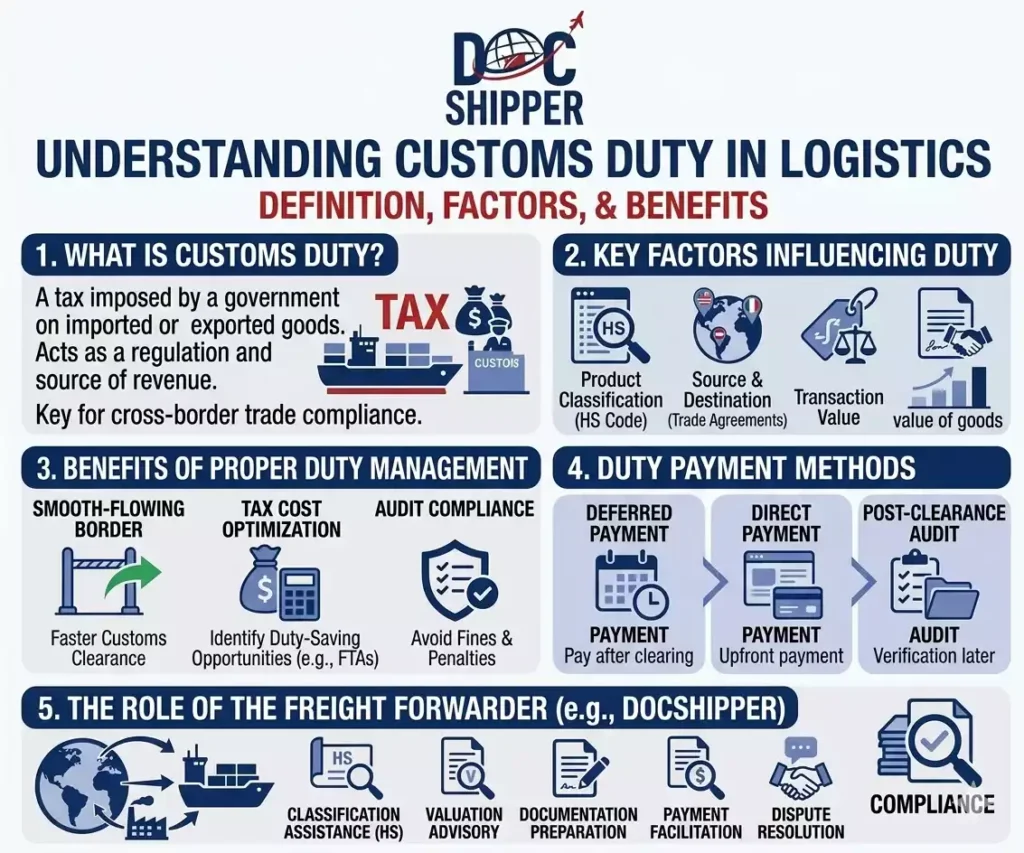
Duty is a mandatory tax levied by customs authorities on imported or exported goods crossing international borders. This tariff serves to regulate trade, protect domestic industries, and generate government revenue. Calculated as a percentage of the customs value or as a fixed amount per unit, duty directly impacts the final cost of international shipments.
Introduction
Why does a shipment from China cost $1,000 but your invoice shows $1,450? The answer lies in customs duty—an often-misunderstood element that catches importers off guard. This tariff represents a critical component of international trade compliance, directly affecting pricing strategies, profit margins, and supply chain planning.
In global commerce, duty serves multiple purposes beyond revenue generation. It functions as a trade policy instrument that governments use to balance imports, support local manufacturers, and comply with international agreements. Understanding how duty works is essential for anyone involved in cross-border transactions, from e-commerce sellers to multinational corporations.
Key characteristics of customs duty include:
- Ad valorem rates: Calculated as a percentage of the goods’ declared value
- Specific duties: Fixed amounts charged per unit, weight, or volume
- Compound duties: Combination of ad valorem and specific rates
- Variable application: Rates differ by product classification (HS Code), origin country, and trade agreements
- Legal obligation: Non-payment results in shipment detention, penalties, or seizure
Understanding Duty Mechanisms & Legal Framework
Duty calculation begins with customs valuation, typically based on the transaction value—the price actually paid or payable for goods when sold for export. This includes the cost of goods, insurance, and freight (CIF value in most jurisdictions). Customs authorities follow the WCO Valuation Agreement principles to ensure consistency across borders.
The Harmonized System (HS) Code determines the applicable duty rate. This internationally standardized nomenclature classifies products into over 5,000 categories, each with specific tariff treatment. A single digit error in classification can result in paying 0% instead of 25% duty—or vice versa. Classification disputes represent a major source of customs audits and penalties.
Preferential trade agreements significantly impact duty obligations. Free trade agreements (FTAs) like USMCA, CPTPP, or EU trade deals can reduce or eliminate duties entirely. However, benefiting from these preferences requires strict compliance with rules of origin, documented through certificates of origin or supplier declarations.
Anti-dumping and countervailing duties represent additional charges imposed when imports are sold below fair market value or benefit from foreign subsidies. These protective measures can add 25% to 200% on top of normal duty rates, dramatically altering import economics. Industries like steel, solar panels, and textiles frequently face these special duties.
At DocShipper, we systematically verify HS code classification and applicable duty rates during shipment planning to prevent costly surprises. Our customs brokerage team ensures accurate valuation declarations and maximizes duty savings through proper use of trade agreements. Need clarification on your duty obligations? Contact our experts for a preliminary assessment.
Practical Examples & Calculation Methods
Understanding duty in theory differs vastly from applying it in real scenarios. The following examples demonstrate how different calculation methods affect your import costs and how strategic planning can minimize tariff exposure.
Calculation Example 1: Ad Valorem Duty
A U.S. importer purchases textile garments from Bangladesh:
- FOB Value: $10,000
- Freight Cost: $800
- Insurance: $200
- CIF Value (Customs Value): $11,000
- Applicable Duty Rate: 16.5% (HS Code 6203.42)
- Duty Payable: $11,000 × 16.5% = $1,815
Calculation Example 2: Specific Duty
An EU importer receives 5,000 liters of wine from Chile:
- Product Value: €15,000
- Specific Duty Rate: €0.32 per liter
- Duty Payable: 5,000 L × €0.32 = €1,600
- Note: Product value does not affect specific duty calculation—only quantity matters
Calculation Example 3: Compound Duty
A Canadian business imports specialized footwear from Vietnam:
- Declared Value: CAD 8,000
- Quantity: 400 pairs
- Ad Valorem Component: 18%
- Specific Component: CAD 2.50 per pair
- Calculation: (CAD 8,000 × 18%) + (400 × CAD 2.50) = CAD 2,440
Comparative Duty Rates by Product Category
| Product Category | HS Code Range | Typical EU Duty | Typical U.S. Duty |
|---|---|---|---|
| Electronics | 8471-8473 | 0-3.7% | 0-2.6% |
| Textiles/Apparel | 6201-6217 | 8-12% | 16-32% |
| Footwear | 6401-6405 | 4-17% | 8.5-48% |
| Machinery | 8419-8480 | 1.7-4.2% | 0-4.7% |
| Agricultural Products | 0701-2309 | 0-142% | 0-350% |
Strategic Insight: Notice how agricultural products and textiles face significantly higher duty rates than electronics or machinery. This explains why many businesses source these items from countries with preferential trade agreements. At DocShipper, we analyze your product mix against available FTA benefits to identify optimal sourcing strategies that minimize duty exposure while maintaining supply chain reliability.
Conclusion
Duty represents far more than a simple tax—it’s a strategic factor that influences sourcing decisions, pricing models, and competitive positioning in international markets. Proper understanding and management of duty obligations can mean the difference between profitable operations and financial losses in cross-border trade.
Need expert guidance on calculating and minimizing your duty obligations? Contact DocShipper today for personalized customs compliance support that protects your bottom line.
📚 Quiz
Test Your Knowledge: Customs Duty
What is the primary basis for calculating customs duty on imported goods?
A company deliberately undervalues goods on their commercial invoice to reduce duty payments. What is this practice considered?
You're importing electronics worth $10,000 from China to the U.S. with a 2.6% duty rate. Freight costs $500 and insurance $100. What duty do you owe?
🎯 Your Result
📞 Free Quote in 24hFAQ | Duty: Definition, Calculation & Practical Examples
The importer of record—typically the buyer or consignee—bears legal responsibility for paying duty. In some Incoterms like DDP (Delivered Duty Paid), the seller assumes this obligation, but customs authorities always hold the importer accountable if duties remain unpaid. Third-party customs brokers can facilitate payment but do not assume legal liability.
Duty rates are determined by the product's HS Code classification. You can research rates through official customs websites (like USITC.gov for the U.S. or TARIC for the EU), or consult with a licensed customs broker. Accurate classification requires understanding product composition, function, and intended use—misclassification can result in penalties or duty overpayment.
Duty rates applicable at the time of customs entry determine your obligation, not when you shipped or ordered goods. However, once goods are entered and duty paid, rates cannot retroactively change for that shipment. Trade policy changes, anti-dumping investigations, or tariff wars can alter rates for future shipments with little notice.
Duty is a tariff on imported goods based on customs value and product classification. VAT (Value Added Tax) or GST (Goods and Services Tax) is a consumption tax applied to the duty-paid value plus duty itself. Both are collected at import, but serve different purposes—duty protects domestic industry while VAT generates general government revenue.
Many countries have de minimis values—shipment thresholds below which duty and taxes are waived to reduce administrative burden. The U.S. threshold is $800, the EU is €150 (€22 for VAT exemption), and Canada is CAD $20 for duty (CAD $40 for taxes). These apply to personal shipments and low-value commercial imports.
FTAs eliminate or reduce duty rates for qualifying goods originating in member countries. To benefit, products must meet rules of origin criteria (minimum percentage of value added in FTA countries) and be properly documented with certificates of origin. Some agreements like USMCA allow for duty-free treatment on North American manufactured goods.
Customs undervaluation is fraud and carries severe consequences including shipment seizure, fines up to the goods' true value, criminal prosecution, and loss of import privileges. Customs authorities use databases, transaction histories, and risk assessment algorithms to detect undervaluation. The financial and reputational damage far exceeds any short-term duty savings.
While the WCO Valuation Agreement provides international standards, implementation varies. Most developed nations use transaction value (CIF or FOB plus adjustments) as the basis. Some countries add royalties, assist costs, or subsequent proceeds. Calculation methods differ—some use FOB plus freight/insurance, others use CIF directly. Country-specific rules always apply.
Yes, through a duty drawback or refund process. You must file a formal protest or adjustment request within statutory timeframes (typically 90 days to 1 year depending on jurisdiction). Valid reasons include classification errors, rate miscalculation, or qualification for preferential treatment not claimed at entry. Documentation requirements are strict and professional assistance is recommended.
Total landed cost includes product cost, international freight, insurance, duty, VAT/GST, customs brokerage fees, and destination handling charges. Duty typically represents 2-30% of product value depending on classification and origin. Accurately forecasting duty is critical for pricing strategy—underestimating duty can eliminate profit margins on entire shipments.
Essential documents include commercial invoice, packing list, bill of lading or airway bill, certificate of origin (if claiming FTA benefits), and any product-specific certificates (safety, phytosanitary, etc.). The commercial invoice must accurately declare customs value, HS codes, country of origin, and transaction terms. Missing or inaccurate documentation causes clearance delays and potential penalty assessments.
The growth of cross-border e-commerce has prompted countries to lower de minimis thresholds and require online platforms to collect duty at checkout. Some jurisdictions now mandate that marketplaces act as importers of record for low-value shipments. This shift moves duty collection upstream, improving compliance and reducing customs processing burdens for small parcels.
Need Help with
Logistics or Sourcing ?
First, we secure the right products from the right suppliers at the right price by managing the sourcing process from start to finish. Then, we simplify your shipping experience - from pickup to final delivery - ensuring any product, anywhere, is delivered at highly competitive prices.


Fill the Form
Prefer email? Send us your inquiry, and we’ll get back to you as soon as possible.
Contact us




