



In short ⚡
DEMDES (Design Engineering Manufacturing Development and Engineering Services) is an integrated methodology combining design, engineering, manufacturing, and continuous development to optimize product lifecycle management in industrial and logistical operations. This approach ensures seamless coordination between conception, production, and distribution phases, reducing time-to-market and enhancing supply chain efficiency.
Introduction
Many importers and manufacturers struggle with fragmented workflows between design teams, production facilities, and logistics partners. This disconnection creates costly delays, quality inconsistencies, and supply chain bottlenecks. DEMDES addresses this challenge by establishing a unified framework that bridges these critical stages.
In international trade and manufacturing, the DEMDES approach has become essential for companies managing complex global operations. It provides the structure needed to coordinate multi-location teams, ensure regulatory compliance across jurisdictions, and maintain quality standards throughout the production cycle.
Key characteristics of the DEMDES methodology include:
- Integrated design and engineering processes that anticipate manufacturing constraints early in development
- Continuous feedback loops between production floors and design teams to refine specifications
- Standardized documentation protocols ensuring traceability across the entire supply chain
- Cross-functional collaboration frameworks connecting engineering, manufacturing, and logistics departments
- Quality management integration embedded at every stage from concept to delivery
Technical Framework & Implementation
The DEMDES methodology operates through five interconnected phases that form a continuous improvement cycle. Each phase contains specific deliverables and quality checkpoints that must be validated before proceeding.
The Design Engineering phase establishes product specifications with manufacturability considerations built in from inception. Engineering teams collaborate with manufacturing specialists to ensure designs can be produced efficiently at scale. This prevents the common scenario where brilliant designs prove impossible or prohibitively expensive to manufacture.
During the Manufacturing Development stage, prototyping and testing validate production processes. This phase identifies potential bottlenecks, material sourcing challenges, and quality control requirements. At DocShipper, we assist clients in coordinating prototype shipments and managing international testing certifications during this critical phase.
The Engineering Services component provides ongoing technical support throughout production. This includes process optimization, troubleshooting, and continuous refinement based on real-world manufacturing data. Engineering teams remain engaged rather than disconnecting after initial design handoff.
Development integration ensures that improvements discovered during manufacturing feed back into design iterations. This creates a learning organization where each production run informs future enhancements. Documentation standards maintained throughout this process become invaluable for regulatory compliance and quality audits.
The European Union’s Industrial Strategy framework increasingly references integrated methodologies like DEMDES as best practices for competitive manufacturing. These approaches align with international quality standards including ISO 9001 and sector-specific certifications.
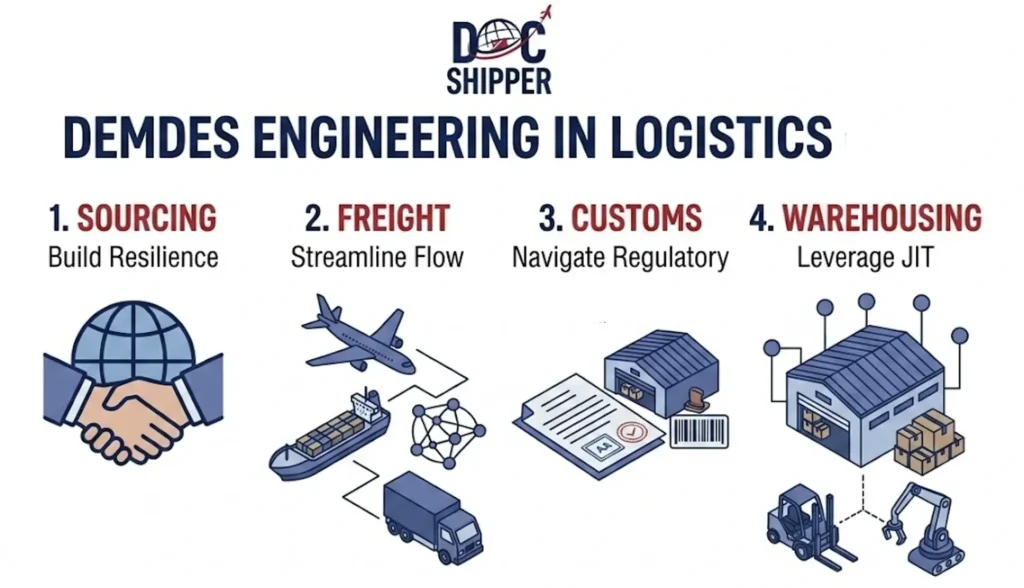
Supply chain integration represents the critical fifth element. DEMDES extends beyond factory walls to encompass logistics planning, customs documentation, and distribution network optimization. Product design decisions directly impact shipping classifications, packaging requirements, and transportation modes—factors that must be considered from the earliest design stages.
Practical Applications & Industry Data
DEMDES implementation varies significantly across industries, but certain patterns consistently emerge. Manufacturing sectors with complex regulatory requirements or rapid innovation cycles benefit most dramatically from this integrated approach.
Use Case: Electronics Manufacturing
A European electronics company implementing DEMDES reduced time-to-market by 34% over 18 months. By integrating design engineers with manufacturing facilities in Asia and logistics partners, they identified packaging optimization opportunities that reduced shipping costs by 22% while improving product protection. The design team modified component layouts to accommodate automated assembly, cutting production time per unit by 41 minutes. Customs classification was determined during design phase, eliminating delays at multiple borders.
| Implementation Phase | Timeline | Key Deliverables | Logistics Integration |
|---|---|---|---|
| Design Engineering | Weeks 1-6 | CAD models, material specifications, DFM analysis | HS code determination, packaging requirements |
| Manufacturing Development | Weeks 7-14 | Process documentation, quality protocols, tooling design | Production location selection, incoterms strategy |
| Engineering Services | Weeks 15-20 | Process optimization, quality audits, training materials | Supplier qualification, compliance documentation |
| Continuous Development | Ongoing | Performance metrics, improvement initiatives, design updates | Route optimization, inventory management integration |
Industry research indicates that companies fully implementing DEMDES principles achieve 18-27% reduction in total product development costs. The methodology proves particularly valuable when manufacturing occurs in different countries than design centers, as it establishes communication protocols and documentation standards that transcend geographic boundaries.
Five critical success factors for DEMDES implementation:
- Executive sponsorship ensuring cross-departmental cooperation and resource allocation
- Integrated software platforms enabling real-time collaboration across design, manufacturing, and logistics teams
- Standardized documentation frameworks compatible with international regulatory requirements
- Regular cross-functional review meetings with representatives from all DEMDES phases
- Performance metrics tracking that measure outcomes across the entire lifecycle rather than isolated departmental goals
The automotive industry demonstrates DEMDES effectiveness at scale. Major manufacturers report 30-40% reductions in engineering change orders when design and manufacturing teams collaborate from project inception. These improvements directly impact supply chain efficiency by reducing rush shipments, emergency sourcing, and production line disruptions.
Conclusion
DEMDES represents a fundamental shift from sequential development to integrated lifecycle management. Companies implementing this methodology gain competitive advantages through faster innovation cycles, reduced costs, and more reliable supply chains.
Need assistance implementing DEMDES principles in your international operations? Contact DocShipper to optimize your global manufacturing and logistics workflows.
📚 Quiz
Test Your Knowledge: DEMDES Methodology
What is the primary characteristic that distinguishes DEMDES from traditional product development approaches?
A company implements DEMDES but only involves logistics specialists after manufacturing processes are finalized. What critical advantage are they missing?
An electronics manufacturer discovers during production that their brilliant product design requires prohibitively expensive custom tooling and generates frequent quality issues. Which DEMDES principle would have prevented this scenario?
🎯 Your Results
📞 Free Quote in 24hFAQ | DEMDES (Design Engineering Manufacturing Development and Engineering Services): Definition, Process & Application in Global Supply Chains
DEMDES integrates manufacturing and logistics considerations from the initial design phase rather than treating them as sequential steps. Traditional approaches often create silos where design teams complete work before manufacturing engineers become involved, leading to costly redesigns and supply chain complications. DEMDES establishes continuous collaboration and feedback loops that prevent these disconnections.
By involving logistics specialists during design phases, DEMDES ensures products are optimized for international transport. Teams determine harmonized system codes early, design packaging that meets international regulations, and structure component sourcing to optimize duty rates. This proactive approach eliminates common customs delays and reduces total landed costs significantly.
Effective DEMDES requires integrated PLM (Product Lifecycle Management) systems that connect CAD tools, ERP platforms, and supply chain management software. Leading solutions include Siemens Teamcenter, PTC Windchill, and Dassault Systèmes' 3DEXPERIENCE. These platforms enable real-time collaboration across geographic locations and functional departments.
Absolutely. While large corporations pioneered DEMDES, SMEs gain proportionally greater benefits due to their typically limited resources. Even simplified DEMDES implementation—establishing regular communication between design and manufacturing teams and documenting lessons learned—produces measurable improvements. Cloud-based collaboration tools make sophisticated DEMDES approaches accessible at reasonable costs.
Organizations typically achieve basic integration within 6-9 months, with mature implementation taking 18-24 months. The timeline depends on organizational complexity, existing systems, and change management effectiveness. Companies often implement DEMDES incrementally, starting with pilot projects before expanding to full product portfolios.
Forward-thinking 3PLs participate as strategic partners rather than transactional service providers. They contribute expertise during design phases regarding packaging optimization, transportation mode selection, and regulatory compliance. This early involvement prevents logistical constraints from becoming expensive surprises during production ramp-up.
DEMDES embeds quality protocols at each phase rather than treating quality as a final inspection step. Design specifications include measurable quality criteria, manufacturing development establishes control points, and engineering services provide ongoing monitoring. This distributed quality approach proves more effective than traditional end-of-line inspection, particularly across international operations.
Organizational silos represent the primary challenge, as DEMDES requires breaking down traditional departmental boundaries. Other obstacles include inadequate information systems, resistance to documentation requirements, and insufficient executive support. Successful implementations address cultural change management alongside process and technology improvements.
DEMDES and agile methodologies complement each other effectively. Agile's iterative approach fits naturally within DEMDES continuous development cycles. Many organizations combine agile sprint planning with DEMDES phase gates, creating flexible yet structured development processes that accommodate both rapid innovation and manufacturing realities.
Key performance indicators include time-to-market reduction, engineering change order frequency, first-pass yield rates, total landed cost optimization, and supply chain disruption incidents. Effective DEMDES implementations track these metrics across the entire lifecycle rather than within individual departments, revealing systemic improvements that departmental metrics might miss.
DEMDES frameworks incorporate regulatory analysis during design phases, identifying market-specific requirements early. Engineering teams create modular designs accommodating regional variations without requiring complete redesigns. This approach proves essential for companies manufacturing in one region while selling globally, as it prevents costly compliance surprises.
Comprehensive DEMDES documentation includes design specifications with manufacturability annotations, process control plans linking to design requirements, engineering change procedures tracking modifications across all phases, and supply chain documentation connecting logistics considerations to product specifications. These documents must remain synchronized as products evolve, requiring robust version control systems.
Need Help with
Logistics or Sourcing ?
First, we secure the right products from the right suppliers at the right price by managing the sourcing process from start to finish. Then, we simplify your shipping experience - from pickup to final delivery - ensuring any product, anywhere, is delivered at highly competitive prices.


Fill the Form
Prefer email? Send us your inquiry, and we’ll get back to you as soon as possible.
Contact us




:%20Definition,%20Process%20&%20Application%20in%20Global%20Supply%20Chains)