


In short ⚡
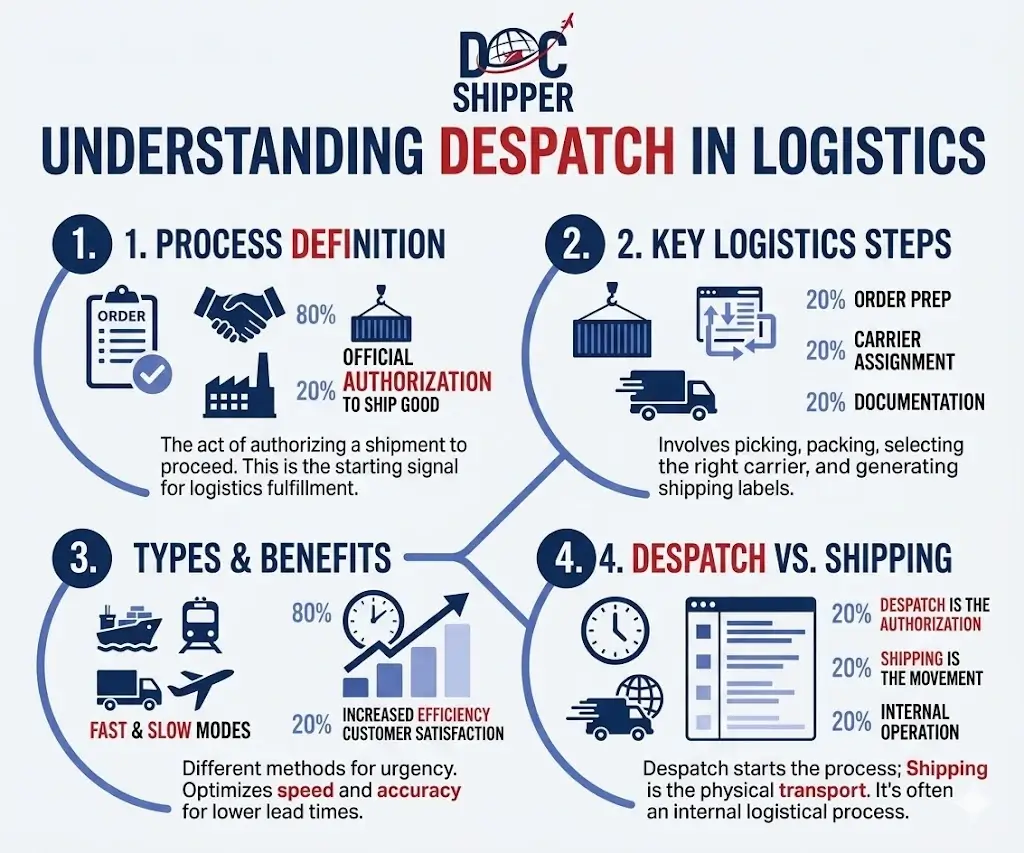
Despatch is a financial incentive paid by the charterer to the shipowner when cargo loading or unloading operations are completed in less time than the laytime allowed in the charter party. It rewards operational efficiency and encourages faster turnaround, typically calculated as a percentage of the demurrage rate—usually 50%—multiplied by the time saved.Introduction
Confusion between demurrage and despatch remains a common pitfall in international shipping. While demurrage penalizes delays, despatch does the opposite: it rewards speed.
In maritime logistics, time is money. Every hour a vessel spends in port costs charterers and shipowners alike. The despatch mechanism aligns incentives, encouraging efficient cargo operations while maintaining fairness between contracting parties.
- Financial Incentive: Rewards charterers for completing operations ahead of schedule
- Negotiable Rate: Typically 50% of the demurrage rate, but can vary by contract
- Laytime Calculation: Based on the difference between allowed and actual time used
- Charter Party Clause: Must be explicitly stated; not automatically assumed
- Operational Efficiency Driver: Encourages pre-planning and streamlined cargo handling
Despatch Mechanisms & Contractual Framework
The contractual basis for despatch lies in the charter party agreement, specifically the laytime and demurrage/despatch clauses. Unlike demurrage—which applies automatically when laytime is exceeded—despatch requires explicit contractual provision.
Most charter parties stipulate despatch at “half demurrage rate” (HDAA: Half Demurrage All Accounts). If demurrage is $10,000 per day, despatch would be $5,000 per day. This asymmetry reflects the shipowner’s perspective: the cost of delays exceeds the benefit of early completion.
The laytime calculation methodology determines when despatch applies. Under “reversible laytime,” loading and discharging time pools together. If loading takes longer but discharging is faster, the net time saved may still earn despatch. Under “non-reversible” terms, each operation stands alone.
International maritime law recognizes despatch under the UNCLOS framework, though specific enforcement relies on the governing law clause in the charter party—often English law or New York arbitration rules.
Key operational considerations include weather exclusions, shifting time, and notice of readiness. If laytime is interrupted by exceptions (storms, strikes), only the “net saved time” counts toward despatch. At DocShipper, we meticulously track laytime statements to ensure our clients receive accurate despatch calculations when operational efficiency exceeds charter party expectations.
Calculation Methods & Real-World Examples
Despatch calculations follow a straightforward formula, but real-world scenarios introduce complexities. The basic equation is:
Despatch = (Laytime Allowed – Actual Time Used) × Despatch Rate
Consider this practical scenario: A bulk carrier charters 72 hours of laytime to load grain. The demurrage rate is $12,000/day; despatch is 50%. Operations complete in 60 hours.
| Parameter | Value |
|---|---|
| Laytime Allowed | 72 hours (3 days) |
| Actual Time Used | 60 hours (2.5 days) |
| Time Saved | 12 hours (0.5 days) |
| Demurrage Rate | $12,000/day |
| Despatch Rate (50%) | $6,000/day |
| Total Despatch Payable | $3,000 |
Another common scenario involves container vessel operations. A charter party allows 96 hours for loading/discharging 1,500 TEUs. The actual operation takes 78 hours. With demurrage at $15,000/day and despatch at 50%:
- Time Saved: 18 hours = 0.75 days
- Despatch Rate: $7,500/day (50% of $15,000)
- Despatch Due: $5,625
Industry data shows that only 23% of voyages qualify for despatch, compared to 41% incurring demurrage (source: Baltic Exchange 2023 report). This asymmetry reflects the challenges of consistently beating laytime allowances.
Payment timing varies by agreement. Some contracts offset despatch against demurrage across multiple voyages (“running account”). Others require separate invoicing. DocShipper assists clients in negotiating favorable despatch terms and ensuring proper documentation for timely payment.
Conclusion
Despatch represents a win-win mechanism in maritime logistics: charterers benefit financially from operational excellence, while shipowners gain faster vessel turnaround. Understanding its calculation and contractual nuances prevents disputes and optimizes cost management.
Need expert guidance on charter party negotiations or laytime management? Contact DocShipper for specialized assistance tailored to your shipping operations.
📚 Quiz
Test Your Knowledge: Despatch
What is the primary purpose of despatch in maritime charter parties?
A common misconception about despatch is that it:
A vessel has 72 hours allowed laytime with a $12,000/day demurrage rate and 50% despatch rate. Operations complete in 60 hours. What despatch is owed to the charterer?
🎯 Your Result
📞 Free Quote in 24hFAQ | Despatch: Definition, Calculation & Practical Examples
Need Help with
Logistics or Sourcing ?
First, we secure the right products from the right suppliers at the right price by managing the sourcing process from start to finish. Then, we simplify your shipping experience - from pickup to final delivery - ensuring any product, anywhere, is delivered at highly competitive prices.


Fill the Form
Prefer email? Send us your inquiry, and we’ll get back to you as soon as possible.
Contact us




