


In short ⚡
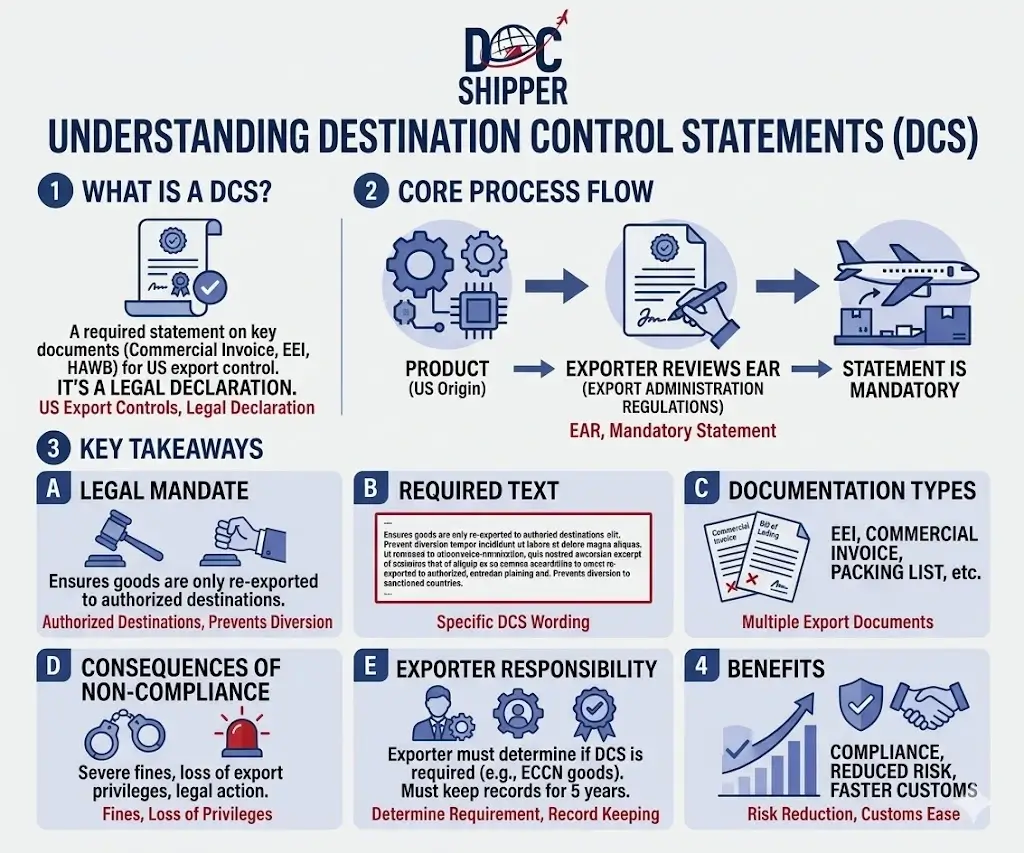
The Destination Control Statement (DCS) is a mandatory legal declaration required on U.S. export documentation that warns recipients against re-exporting or diverting controlled goods to unauthorized destinations without U.S. government approval. This compliance safeguard protects national security interests and ensures adherence to Export Administration Regulations (EAR).
Introduction
Many exporters mistakenly believe that once goods leave U.S. territory, their regulatory obligations end. This misconception can lead to penalties exceeding $300,000 per violation and criminal prosecution. The Destination Control Statement bridges this knowledge gap by explicitly communicating export restrictions to all parties in the supply chain.
In international trade, the DCS serves as a critical control mechanism for items subject to the Export Administration Regulations. It applies to both physical shipments and electronic transmissions of controlled technology, making it essential for manufacturers, freight forwarders, and logistics providers handling U.S.-origin goods.
Key characteristics of the Destination Control Statement include:
- Legal mandate: Required by U.S. law for most commercial exports from the United States
- Universal placement: Must appear on commercial invoices, ocean/air waybills, and other shipping documents
- Standardized wording: Specific language prescribed by Bureau of Industry and Security (BIS)
- Chain of custody: Binds all subsequent handlers of the merchandise to compliance obligations
- Extraterritorial reach: Extends U.S. export control jurisdiction beyond national borders
Regulatory Framework & Compliance Requirements
The legal foundation for the Destination Control Statement stems from 15 CFR § 758.6 of the Export Administration Regulations. This provision mandates that specific warning language appear on documentation accompanying controlled exports, creating a traceable compliance trail from origin to final destination.
The standard DCS language reads: “These commodities, technology, or software were exported from the United States in accordance with the Export Administration Regulations. Diversion contrary to U.S. law is prohibited.” This precise wording must appear verbatim on applicable documents—paraphrasing or translation does not satisfy the requirement.
Applicability criteria determine when the DCS is mandatory. It applies to all items listed on the Commerce Control List (CCL) except those classified as EAR99 when destined for Canada. Even items not requiring an export license must display the statement if they fall under EAR jurisdiction. Technology transfers via email, cloud storage, or technical specifications also require DCS notation in accompanying documentation.
The placement requirements specify exact locations where the statement must appear. For ocean shipments, it belongs on the commercial invoice, bill of lading, and sea waybill. Air cargo requires DCS on the air waybill and commercial invoice. When goods transit through multiple countries, each intermediate document must carry the statement to maintain the compliance chain.
Exemptions and special cases exist for specific scenarios. Exports to Canada of most items (except those requiring a license) do not require the DCS. Humanitarian donations, temporary exports, and certain personal effects may also qualify for exemptions. According to the Bureau of Industry and Security, exporters should verify current exemption lists before omitting the statement.
At DocShipper, we systematically verify DCS compliance on all U.S.-origin shipments during our documentation review process, preventing costly delays and regulatory violations before goods reach the port.
Practical Implementation & Documentation Examples
Understanding theoretical requirements differs significantly from proper execution. Exporters frequently struggle with formatting consistency across document types. The DCS should appear in a prominent location—typically in the footer of commercial invoices or in a dedicated section labeled “Export Compliance Information.” Font size must be readable (minimum 10-point type), and the statement should not be buried within dense contractual terms.
Consider this practical scenario: A California semiconductor manufacturer exports specialized chips (ECCN 3A001) to a distributor in Germany valued at $45,000. The shipment requires proper DCS placement across multiple documents:
| Document Type | DCS Placement | Additional Requirements |
|---|---|---|
| Commercial Invoice | Bottom of document, before signature line | Include ECCN classification |
| Air Waybill | Special handling instructions field | Reference invoice number |
| Packing List | Header or footer section | Optional but recommended |
| Electronic Filing (AES) | Not required in AES itself | Must appear on paper documentation |
Common implementation errors create unnecessary compliance risks. Using outdated DCS language from pre-2013 regulations remains a frequent mistake—the statement must reflect current EAR terminology. Another error involves omitting the DCS from forwarder-generated documents when the exporter assumes freight partners will add it automatically. The legal responsibility always rests with the U.S. Principal Party in Interest (USPPI).
Technology exports present unique challenges. When sending technical drawings via email to a foreign customer, the DCS must appear in the email body or as a watermark on PDF attachments. Cloud-based file sharing systems should include the statement in access notifications or as a persistent header on shared technical documents. Enforcement actions increased 34% in technology transfer violations during 2023, primarily due to inadequate DCS implementation in digital transfers.
Re-export implications extend U.S. jurisdiction globally. If the German distributor from our earlier example wishes to sell the semiconductors to a customer in India, they must obtain U.S. government authorization even though the goods physically reside in Germany. The DCS on the original documents alerts the distributor to this obligation, preventing inadvertent violations.
Conclusion
The Destination Control Statement functions as both legal protection and compliance communication tool, ensuring all parties understand restrictions on U.S.-origin controlled items. Proper implementation requires attention to regulatory details, consistent documentation practices, and awareness of digital export challenges.
Need expert guidance on DCS compliance or comprehensive export documentation services? Contact DocShipper today for specialized support in navigating U.S. export regulations.
📚 Quiz
Test Your Knowledge: Destination Control Statement (DCS)
1. What is the primary purpose of the Destination Control Statement?
2. A U.S. exporter believes that once goods are shipped to Canada, no Destination Control Statement is needed for any items. Is this understanding correct?
3. Your company is emailing technical specifications for semiconductor equipment (ECCN controlled) to a German partner. Which approach correctly implements DCS requirements?
🎯 Your Results
📞 Get Your Free Custom QuoteFAQ | Destination Control Statement (DCS): Definition, Requirements & Practical Examples
No, the DCS is not universally required. It applies to items subject to the Export Administration Regulations (EAR) but has exemptions for most exports to Canada (except licensed items), certain humanitarian shipments, and temporary exports. EAR99 items to Canada typically do not require the statement. Always verify the specific classification and destination before omitting the DCS.
Omitting the DCS constitutes a violation of export regulations, potentially resulting in penalties up to $300,000 per violation for administrative cases or $1 million for criminal violations. The shipment may be detained at customs, and repeat offenses can lead to export privilege denial. Exporters should implement document review protocols to prevent such oversights.
The DCS must appear in English using the exact prescribed wording. While you may include a translation for recipient convenience, the official English version must be present on all required documents. Translations alone do not satisfy the regulatory requirement, as the legal effectiveness depends on the standardized English text.
Yes, electronic transmissions of controlled technology require DCS notation. For emails, include the statement in the message body. For cloud-shared documents, add it as a watermark, persistent header, or in access notifications. The medium of transfer does not exempt the exporter from compliance obligations under EAR regulations.
The statement should be prominently displayed, typically in the footer section or in a clearly labeled "Export Compliance" section. It must be readily visible and legible (minimum 10-point font recommended). Avoid burying it within dense contractual terms or small print that might be overlooked by handlers in the supply chain.
Not necessarily. While some forwarders include the DCS as part of their service, the legal responsibility rests with the U.S. Principal Party in Interest (USPPI)—typically the exporter or seller. Exporters should explicitly verify with their forwarder whether DCS inclusion is covered and never assume automatic compliance without confirmation.
Yes, if U.S.-origin items subject to EAR are re-exported from a foreign location, the DCS requirement continues to apply. The original statement on documents alerts subsequent handlers to ongoing export control obligations. Re-exporters must maintain documentation chains and may need to add the DCS to new documents they generate.
The DCS applies to items controlled under the Export Administration Regulations (EAR) administered by the Commerce Department's BIS. ITAR warnings apply to defense articles controlled under International Traffic in Arms Regulations (ITAR) administered by the State Department's DDTC. They have different wording and regulatory foundations, though both restrict unauthorized transfers.
No, the DCS must use the complete prescribed language verbatim. Abbreviations, paraphrasing, or shortened versions do not satisfy regulatory requirements. If space is genuinely constrained, reformatting document layouts is preferable to modifying the statement. Compliance depends on using the exact wording specified in 15 CFR § 758.6.
The DCS is not required within the AES filing itself but must appear on physical shipping documents accompanying the goods. The EEI filing and DCS serve complementary but distinct compliance functions—AES captures transaction data for government reporting, while the DCS provides legal notice to all parties handling the merchandise.
Yes, the DCS requirement is not value-dependent. Even no-charge samples, low-value shipments, or temporary exports of controlled items require the statement if they are subject to EAR. The classification and nature of the items—not their commercial value—determines DCS applicability.
You must refuse such requests, as the DCS is a legal requirement that cannot be waived by agreement between commercial parties. Removing the statement to accommodate a customer would constitute a willful export violation. Explain that the DCS is a U.S. government mandate, not a negotiable commercial term, and document the customer's understanding in writing.
Need Help with
Logistics or Sourcing ?
First, we secure the right products from the right suppliers at the right price by managing the sourcing process from start to finish. Then, we simplify your shipping experience - from pickup to final delivery - ensuring any product, anywhere, is delivered at highly competitive prices.


Fill the Form
Prefer email? Send us your inquiry, and we’ll get back to you as soon as possible.
Contact us




:%20Definition,%20Requirements%20&%20Practical%20Examples)