


In short ⚡
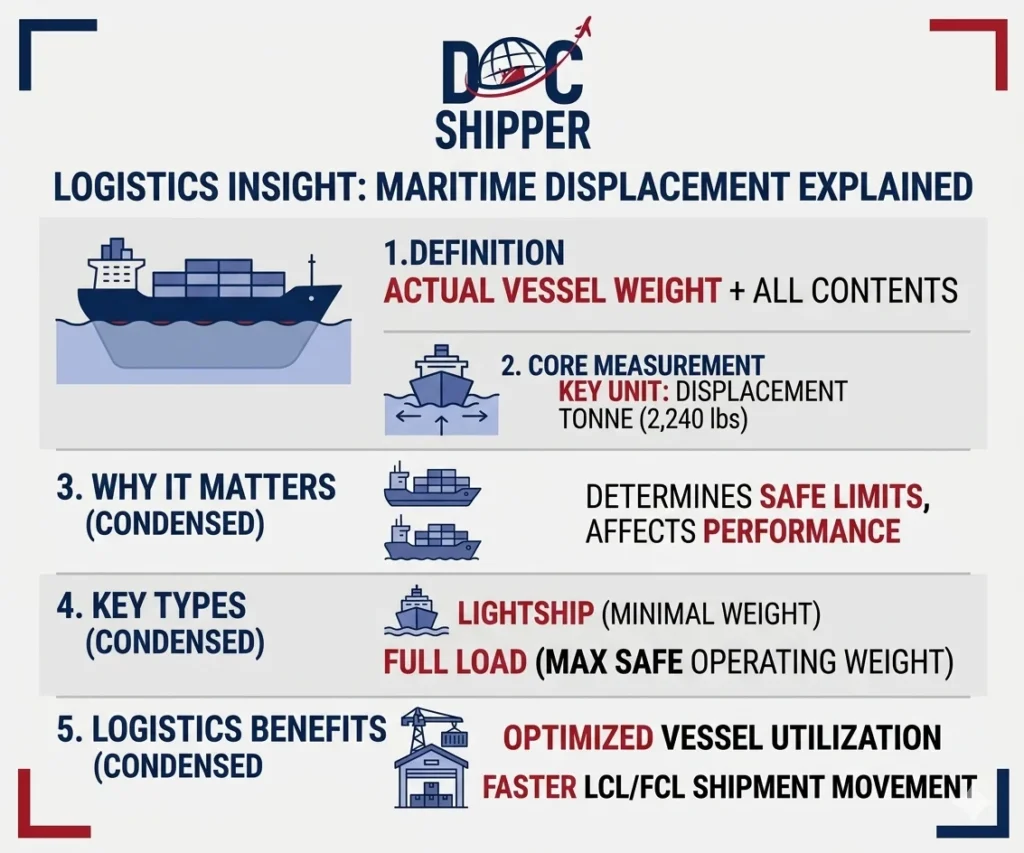
Displacement refers to the weight of water displaced by a vessel's hull when floating. It equals the total weight of the ship, including cargo, fuel, crew, and stores. This fundamental maritime principle, derived from Archimedes' law, determines a vessel's carrying capacity and draft in international shipping operations.
Introduction
Many importers and exporters overlook a critical factor when booking ocean freight: vessel displacement. This oversight can lead to delays, additional costs, or rejected cargo bookings. Understanding displacement is essential because it directly impacts shipping capacity, port access, and freight calculations.
In international logistics, displacement determines whether a vessel can safely navigate specific routes or enter certain ports. It affects everything from Suez Canal transit fees to loading limits at destination terminals.
- Lightship displacement: Empty vessel weight without cargo, fuel, or stores
- Loaded displacement: Total weight when fully loaded to maximum draft
- Deadweight tonnage (DWT): Difference between loaded and lightship displacement
- Draft relationship: Direct correlation between displacement and vessel’s immersion depth
- Stability factor: Critical for safe loading distribution and maritime compliance
Technical Understanding & Maritime Applications
Displacement operates on a simple physics principle: a floating object displaces water equal to its weight. For cargo vessels, this measurement becomes the foundation of loading calculations and maritime engineering.
The calculation involves three primary displacement categories. Lightship displacement represents the vessel’s empty weight, typically 15-25% of total displacement for modern container ships. Loaded displacement includes all cargo, fuel, ballast water, provisions, and crew. The difference yields deadweight tonnage, the actual cargo-carrying capacity.
Port authorities and canal operators use displacement to determine access restrictions. The Suez Canal Authority calculates transit fees based on Suez Canal Net Tonnage (SCNT), which derives from displacement measurements. Similarly, shallow-water ports impose strict displacement limits to prevent grounding.
Draft marks painted on vessel hulls provide visual displacement indicators. These numbered markings, measured in decimeters or feet, allow port officials to verify loaded displacement against declared cargo weight. At DocShipper, we coordinate with shipping lines to ensure your cargo booking aligns with vessel displacement capacity and port limitations.
Trim and list considerations also stem from displacement distribution. Uneven loading creates stability issues, requiring ballast water adjustment to maintain proper displacement balance. International maritime regulations mandate specific metacentric height calculations based on displacement to ensure vessel safety during transit.
Practical Calculations & Real-World Data
Understanding displacement through concrete examples clarifies its impact on shipping operations. Consider a Panamax container vessel with the following specifications:
| Displacement Type | Weight (Metric Tons) | Draft (Meters) |
|---|---|---|
| Lightship Displacement | 15,000 MT | 5.2 m |
| Loaded Displacement (Summer) | 80,000 MT | 12.5 m |
| Deadweight Tonnage | 65,000 MT | — |
| Cargo Capacity | 55,000 MT | — |
| Fuel + Stores + Ballast | 10,000 MT | — |
This vessel can carry 55,000 metric tons of cargo while maintaining safe displacement limits. However, seasonal variations affect maximum displacement. Tropical zones allow higher displacement than winter North Atlantic routes due to water density differences.
Practical scenario: A shipper books 500 TEU of automotive parts from Shanghai to Hamburg. Each loaded container averages 18 tons, totaling 9,000 MT. The shipping line must verify available deadweight capacity, accounting for fuel consumption (approximately 150 MT per day for 25-day transit), ballast water requirements, and other cargo already booked.
Port restrictions add complexity. Hamburg’s maximum draft is 13.7 meters at high tide. If the vessel’s loaded displacement creates a 14-meter draft, it cannot enter regardless of cargo weight. At DocShipper, we verify these constraints before confirming bookings, preventing costly diversions or cargo transfers.
Key displacement considerations for shippers:
- Container weight declarations must be accurate per SOLAS VGM requirements
- Heavy cargo may require displacement calculations to ensure vessel stability
- Seasonal load lines affect maximum displacement during winter months
- Canal transits impose displacement-based surcharges beyond base freight rates
- Port congestion may force vessels to lighter loads at anchorage before berthing
Conclusion
Displacement remains a fundamental concept connecting physics principles to practical shipping operations. Accurate displacement management ensures safe vessel operations, regulatory compliance, and optimized cargo capacity utilization in international trade.
Need guidance on vessel specifications or cargo weight calculations for your shipments? Contact DocShipper for expert logistics support tailored to your import-export requirements.
📚 Quiz
Test Your Knowledge: Displacement
What does vessel displacement fundamentally represent?
A shipper claims their container weighs 15 tons but actual weight is 22 tons. What is the primary risk related to displacement?
Your cargo is booked on a vessel transiting from Shanghai to Hamburg in January. Which displacement consideration is most critical?
🎯 Your Results
📞 Free Quote in 24hFAQ | Displacement: Definition, Calculation & Practical Examples
Displacement measures the total weight of the vessel including its structure, cargo, fuel, and all contents. Deadweight tonnage (DWT) is the difference between loaded displacement and lightship displacement, representing only the carrying capacity available for cargo, fuel, stores, and ballast water. A 50,000 DWT vessel might have a loaded displacement of 65,000 tons with 15,000 tons being the ship's own weight.
While freight rates are typically calculated per container or weight/volume, displacement impacts costs indirectly. Vessels operating near maximum displacement consume more fuel, potentially increasing bunker surcharges. Canal transit fees like Suez or Panama are calculated based on displacement-derived tonnage measurements. Port charges also consider vessel displacement when determining docking and harbor fees.
Load line regulations recognize that water density varies by temperature and salinity. Tropical freshwater has lower density than cold saltwater, affecting buoyancy. Ships can safely carry more displacement in denser saltwater. Load line marks indicate maximum permitted displacement for Tropical, Summer, Winter, and Winter North Atlantic zones, with differences of 5-10% between zones.
Yes, absolutely. Verifying vessel displacement against port draft restrictions before loading prevents costly situations where vessels must offload cargo, wait for higher tides, or divert to deeper ports. Accurate cargo weight declarations ensure the vessel stays within safe displacement limits and can access destination terminals without draft-related complications.
Exceeding maximum displacement violates international maritime safety regulations and insurance conditions. The vessel risks instability, structural damage, and being denied port entry. Port state control inspections can detain overloaded vessels, resulting in fines, cargo discharge requirements, and potential criminal liability for vessel operators. Load line submersion below legal marks is visible evidence of displacement violations.
Displacement is measured using draft readings from marks on the vessel's bow, stern, and midship sections. These readings, combined with the vessel's hydrostatic tables showing displacement at various drafts, provide the current total displacement. Modern vessels use digital draft survey systems, but visual verification remains standard practice for cargo operations and port inspections.
The physics principle remains identical, but practical application differs. Container ships have lower cargo density, often reaching volume capacity before weight limits. Bulk carriers typically load to maximum displacement with dense commodities like iron ore. A container ship might use only 60-70% of deadweight capacity while achieving full volume utilization, whereas bulk carriers routinely operate at 95-100% displacement capacity.
Ballast water allows operators to adjust displacement and trim when cargo loads are insufficient to reach optimal draft. Proper ballast distribution maintains stability and propeller immersion for efficient propulsion. After discharge, vessels take on ballast water to maintain safe displacement and prevent structural stress. International conventions now regulate ballast water treatment to prevent marine species transfer between ports.
Higher displacement increases hull resistance, requiring more engine power and fuel to maintain speed. A vessel at 90% displacement typically consumes 15-20% more fuel than at 70% displacement for the same speed. Operators balance between maximizing cargo revenue and minimizing fuel costs, sometimes reducing speed when operating near maximum displacement to optimize efficiency.
Yes, providing false displacement or cargo weight information can result in substantial penalties. Port authorities may refuse berthing, impose fines up to $100,000, or prosecute under maritime safety laws. Insurance coverage may be voided for accidents involving undeclared cargo weight. The SOLAS VGM (Verified Gross Mass) requirement specifically addresses this issue by mandating certified container weight declarations.
Ice-class vessels must account for additional displacement from ice accumulation on decks and superstructure. Polar water's higher density allows slightly greater displacement than temperate zones, but ice accretion can add hundreds of tons to vessel weight. Operators reduce maximum cargo displacement by 3-5% when anticipating ice accumulation to maintain stability and regulatory compliance in polar operations.
Definitely. Displacement distribution affects trim and stability throughout loading operations. Heavy containers placed too far forward or aft create excessive trim, while uneven side distribution causes list. Stowage planning software uses displacement calculations to optimize container placement, ensuring the vessel remains within safe stability parameters while maximizing cargo capacity and maintaining efficient sailing trim.
Need Help with
Logistics or Sourcing ?
First, we secure the right products from the right suppliers at the right price by managing the sourcing process from start to finish. Then, we simplify your shipping experience - from pickup to final delivery - ensuring any product, anywhere, is delivered at highly competitive prices.


Fill the Form
Prefer email? Send us your inquiry, and we’ll get back to you as soon as possible.
Contact us




