


In short ⚡
DF Car (Duty-Free Car) refers to a vehicle imported under specific customs exemptions that allow duty-free entry, typically for diplomatic personnel, returning expatriates, or individuals covered by international agreements. This exemption eliminates import duties, VAT, and certain taxes, significantly reducing the total cost of vehicle importation.
Introduction
Many businesses and individuals face confusion when importing vehicles across borders, particularly regarding tax obligations. The DF Car exemption represents a significant opportunity for cost savings, yet eligibility requirements remain poorly understood by most importers.
In international logistics and customs operations, understanding duty-free vehicle schemes becomes crucial for diplomatic missions, expatriates, and qualifying organizations. These exemptions can reduce vehicle import costs by 20-60%, depending on the destination country’s tax structure.
- Tax exemption: Eliminates customs duties and VAT on qualifying vehicles
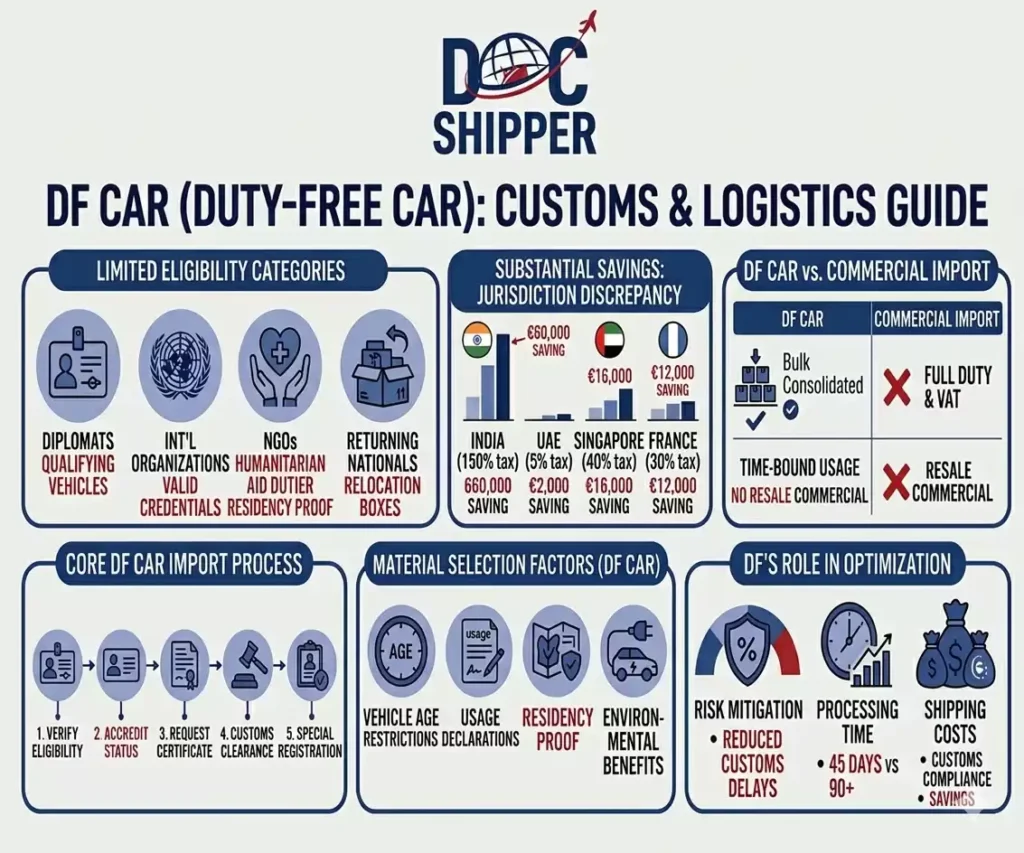
- Limited eligibility: Reserved for specific categories (diplomats, humanitarian organizations, returning nationals)
- Strict documentation: Requires proof of status and compliance with bilateral agreements
- Time-bound usage: Often includes restrictions on resale within specific periods
- Registration requirements: Must follow host country’s special registration procedures
Legal Framework & Mechanisms
The DF Car regime operates under international conventions, primarily the Vienna Convention on Diplomatic Relations (1961) and bilateral tax treaties. Each country maintains specific regulations governing duty-free importation, with eligibility criteria varying significantly across jurisdictions.
Diplomatic personnel typically qualify automatically, but other categories must demonstrate legitimate claims. Returning expatriates often receive temporary exemptions when relocating after extended periods abroad. Humanitarian organizations accredited with host governments may import operational vehicles duty-free under specific agreements.
The customs clearance process requires specialized documentation: diplomatic credentials, employment contracts with international organizations, or proof of residency status. The World Customs Organization provides harmonized standards, but implementation varies by member state.
Time restrictions constitute a critical compliance element. Most jurisdictions prohibit selling DF cars within 2-5 years without paying deferred duties. Violations trigger retroactive tax assessments plus penalties, sometimes exceeding the original exemption value.
At DocShipper, we verify diplomatic credentials and eligibility documentation before initiating DF Car imports, preventing costly customs rejections and ensuring full regulatory compliance throughout the process.
Concrete Examples & Data
Understanding DF Car savings requires concrete calculations based on real import scenarios. Tax structures vary dramatically, making exemption value highly jurisdiction-dependent.
Comparative Import Cost Analysis
| Country | Vehicle Value | Standard Import Cost | DF Car Cost | Savings |
|---|---|---|---|---|
| France | €40,000 | €52,000 (30% tax) | €40,000 | €12,000 (23%) |
| UAE | €40,000 | €42,000 (5% tax) | €40,000 | €2,000 (5%) |
| India | €40,000 | €100,000 (150% tax) | €40,000 | €60,000 (60%) |
| Singapore | €40,000 | €56,000 (40% tax) | €40,000 | €16,000 (29%) |
Real Case Study: Diplomatic Mission Vehicle Import
A French diplomatic mission in New Delhi required five vehicles for official operations. Standard import would have cost $480,000 including duties. Through DF Car procedures, the mission imported vehicles at base cost of $200,000, saving $280,000.
The process required: diplomatic note verbale, vehicle specifications approved by the Ministry of External Affairs, customs exemption certificate, and special registration plates. Processing time: 45 days versus 90+ days for standard commercial imports.
Key Considerations for DF Car Eligibility
- Diplomatic immunity documentation: Valid credentials from sending country’s foreign ministry
- Employment verification: Contract with recognized international organization (UN, World Bank, etc.)
- Residency proof: For returning nationals, minimum 2-year foreign residency typically required
- Vehicle age restrictions: Many countries limit DF exemptions to vehicles under 3-5 years old
- Usage declarations: Affidavits confirming personal/official use, not commercial resale
Conclusion
The DF Car exemption provides substantial financial advantages for eligible importers, but requires meticulous compliance with international agreements and national regulations. Understanding eligibility criteria and documentation requirements prevents costly delays and rejections.
Need expert guidance on DF Car importation? Contact DocShipper for comprehensive customs support and documentation handling.
📚 Quiz
Test Your Knowledge: DF Car (Duty-Free Car)
What is the primary purpose of the DF Car exemption?
A diplomat imports a DF Car and wants to sell it after 6 months. What is the correct procedure?
An international organization wants to import operational vehicles under DF Car exemption. Which scenario correctly applies the regulation?
🎯 Your Result
📞 Free Personalized QuoteFAQ | DF Car: Definition, Calculation & Concrete Examples
Diplomatic personnel with valid credentials, employees of accredited international organizations (UN agencies, World Bank), and returning nationals meeting specific residency criteria qualify. Some countries extend exemptions to NGOs registered under bilateral agreements. Eligibility verification requires documentation from both sending and receiving governments.
No. Most jurisdictions impose 2-5 year holding periods before tax-free sale. Early disposal triggers full retroactive duty payment plus penalties ranging from 20-100% of the exempted amount. Transfer to another eligible person may be permitted with proper customs authorization and documentation.
Essential documents include: diplomatic identity card or employment contract with international organization, vehicle purchase invoice, bill of lading, certificate of origin, vehicle registration from origin country, customs exemption certificate from host country's foreign ministry, and import declaration forms. Additional requirements vary by jurisdiction.
Processing times range from 30-90 days depending on country and documentation completeness. Diplomatic missions typically experience faster clearance (2-4 weeks). Delays occur when credentials require verification or vehicle specifications need ministry approval. Working with specialized customs brokers reduces processing time significantly.
Yes. Most countries limit exemptions to passenger vehicles and light commercial vehicles under certain weight thresholds. Luxury vehicles may face restrictions or partial taxation. Some jurisdictions exclude sports cars, motorcycles, or vehicles above specified engine capacities. Age restrictions typically limit exemptions to vehicles under 3-5 years from manufacture date.
Loss of diplomatic status typically triggers duty payment obligations within 30-90 days. Some countries allow transferring the vehicle to another eligible diplomat or exporting it duty-free. Failing to notify customs authorities of status changes results in penalties. Proper exit procedures must be followed when concluding assignments.
Temporary export for personal travel is generally permitted with proper documentation. Extended absences may require customs notification. Re-importation must occur within specified timeframes (typically 6-12 months). Failure to comply can void the exemption, triggering full duty assessment upon return.
Yes. DF Cars receive special registration plates (often CD or Corps Diplomatique series) indicating duty-free status. Insurance requirements mirror standard vehicles, but specialized diplomatic insurance policies offer better coverage for international use. Registration renewal procedures differ from commercial vehicles and may require annual diplomatic status verification.
Violations result in full duty and VAT payment retroactively, plus penalties ranging from 50-200% of exempted amounts. Serious breaches may trigger criminal proceedings for customs fraud. Diplomatic immunity does not protect against civil tax obligations. Vehicles may be seized pending duty settlement, and future exemption eligibility can be permanently revoked.
Dependent family members listed on diplomatic credentials typically qualify for one additional vehicle exemption. Eligibility extends to spouses and sometimes adult children with separate diplomatic cards. Each family unit faces combined vehicle limits (usually 2-3 vehicles total). Documentation must prove family relationship and shared residence with the primary cardholder.
NGOs and humanitarian organizations accredited with host governments may import operational vehicles duty-free under specific framework agreements. Exemptions typically require proving charitable status, project-specific vehicle use, and non-commercial operations. Vehicles must bear organizational markings and cannot be sold commercially. Regular audits verify compliance with exemption conditions.
Yes, electric and hybrid vehicles qualify under the same criteria as conventional vehicles. Some countries offer enhanced exemptions or additional incentives for zero-emission vehicles imported by diplomats. Standard documentation requirements apply, though battery specifications may require additional technical certification. Environmental benefits do not expand eligibility beyond standard diplomatic categories.
Need Help with
Logistics or Sourcing ?
First, we secure the right products from the right suppliers at the right price by managing the sourcing process from start to finish. Then, we simplify your shipping experience - from pickup to final delivery - ensuring any product, anywhere, is delivered at highly competitive prices.


Fill the Form
Prefer email? Send us your inquiry, and we’ll get back to you as soon as possible.
Contact us




