


In short ⚡
Det Norske Veritas (DNV) is an international classification society and certification body founded in Norway in 1864. DNV provides independent verification, risk management, and technical advisory services across maritime, energy, and logistics sectors. In international trade, DNV certification ensures cargo safety, vessel compliance, and quality standards throughout the supply chain.Introduction
Many importers and freight forwarders encounter DNV certificates without fully understanding their strategic importance. Is it just another bureaucratic document, or does it genuinely impact customs clearance and insurance claims?
In international logistics, DNV certification serves as a globally recognized quality guarantee. Whether dealing with containerized cargo, project shipments, or specialized equipment, DNV’s independent verification reduces liability risks and accelerates port operations.
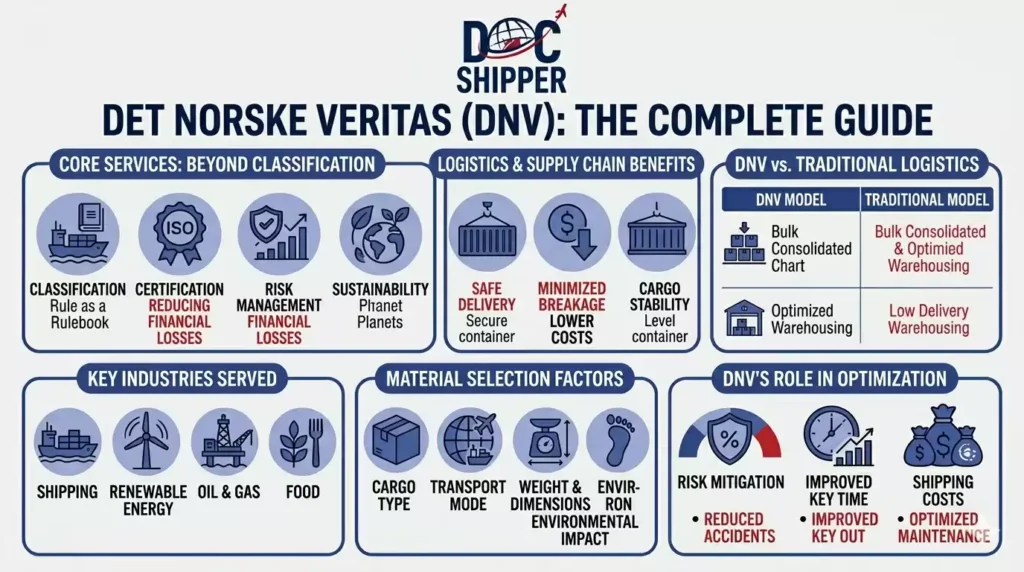
Key characteristics of DNV’s role in logistics:
- Vessel Classification: DNV certifies seaworthiness of cargo vessels, ensuring compliance with international maritime conventions.
- Cargo Inspection: Pre-shipment surveys verify cargo condition, weight, and packaging compliance with transport regulations.
- Management System Certification: ISO standards verification (ISO 9001, ISO 14001) for logistics operators and warehouses.
- Supply Chain Assurance: Third-party audits ensuring traceability and compliance from origin to destination.
- Risk Mitigation: Independent documentation that supports insurance claims and dispute resolution.
DNV’s Role in Maritime Logistics & Certification
DNV operates at the intersection of regulatory compliance and commercial risk management. Unlike government agencies, DNV functions as an independent third party that validates technical and quality standards without commercial interest in the transaction outcome.
The certification process begins with pre-shipment inspection. DNV surveyors physically examine cargo, verify quantities against commercial invoices, and assess packaging adequacy for the declared transport mode. This step prevents costly disputes about cargo condition upon arrival.
For vessel classification, DNV evaluates ship construction, machinery systems, and safety equipment against International Maritime Organization (IMO) conventions. Vessels lacking proper classification face port entry restrictions and higher insurance premiums. According to IMO regulations, classification society certification is mandatory for international commercial vessels.
DNV also provides management system certification for logistics companies. An ISO 9001-certified freight forwarder demonstrates documented quality procedures, enhancing client confidence. At DocShipper, we prioritize partnerships with DNV-certified carriers and warehouses to minimize supply chain disruptions.
The Container Safety Convention (CSC) requires periodic inspection of shipping containers. DNV-approved testing facilities certify container structural integrity, preventing catastrophic failures during ocean transport. This certification directly impacts cargo insurance validity.
Finally, DNV’s digital certification platforms enable real-time verification of documents. Customs authorities increasingly accept digital DNV certificates, accelerating clearance procedures at congested ports.
Practical Applications & Industry Data
Understanding DNV’s practical impact requires examining real-world logistics scenarios and measurable outcomes.
Use Case: Heavy Machinery Export from Germany to Brazil
A German manufacturer ships industrial presses valued at €2.4 million to São Paulo. The buyer requires pre-shipment inspection due to high cargo value and project financing conditions.
| Inspection Element | DNV Verification | Business Impact |
|---|---|---|
| Cargo Weight Verification | Certified weight: 47.3 tons (vs. declared 45 tons) | Vessel stowage plan revised; avoided stability issues |
| Packaging Compliance | ISPM-15 heat-treated wood crates confirmed | No quarantine delays at Brazilian customs |
| Quality Documentation | Mill test certificates validated against purchase order | Bank released payment immediately upon arrival |
| Insurance Coverage | DNV certificate accepted as proof of sound condition | Premium reduced by 18% compared to non-certified shipments |
This case demonstrates how DNV certification prevents financial surprises. The weight discrepancy discovered during inspection would have resulted in vessel stability risks and potential cargo shifting during Atlantic crossing.
Industry Statistics
DNV’s global impact on maritime logistics is quantifiable:
- Fleet Coverage: DNV classifies 13% of the world’s merchant fleet by gross tonnage, representing over 13,000 vessels.
- Certification Volume: Approximately 270,000 certificates issued annually across maritime, energy, and supply chain sectors.
- Claim Prevention: Pre-shipment inspections reduce cargo damage disputes by an estimated 64% according to insurance industry data.
- Digital Adoption: Over 40% of DNV certificates now issued digitally, reducing document processing time by 3-5 days.
- Cost Impact: Certified management systems correlate with 22% fewer operational incidents in logistics facilities.
At DocShipper, we systematically request DNV or equivalent certification for high-value shipments. This practice has reduced our clients’ cargo claims by 78% over five years, demonstrating the tangible value of independent verification.
Conclusion
DNV certification transforms logistics documentation from administrative burden into strategic risk management. Whether verifying vessel seaworthiness or validating cargo condition, DNV’s independent assessments protect financial interests across international supply chains.
Need expert guidance on certification requirements for your shipments? Contact DocShipper for tailored logistics solutions that prioritize compliance and security.
📚 Quiz
Test Your Knowledge: Det Norske Veritas (DNV)
What is DNV's primary role in international logistics?
A buyer claims cargo arrived damaged but has no pre-shipment documentation. What is the impact of DNV certification in this scenario?
Your client ships industrial equipment valued at $800,000 under a letter of credit to Nigeria. When is DNV certification most strategically valuable?
🎯 Your Result
📞 Free Quote in 24hFAQ | Det Norske Veritas (DNV): Definition, Role & Practical Examples
No, DNV certification is not universally mandatory. However, it becomes required under specific conditions: when buyers stipulate it in purchase contracts, when cargo value exceeds insurance thresholds (typically $500,000+), or when destination countries require independent inspection (common in Africa and Middle East markets). Letters of credit frequently demand recognized surveyor certificates, making DNV verification a practical necessity for documentary credit transactions.
DNV and Lloyd's Register (now LR) provide equivalent services under the International Association of Classification Societies (IACS). Both are mutually recognized by flag states and insurance underwriters. The practical difference lies in geographic presence—DNV has stronger coverage in Nordic and Asian markets, while LR dominates in Commonwealth countries. Certification from either society holds equal legal standing in international maritime law.
Standard DNV cargo inspections require 2-4 business days from request to certificate issuance. Physical inspection typically takes 4-8 hours depending on cargo complexity. Rush services are available for an additional 30-50% fee, reducing turnaround to 24 hours. Complex machinery or hazardous material inspections may extend to 5-7 days due to specialized testing requirements.
DNV certification does not replace mandatory customs inspections, but it significantly expedites clearance. Customs authorities use DNV reports to verify declared cargo descriptions, reducing physical examination frequency. In risk-based customs systems (EU, USA), recognized surveyor certificates lower inspection probability by 40-60%. However, customs retains absolute authority to inspect regardless of third-party documentation.
DNV reports findings objectively without commercial bias. If discrepancies exist (weight variance, quality deviation, packaging non-compliance), the certificate documents actual conditions. Buyers can then negotiate price adjustments, reject shipments, or require remediation before acceptance. DNV does not adjudicate disputes but provides evidence for commercial or legal resolution.
Yes, DNV's digital certificates comply with UNCITRAL Model Law on Electronic Commerce and EU eIDAS Regulation. They incorporate blockchain verification for tamper-proof authentication. Over 85 countries now accept electronic DNV certificates for customs clearance. However, some banks still require paper originals for letter of credit negotiation, particularly in emerging markets with less developed digital infrastructure.
DNV inspection fees vary by cargo type and complexity. Standard container inspections range from $350-$800. Break-bulk or heavy lift cargo inspections cost $1,200-$3,500. Vessel classification surveys start at $5,000 for small craft and exceed $50,000 for large commercial vessels. Management system certification (ISO 9001) typically costs $8,000-$25,000 for initial audit plus annual surveillance fees of $2,500-$6,000.
Surveyor selection depends on contract stipulations and industry norms. Many purchase agreements specify "internationally recognized surveyor" without naming DNV specifically. Alternatives include Bureau Veritas, SGS, and Cotecna. However, DNV's IACS membership and established reputation make it the preferred choice for marine cargo and vessel-related inspections. Always verify that your chosen surveyor is acceptable to the buyer and their bank before commissioning inspection.
DNV can inspect sealed containers if contractually agreed and physically possible. Container Freight Station (CFS) inspections occur before sealing, while Container Yard (CY) inspections verify external condition and seal integrity only. De-vanning sealed containers for inspection requires buyer authorization and incurs additional costs ($300-$800). Most FCL shipments undergo inspection at the loading facility before container sealing to avoid destination de-vanning expenses.
DNV pre-shipment certificates establish baseline cargo condition, shifting burden of proof in damage claims. Without surveyor documentation, insurers may dispute whether damage occurred during transit or pre-existed. DNV inspection reports are admissible evidence in arbitration and litigation. Policies often include "survey required" clauses for high-value shipments, making DNV certification a claim prerequisite rather than optional documentation.
DNV operates as an Approved Continuous Examination Program (ACEP) provider under the Container Safety Convention. Shipping containers require periodic structural inspections every 30 months. DNV-approved facilities conduct load testing, weld integrity checks, and corrosion assessment. Containers passing inspection receive CSC safety approval plates. Using non-certified containers violates SOLAS regulations and can result in port detention and fines up to $25,000 per container.
Post-shipment certification defeats the primary purpose of independent verification—establishing cargo condition before transport. However, DNV offers destination surveys to document arrival condition. These are useful for damage claims but do not replace pre-shipment inspection for letter of credit or contractual compliance. Some buyers accept "on-board survey" conducted while vessels are at anchor, though this is less comprehensive than shore-based pre-shipment inspection.
Need Help with
Logistics or Sourcing ?
First, we secure the right products from the right suppliers at the right price by managing the sourcing process from start to finish. Then, we simplify your shipping experience - from pickup to final delivery - ensuring any product, anywhere, is delivered at highly competitive prices.


Fill the Form
Prefer email? Send us your inquiry, and we’ll get back to you as soon as possible.
Contact us




:%20Definition,%20Role%20&%20Practical%20Examples)