


In short ⚡
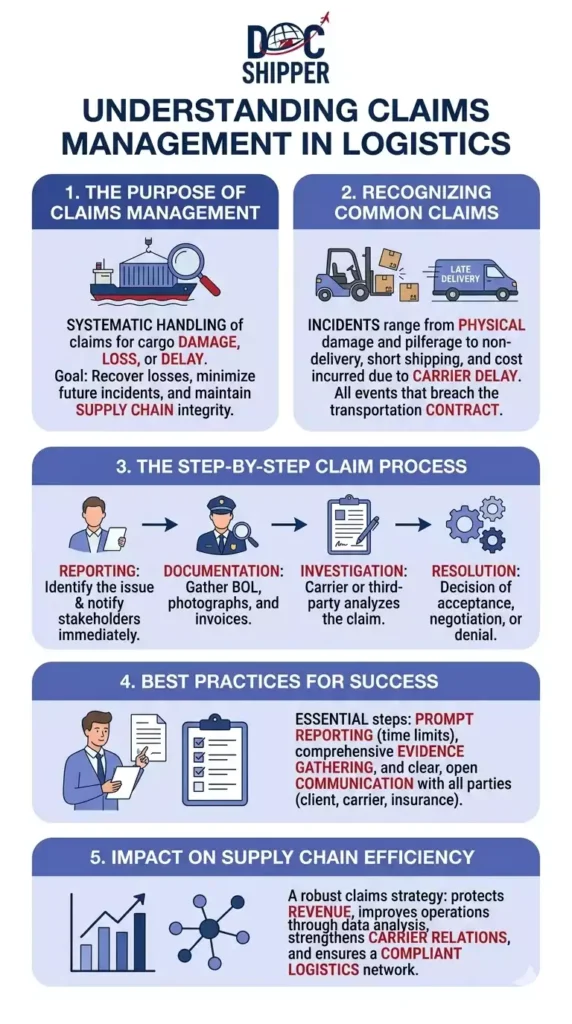
Claims management is the systematic process of handling cargo damage, loss, or delay claims in international logistics. It encompasses documentation collection, liability assessment, negotiation with carriers and insurers, and financial recovery. Effective claims management protects businesses from financial losses while maintaining supply chain integrity and contractual relationships.
Introduction
Every year, businesses lose millions due to cargo damage, yet 40% never file claims due to complexity or lack of knowledge. In international trade, where goods cross multiple jurisdictions and change hands repeatedly, understanding claims management becomes essential for financial protection.
Claims management represents the defensive backbone of logistics operations. When shipments face damage, loss, theft, or delays, proper claims handling determines whether businesses recover their losses or absorb devastating costs.
Key characteristics of effective claims management include:
- Time-sensitivity: Most claims have strict filing deadlines (often 9 months for sea freight under Hague-Visby Rules)
- Documentation precision: Complete evidence collection including photos, surveys, and commercial documents
- Liability determination: Identifying responsible parties across complex logistics chains
- Negotiation expertise: Securing fair compensation from carriers, insurers, or suppliers
- Legal compliance: Navigating international conventions (CMR, Montreal, Hamburg Rules)
Claims Management Process & Legal Framework
Claims management follows a structured workflow that begins the moment damage is detected. The process varies by transport mode but shares fundamental principles across air, sea, and land freight.
Initial damage assessment must occur immediately upon delivery. Receivers should note visible damage on delivery receipts (CMR consignment notes, air waybills, or bills of lading). This notation creates legal presumption of carrier liability. Failing to annotate damage within legal timeframes can void claims entirely.
Documentation gathering constitutes the foundation of successful claims. Required evidence includes commercial invoices, packing lists, transport documents, insurance certificates, photographs of damage, and independent surveyor reports. At DocShipper, we systematically compile this documentation to build irrefutable claim files that maximize recovery rates.
Liability analysis determines which party bears financial responsibility. Under the Hamburg Rules for sea freight, carriers are liable unless they prove force majeure. Road transport follows CMR Convention, which limits carrier liability to 8.33 SDR per kilogram unless higher value is declared.
Claim submission must respect strict deadlines. Sea freight claims typically require notice within 3 days for visible damage, 15 days for concealed damage. Air freight under Montreal Convention demands written complaints within 14 days. Missing these windows forfeits legal recourse regardless of damage severity.
Negotiation and settlement involve presenting evidence to carriers or insurers and negotiating compensation. Carriers often contest claims to minimize payouts. Professional claims handlers leverage legal knowledge and industry relationships to secure settlements that reflect actual losses, not arbitrary reductions.
Concrete Examples & Recovery Data
Real-world claims management reveals patterns that help businesses protect their interests. Industry data shows significant variations in claim success rates based on preparation quality and professional handling.
| Transport Mode | Average Claim Rate | Recovery Rate (Self-Filed) | Recovery Rate (Professional) | Typical Timeline |
|---|---|---|---|---|
| Sea Freight | 2.8% of shipments | 45% | 78% | 3-6 months |
| Air Freight | 1.2% of shipments | 52% | 82% | 2-4 months |
| Road Transport | 3.5% of shipments | 38% | 71% | 1-3 months |
Case Study 1: Electronics Damage (Sea Freight) — A European importer received a container of smartphones with water damage affecting 30% of units (€180,000 value). The carrier initially denied liability, claiming pre-shipment damage. DocShipper commissioned an independent surveyor who confirmed improper container sealing. With photographic evidence, surveyor report, and CMR documentation, we secured 92% recovery (€165,600) within four months.
Case Study 2: Temperature Deviation (Air Freight) — Pharmaceutical products valued at $250,000 arrived with temperature logs showing excursions beyond acceptable range. The airline contested causation. By presenting calibrated data loggers, manufacturer specifications, and expert testimony, full compensation was recovered in 75 days under Montreal Convention provisions.
Case Study 3: Partial Theft (Road Transport) — A textile shipment lost 15 cartons during European transit (€42,000). The trucking company claimed improper sealing by shipper. We obtained CCTV footage from the warehouse showing intact seals at departure, plus GPS data indicating unauthorized stop. Settlement reached at 88% of claimed value within six weeks.
Key success factors across these examples include:
- Immediate damage notation on transport documents
- Independent expert verification to establish causation
- Complete documentary chain from origin to destination
- Professional negotiation leveraging legal frameworks
- Persistence through carrier objections and delay tactics
Conclusion
Claims management transforms potential financial disasters into recoverable losses through systematic documentation, legal knowledge, and strategic negotiation. Businesses that implement proper claims procedures protect their bottom line while maintaining supply chain resilience.
Need expert assistance with cargo claims or want to prevent future losses? Contact DocShipper for professional claims management that maximizes your recovery.
📚 Quiz
Test Your Knowledge: Claims Management
Q1 — What does claims management primarily refer to in international logistics?
Q2 — A consignee receives a sea freight shipment with visible water damage but does not annotate it on the delivery receipt. What is the most likely consequence?
Q3 — A pharmaceutical company's air freight shipment arrives with temperature excursions. The airline contests liability. Which approach best reflects professional claims management?
🎯 Your Result
📞 Free Quote in 24hFAQ | Claims Management: Definition, Process & Concrete Examples
Time limits vary by transport mode: sea freight typically allows 9 months under Hague-Visby Rules, air freight 2 years under Montreal Convention, and road transport 1 year under CMR. However, written notice must be given within days of delivery (3-15 days depending on damage visibility).
The party holding title to goods when damage occurs files the claim. Typically, consignees file under CIF terms (seller pays freight/insurance), while shippers file under FOB terms (buyer arranges transport). The bill of lading holder has legal standing to claim.
Essential documents include original transport documents (B/L, AWB, CMR), commercial invoice, packing list, delivery receipt with damage notation, photographs of damage, surveyor report, and insurance certificate. Missing any critical document significantly reduces recovery chances.
Recovery depends on liability limits in international conventions. Sea freight limits to 666.67 SDR per package or 2 SDR per kilogram (whichever higher) unless higher value declared. Air freight limits to 22 SDR per kilogram. Road transport limits to 8.33 SDR per kilogram under CMR.
Carrier liability is the limited legal responsibility of transporters under international conventions (often insufficient for full value). Cargo insurance provides comprehensive coverage for declared value, covering risks beyond carrier liability including force majeure, inherent vice, and full replacement cost.
Delay claims are possible but complex. Under Hamburg Rules, carriers are liable if delay causes loss. Montreal Convention allows delay claims for air freight up to 4,694 SDR per passenger. CMR permits delay claims if shipper proves financial loss. Documentation of time-sensitivity is crucial.
Contested claims require negotiation or arbitration. Strong evidence (surveyor reports, independent testing, photographic documentation) strengthens your position. Professional claims handlers leverage legal precedents and industry relationships to overcome carrier resistance and secure fair settlements.
Independent surveyors provide critical third-party evidence that carriers cannot easily dispute. For claims exceeding $10,000, surveyor costs (typically $500-2,000) represent worthwhile investment. Surveyors establish causation, quantify damage, and provide expert testimony that significantly increases recovery rates.
Containerized cargo claims focus on container integrity (seals, condition reports, stuffing/destuffing surveys). Break-bulk claims emphasize handling damage and stowage issues. FCL (full container load) claims are simpler as liability is clearer; LCL (less than container load) requires proving damage occurred during specific handling stages.
Frequent denial reasons include late notification, insufficient evidence, pre-shipment damage allegations, improper packaging claims, force majeure defenses, and inherent vice arguments. Professional claims management anticipates these defenses and builds evidence that preemptively addresses carrier objections.
Consequential damages (lost profits, production delays, customer penalties) are generally excluded under standard carrier liability. Some jurisdictions allow consequential claims if carrier had notice of special circumstances. Cargo insurance with business interruption coverage provides better protection for indirect losses.
Prevention strategies include proper packaging specifications, cargo insurance, declared value on transport documents, reputable carrier selection, container condition inspections, GPS tracking for high-value goods, and clear Incoterms that define risk transfer points. Proactive risk management reduces claim frequency significantly.
Need Help with
Logistics or Sourcing ?
First, we secure the right products from the right suppliers at the right price by managing the sourcing process from start to finish. Then, we simplify your shipping experience - from pickup to final delivery - ensuring any product, anywhere, is delivered at highly competitive prices.


Fill the Form
Prefer email? Send us your inquiry, and we’ll get back to you as soon as possible.
Contact us




