


In short ⚡
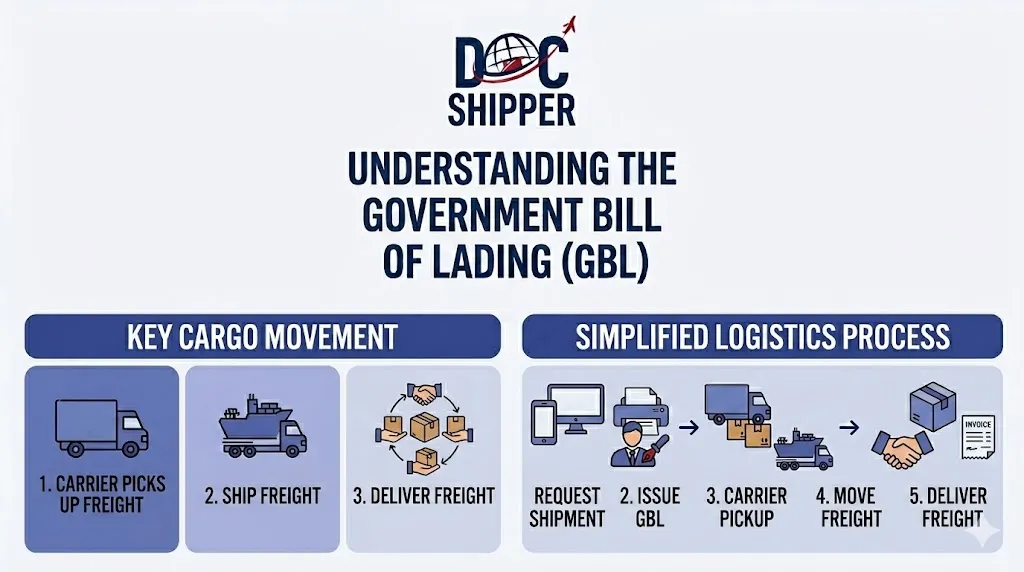
The Government Bill of Lading (GB/L) is a specialized shipping document issued by or on behalf of government entities to control the transportation of cargo for official purposes. Unlike commercial B/Ls, it grants governments priority handling, specific legal protections, and often exemption from standard freight charges, making it essential for military, diplomatic, and public sector shipments worldwide.
Introduction
Many logistics professionals mistakenly treat Government Bills of Lading like standard commercial shipping documents. This confusion can lead to rejected shipments, customs delays, or unauthorized charges when handling government cargo.
In international trade and logistics, the GB/L serves a critical function. It enables government agencies to move essential supplies—from military equipment to humanitarian aid—with legal priority and cost control. Understanding its specific requirements is mandatory for carriers, freight forwarders, and customs brokers serving public sector clients.
Key characteristics distinguishing GB/Ls from commercial documents:
- Sovereign authority: Issued under governmental procurement regulations rather than commercial contracts
- Payment exemptions: Often operates on credit terms or government billing systems instead of prepaid freight
- Priority handling: Legally mandated expedited processing at ports and customs checkpoints
- Security protocols: Subject to enhanced documentation, verification, and chain-of-custody requirements
- Regulatory compliance: Must align with national laws governing public procurement and transportation
Legal Framework & Operational Mechanisms
The GB/L operates within a distinct legal framework that separates it from commercial bills of lading. In the United States, the Transportation Act and related federal acquisition regulations define how government agencies contract for freight services. European Union member states follow similar principles under EU public procurement directives.
Operationally, issuing authority determines validity. Only designated government officials or approved third-party logistics providers can generate authentic GB/Ls. The document must contain specific reference numbers linking back to procurement contracts or official orders. Missing this traceability creates compliance risks for all parties.
The liability structure differs fundamentally from commercial shipping. Carriers accept government cargo under statutory terms rather than negotiated contracts. This means standard Hague-Visby Rules may not apply. Instead, national laws governing government contracts typically dictate liability limits and claim procedures.
Payment mechanisms present another critical distinction. Most GB/Ls operate on post-shipment billing to centralized government finance departments. Carriers must verify creditworthiness through official channels rather than relying on traditional commercial credit checks. At DocShipper, we systematically verify GB/L authenticity and government account status before accepting such shipments, preventing payment disputes.
Security and customs clearance protocols add complexity. Government cargo often receives expedited processing, but requires enhanced documentation. Diplomatic shipments may claim immunity from inspection, while military freight follows strict chain-of-custody rules. The GB/L must clearly indicate the cargo classification to ensure proper handling at each transit point.
Use Cases & Data-Driven Insights
Understanding GB/L applications through real-world scenarios clarifies its operational impact. Consider these typical use cases across different government sectors:
| Sector | Typical Cargo | GB/L Priority Level | Average Processing Time |
|---|---|---|---|
| Military | Equipment, spare parts, supplies | Highest (Priority 1) | 24-48 hours |
| Diplomatic | Embassy supplies, pouches | High (Priority 2) | 48-72 hours |
| Humanitarian Aid | Relief supplies, medical equipment | Emergency dependent | Varies (6-72 hours) |
| Research Institutions | Scientific samples, equipment | Standard | 3-5 days |
| Public Infrastructure | Construction materials, IT systems | Standard | 5-7 days |
Case Study: Military Equipment Relocation
A European defense ministry needed to transport 85 tons of communication equipment from Germany to a NATO base in Poland. Using a GB/L instead of commercial documentation resulted in:
- Freight cost savings: €12,400 (government rate vs. commercial rate)
- Customs clearance time: 18 hours instead of typical 3-5 days
- Security compliance: Sealed transport with military escort coordination
- Documentation simplification: Single GB/L covering multi-modal transport (road + rail)
Industry data reveals significant patterns. According to logistics sector reports, approximately 3-5% of international air cargo and 1-2% of ocean freight moves under government bills of lading. Priority processing reduces average dwell time by 40-60% compared to commercial shipments at major ports.
Cost implications vary dramatically. Military shipments often operate at government contract rates that may be 15-25% below commercial pricing. However, diplomatic cargo sometimes requires specialized handling that increases operational costs despite freight exemptions. Understanding these nuances prevents unexpected financial exposure for carriers and forwarders.
Conclusion
The Government Bill of Lading represents a specialized logistics instrument requiring distinct handling protocols, legal understanding, and operational expertise. Proper GB/L management ensures compliance, accelerates government cargo movement, and protects all parties from regulatory or financial risks.
Need expert guidance on handling government shipments or GB/L compliance? Contact DocShipper for specialized support in public sector logistics.
📚 Quiz
Test Your Knowledge: Government Bill of Lading (GB/L)
What is the primary purpose of a Government Bill of Lading?
Can private freight forwarders independently issue Government Bills of Lading?
A military shipment of communication equipment uses a GB/L. Which scenario reflects proper GB/L application?
🎯 Your Result
📞 Get Free Quote in 24hFAQ | GB/L (Government Bill of Lading): Definition, Process & Practical Examples
A Government Bill of Lading is issued by or for government entities and operates under public procurement regulations, offering priority handling and often special payment terms. Commercial Bills of Lading are issued by private shippers under contractual agreements with carriers, following standard freight terms and commercial liability rules.
No, private companies cannot independently issue GB/Ls. Only authorized government officials or specifically contracted third-party logistics providers with delegated authority can generate valid Government Bills of Lading. Unauthorized issuance constitutes fraud and violates public procurement laws.
Not automatically. While diplomatic cargo may claim certain immunities, most government shipments remain subject to import duties and taxes unless covered by specific bilateral agreements or international conventions. The GB/L itself does not grant tax exemption—only proper diplomatic or military documentation can provide such privileges.
Carriers should verify the issuing agency's authorization through official government contacts, check document serial numbers against registered databases, and confirm that referenced contract or purchase order numbers are valid. Many governments maintain verification hotlines or online portals for this purpose.
Claims follow government contract terms rather than standard carrier liability limits. The responsible party must file claims through official government channels, often requiring detailed documentation and adherence to specific timelines. Recovery procedures can take significantly longer than commercial cargo claims due to bureaucratic processes.
Government Bills of Lading apply to all transport modes—ocean, air, road, and rail. Each mode has specific GB/L formats adapted to industry standards (e.g., Government Air Waybills for aviation), but the core principles of governmental authority and priority handling remain consistent across all methods.
Generally no. Most Government Bills of Lading are non-negotiable "straight" bills consigned directly to the receiving government agency. This prevents unauthorized transfer of government property and maintains chain-of-custody integrity required for security-sensitive or regulated cargo.
Standard accompanying documents include commercial invoices (even for government cargo), packing lists, certificates of origin when required, and any specialized permits for controlled goods. Military or diplomatic shipments may require additional security clearances, end-user certificates, or exemption letters depending on destination country regulations.
Most GB/L shipments operate on credit terms with post-delivery billing to centralized government payment offices. Carriers submit invoices with GB/L references to designated finance departments, often with payment cycles ranging from 30 to 90 days. Prepayment is rare except for certain expedited or high-security shipments.
Only when operating as official government contractors or under formal governmental authorization. Private NGOs typically cannot issue GB/Ls independently, but may benefit from government-facilitated logistics when relief operations are coordinated through official channels or international governmental organizations like the UN.
Government cargo typically receives enhanced security including segregated storage areas, restricted access requiring clearances, video surveillance, and sealed containers with tamper-evident features. Military shipments may require armed escorts or dedicated handling teams with security clearances, depending on cargo classification.
No single universal standard exists. Each country establishes its own GB/L regulations under national procurement and transportation laws. However, NATO member states follow compatible standards for military logistics, and UN agencies use standardized procedures for humanitarian operations to facilitate multinational cooperation.
Need Help with
Logistics or Sourcing ?
First, we secure the right products from the right suppliers at the right price by managing the sourcing process from start to finish. Then, we simplify your shipping experience - from pickup to final delivery - ensuring any product, anywhere, is delivered at highly competitive prices.


Fill the Form
Prefer email? Send us your inquiry, and we’ll get back to you as soon as possible.
Contact us




:%20Definition,%20Process%20&%20Practical%20Examples)