


In short ⚡
Draft time refers to the specified period granted for payment of a bill of exchange or draft in international trade. It represents the delay between the issuance date and the maturity date when payment becomes due, typically expressed as sight draft (immediate payment) or time draft (deferred payment ranging from 30 to 180 days).
Introduction
Confusion between payment terms and actual cash flow creates major complications in international transactions. Many importers assume “30-day terms” guarantee immediate goods release, while exporters struggle with working capital constraints during extended draft periods.
Draft time directly impacts supply chain financing, risk management, and commercial relationships. Understanding these payment instruments prevents costly disputes and optimizes treasury operations across borders.
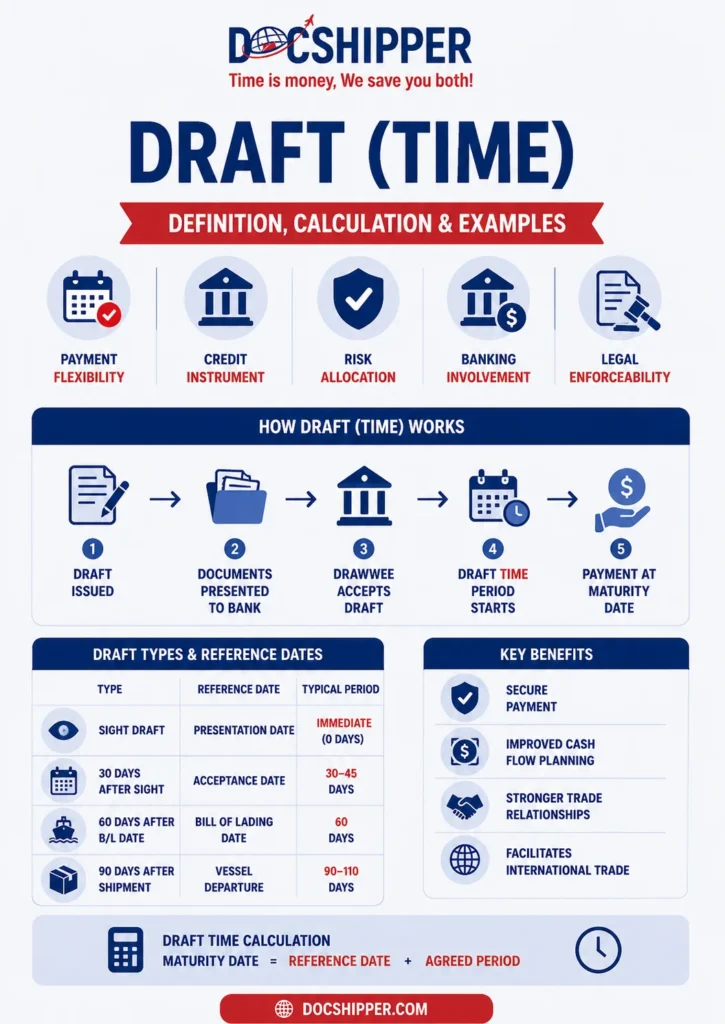
- Payment flexibility: Allows buyers time to resell goods before payment obligation
- Credit instrument: Functions as negotiable commercial paper in banking systems
- Risk allocation: Determines who bears currency fluctuation and default exposure
- Banking involvement: Enables letter of credit mechanisms and trade finance solutions
- Legal enforceability: Governed by international conventions including UCP 600 and URC 522
Mechanisms & Legal Implications
Draft time operates through negotiable instruments that create unconditional payment obligations. A sight draft requires payment upon presentation, while time drafts specify future maturity dates calculated from acceptance or issuance.
The tenor calculation determines exact payment deadlines. “30 days after sight” begins counting from acceptance date, not shipment date. “90 days after bill of lading date” provides fixed calculation independent of document presentation timing.
Under ICC UCP 600 regulations, banks must examine documents within five business days. Discrepancies trigger refusal notices that can extend effective draft periods significantly beyond original terms.
Acceptance procedures require designated parties to formally acknowledge payment obligations. Bank acceptance transforms commercial drafts into banker’s acceptances, improving negotiability and reducing buyer credit risk for exporters.
The usance period creates working capital implications for both parties. Exporters face financing costs during deferred payment periods. At DocShipper, we analyze these cash flow impacts during initial contract negotiations to recommend optimal payment structures aligned with your treasury capabilities.
Legal jurisdiction issues arise when parties dispute draft terms. International Commercial Terms (Incoterms) don’t govern payment methods, requiring separate contractual specifications. Governing law clauses determine which courts interpret ambiguous draft language.
Practical Examples & Calculations
Draft time calculations vary significantly based on reference points and banking practices. Understanding these differences prevents payment timing disputes.
Comparative Draft Time Scenarios
| Draft Type | Reference Date | Typical Period | Risk Bearer |
|---|---|---|---|
| Sight Draft | Presentation Date | Immediate (0 days) | Buyer (cash required) |
| 30 Days After Sight | Acceptance Date | 30-45 days effective | Seller (financing cost) |
| 60 Days After B/L Date | Bill of Lading Date | 60 days fixed | Seller (predictable) |
| 90 Days After Shipment | Vessel Departure | 90-110 days effective | Seller (longest exposure) |
Use Case: Electronics Import from China
A European retailer negotiates 90-day payment terms for consumer electronics shipment valued at €200,000.
- Shipment date: January 15, 2025 (B/L issued)
- Document presentation: January 22, 2025 (7-day courier delay)
- Bank examination: January 27, 2025 (5 business days maximum)
- Draft calculation: 90 days from B/L date = April 15, 2025
- Actual payment date: April 15, 2025 (regardless of presentation timing)
If terms specified “90 days after sight” instead, payment would be due April 27, 2025 (90 days from January 27 acceptance), adding 12 extra days to the exporter’s financing requirement.
DocShipper regularly handles draft time negotiations for clients, ensuring payment terms align with transit durations and inventory turnover cycles. Our trade finance partnerships provide discounting solutions when extended draft periods create cash flow challenges.
Conclusion
Draft time fundamentally shapes international trade relationships by balancing buyer flexibility against seller liquidity needs. Precise terminology and calculation methods prevent disputes while enabling sophisticated trade finance strategies.
Need assistance structuring payment terms for your international transactions? Contact DocShipper for customized solutions that optimize your working capital while maintaining secure trade relationships.
📚 Quiz
Test Your Knowledge: Draft Time in International Trade
What does "draft time" primarily define in international trade transactions?
A European importer has "90 days after sight" payment terms with document acceptance on March 15. When is payment due?
Which statement correctly describes the primary risk allocation difference between sight drafts and time drafts?
🎯 Your Result
📞 Free Quote in 24hFAQ | Draft (Time): Definition, Calculation & Practical Examples
A sight draft requires immediate payment upon presentation to the drawee, typically within banking days. Time drafts specify deferred payment periods (30, 60, 90, or 180 days) calculated from specific reference dates like acceptance, shipment, or bill of lading issuance. Time drafts provide buyers extended payment terms while creating financing obligations for sellers.
Under documentary credits, draft time determines when issuing banks release payment to beneficiaries. Sight L/Cs trigger immediate payment after compliant document presentation. Usance L/Cs with time drafts defer payment to maturity dates, though banks may offer discounting at negotiation. The draft period impacts both parties' cash flow and financing costs throughout the transaction cycle.
Modifications require written amendments agreed by all parties including banks when letters of credit are involved. Changes to draft calculation methods, tenor periods, or reference dates must follow formal amendment procedures under UCP 600 Article 10. Unilateral alterations create discrepancies that banks will reject, potentially blocking the entire transaction.
Non-payment at maturity constitutes default under the draft instrument. Holders may initiate legal collection procedures through courts in the governing jurisdiction. For banker's acceptances, banks honor payment obligations then pursue buyers for reimbursement. Interest penalties and legal costs accumulate from the maturity date, significantly increasing total payment obligations.
Banks apply discount rates based on the remaining tenor period, credit risk assessment, and prevailing interbank rates (SOFR, EURIBOR). The discount amount equals the face value minus interest calculated from negotiation date to maturity. For example, a $100,000 draft with 60 days remaining at 5% annual rate would be discounted by approximately $822, with the seller receiving $99,178 immediately.
No global standardization exists, though 30, 60, 90, and 180-day periods are most common in international trade. Industry practices vary significantly—agricultural commodities often use shorter periods while capital equipment transactions may extend to 360 days. Regional banking regulations and credit insurance requirements influence acceptable draft tenors for specific trade corridors.
Incoterms govern delivery obligations and risk transfer points but don't specify payment methods or draft terms. A DDP delivery term doesn't imply any particular draft period—parties must separately negotiate payment instruments. However, longer delivery times under Incoterms like EXW or FCA often correlate with extended draft periods to allow resale before payment obligation.
Electronic bills of exchange under instruments like eUCP supplement (version 2.0) enable digital draft processing while maintaining legal enforceability. Platforms using blockchain and MLETR-compliant frameworks provide equivalent legal status to paper instruments. However, adoption remains limited in jurisdictions without updated negotiable instruments legislation recognizing electronic signatures and transmission.
Extended draft periods expose parties to exchange rate movements between contract date and payment date. A 90-day time draft denominated in USD exposes European importers to dollar appreciation risk during the usance period. Forward contracts, currency options, or multi-currency draft structures can hedge these exposures, though hedging costs reduce the working capital benefits of extended payment terms.
Accepted drafts bear the drawee's signature, acceptance date, and payment commitment statement directly on the instrument. Banks stamp and sign drafts under letter of credit transactions, creating banker's acceptances. Electronic acceptance records include digital signatures with timestamps. These endorsed instruments become negotiable securities tradable in secondary markets until maturity.
Sight draft requirements can delay customs clearance since importers must arrange immediate payment before document release. Time drafts with trust receipt arrangements allow goods release before payment maturity, accelerating customs processing. However, customs authorities focus on duty payment rather than commercial payment terms—these remain separate obligations with different timing requirements.
Credit insurers apply higher premiums and require lower coverage percentages for extended draft periods exceeding 90 days due to increased default probability. Many policies cap coverage at 180-day maximum payment terms. Buyers with strong credit ratings may obtain approval for longer tenors, while emerging market transactions often face restrictions at 60-day maximum draft periods regardless of buyer creditworthiness.
Need Help with
Logistics or Sourcing ?
First, we secure the right products from the right suppliers at the right price by managing the sourcing process from start to finish. Then, we simplify your shipping experience - from pickup to final delivery - ensuring any product, anywhere, is delivered at highly competitive prices.


Fill the Form
Prefer email? Send us your inquiry, and we’ll get back to you as soon as possible.
Contact us




