


In short ⚡
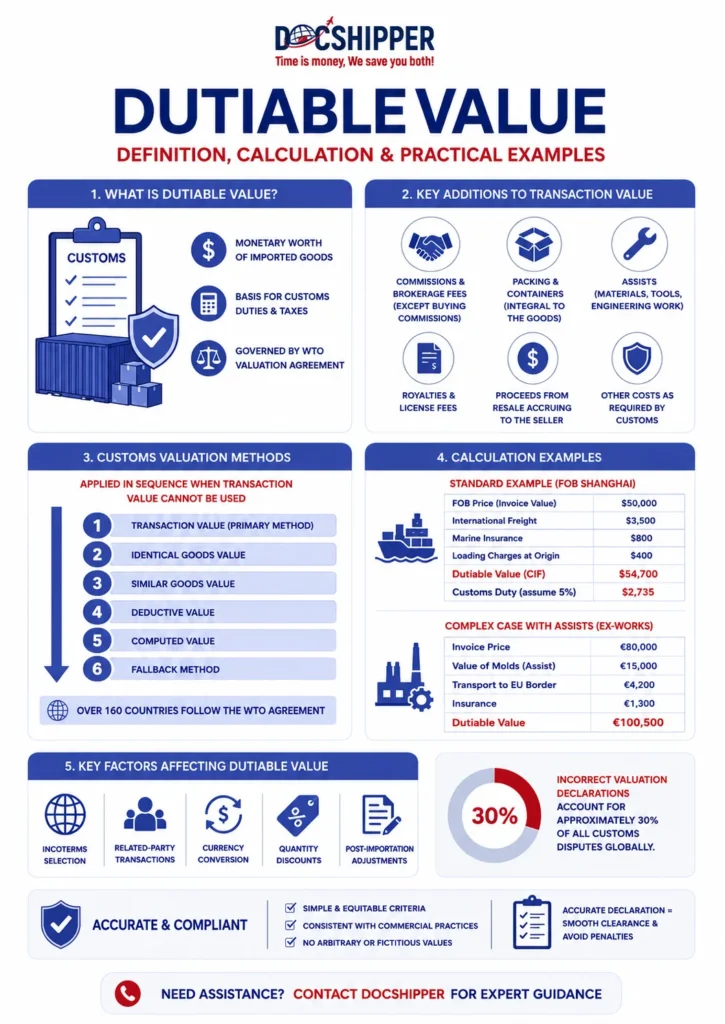
Dutiable value is the monetary worth of imported goods upon which customs duties and taxes are calculated. This value serves as the basis for determining the amount of import duties owed to customs authorities, typically calculated using the transaction value method as defined by the WTO Valuation Agreement.
Introduction
One of the most common sources of confusion in international trade is determining exactly how much duty to pay on imported goods. The dutiable value is not simply the purchase price—it encompasses multiple elements that importers often overlook, leading to costly customs delays or penalties.
Understanding dutiable value is critical for accurate cost forecasting, compliance with customs regulations, and maintaining smooth supply chain operations. Miscalculating this value can result in unexpected fees, shipment holds, or even legal complications.
Key characteristics of dutiable value include:
- Transaction value basis: Primarily the price actually paid or payable for goods when sold for export
- Additional costs inclusion: Certain expenses like freight, insurance, and assists must be added
- Legal framework: Governed by the WTO Agreement on Customs Valuation and national customs laws
- Six valuation methods: Hierarchical alternative approaches when transaction value cannot be used
- Declaration requirement: Importers must accurately declare all components on customs documentation
Valuation Methods & Legal Framework
The WTO Agreement on Customs Valuation establishes a standardized approach used by over 160 member countries. The primary method is transaction value—the price actually paid or payable for the imported goods, adjusted for specific additions and deductions.
Elements that must be added to the transaction value include:
- Commissions and brokerage fees (except buying commissions)
- Cost of containers and packing treated as integral to the goods
- Assists: Materials, tools, engineering work provided by the buyer
- Royalties and license fees related to the imported goods
- Proceeds from resale that accrue to the seller
When transaction value cannot be determined—due to related-party transactions, restrictions on goods, or lack of sale for export—customs authorities apply five alternative methods in sequence: identical goods value, similar goods value, deductive value, computed value, and finally the fallback method.
The WTO Valuation Agreement requires that customs valuation be based on simple and equitable criteria, consistent with commercial practices, without arbitrary or fictitious values.
At DocShipper, our customs compliance team systematically reviews all cost components to ensure accurate dutiable value declarations, preventing costly adjustments or penalties during clearance.
Calculation Examples & Practical Cases
Understanding dutiable value becomes clearer through practical scenarios. The calculation method varies depending on the Incoterms used and the components included in the transaction.
Standard Calculation Example
Scenario: A US company imports electronics from China under FOB Shanghai terms.
| Cost Component | Amount (USD) |
|---|---|
| FOB Price (Invoice Value) | $50,000 |
| International Freight | $3,500 |
| Marine Insurance | $800 |
| Loading Charges at Origin | $400 |
| Dutiable Value (CIF) | $54,700 |
| Customs Duty (assume 5%) | $2,735 |
Complex Case with Assists
Scenario: A European manufacturer imports machinery components where the buyer provided specialized molds worth €15,000 to the supplier at no charge.
| Cost Component | Amount (EUR) |
|---|---|
| Invoice Price (Ex-Works) | €80,000 |
| Value of Molds (Assist) | €15,000 |
| Transport to EU Border | €4,200 |
| Insurance | €1,300 |
| Dutiable Value | €100,500 |
According to World Customs Organization statistics, incorrect valuation declarations account for approximately 30% of all customs disputes globally, emphasizing the importance of accurate calculation.
Five Key Factors Affecting Dutiable Value
- Incoterms selection: FOB requires adding freight and insurance; DDP includes all costs but duties paid separately
- Related-party transactions: May require additional documentation to prove transaction value reflects market conditions
- Currency conversion: Must use official exchange rates on the date of export or importation as specified by customs
- Quantity discounts: Legitimate volume-based price reductions are acceptable if commercially justified
- Post-importation adjustments: Price increases or decreases after clearance may require amended declarations
At DocShipper, we provide comprehensive customs valuation services, including pre-shipment reviews and documentation preparation, ensuring compliance while minimizing duty expenses within legal frameworks.
Conclusion
Accurate determination of dutiable value is fundamental to international trade compliance and cost management. Understanding the components, calculation methods, and legal framework ensures smooth customs clearance and prevents financial surprises.
Need assistance navigating customs valuation complexities? Contact DocShipper for expert guidance on your international shipments.
📚 Quiz
Test Your Knowledge: Dutiable Value
What is the primary basis for calculating dutiable value under WTO guidelines?
When a buyer provides specialized molds worth $10,000 to a supplier free of charge for manufacturing imported goods, how should this be treated?
Your company imports machinery under FOB terms for $50,000. International freight costs $4,000 and insurance $600. What is the correct dutiable value?
🎯 Your Result
📞 Free Customs Quote in 24hFAQ | Dutiable Value: Definition, Calculation & Practical Examples
The commercial invoice value is the price agreed between buyer and seller, while dutiable value includes additional elements required by customs regulations. Dutiable value typically adds freight, insurance, packing costs, and assists to the invoice price. For FOB shipments, you must add international transportation and insurance. For Ex-Works purchases, you must add all costs up to the border of importation. The dutiable value serves as the tax base for calculating customs duties and import VAT.
Incoterms determine which costs are included in the transaction price. Under FOB (Free on Board), you add international freight and insurance to reach dutiable value. Under CIF (Cost, Insurance, Freight), these elements are already included. Under DDP (Delivered Duty Paid), the price includes duties, but customs still requires a separate dutiable value declaration. Most customs authorities require adjustment to a CIF equivalent regardless of the Incoterm used in the commercial transaction.
Yes, legitimate quantity discounts are acceptable if they reflect normal commercial practices and are available to all buyers meeting the volume criteria. Customs may request documentation proving the discount policy exists for unrelated buyers. Abnormally low prices between related parties face additional scrutiny. Discounts must be reflected on the commercial invoice and supported by contracts or price lists. Post-importation rebates generally don't reduce dutiable value unless declared before clearance.
Assists are goods or services provided by the buyer to the seller free of charge or at reduced cost for use in producing the imported merchandise. Common examples include molds, dies, tooling, engineering designs, artwork, and raw materials. The value of assists must be added to the dutiable value, apportioned appropriately if used for multiple production runs. Detailed documentation of assist values and usage is essential. Failure to declare assists can result in penalties and retroactive duty assessments.
Royalties and license fees must be included in dutiable value if they are: (1) related to the imported goods, (2) paid as a condition of sale, and (3) not already included in the invoice price. Trademark royalties for resale rights typically aren't dutiable. Patent or design royalties incorporated into the product usually are dutiable. The determination requires careful analysis of licensing agreements. Customs authorities worldwide increasingly scrutinize intellectual property payments in valuation disputes.
Declaring an incorrect dutiable value can result in several consequences. Undervaluation may trigger audits, duty reassessments with interest, penalties ranging from 10-40% of duties owed, and potential criminal charges for fraud. Overvaluation results in paying excessive duties without recourse for refund in many jurisdictions. Repeated errors can lead to increased scrutiny, delayed clearances, and loss of trusted trader status. Most customs authorities offer voluntary disclosure programs with reduced penalties for self-correction before detection.
Yes, importers have the right to challenge customs valuation decisions through formal administrative appeals. The process typically involves: (1) requesting a detailed explanation of the adjustment, (2) providing additional documentation supporting your valuation, (3) filing a formal protest within specified timeframes (usually 30-90 days), and (4) potentially pursuing judicial review. Success requires comprehensive documentation of the transaction, pricing justifications, and compliance with valuation principles. Professional customs brokers or trade lawyers significantly improve appeal outcomes.
Customs authorities use multiple verification methods including: document review of invoices, contracts, and payment records; database comparison against historical data and similar transactions; post-clearance audits examining buyer's financial records; exchange of information with foreign customs administrations; and risk assessment systems flagging anomalies. High-value shipments, first-time importers, and related-party transactions receive enhanced scrutiny. Authorized Economic Operator (AEO) status can reduce inspection frequency.
Most customs authorities specify official exchange rates that must be used. Common approaches include: the rate published by the central bank on the date of export (bill of lading date), the rate on the date of importation declaration, or monthly average rates published by customs. Using incorrect exchange rates, even unintentionally, can result in valuation discrepancies. Electronic customs systems often automatically apply official rates. Importers should verify which rate applies in their jurisdiction and maintain documentation of the rate used.
Freight and insurance to the port or place of importation must be included in dutiable value. However, freight within the destination country (after customs clearance) is excluded. For air shipments, freight to the first airport of entry is dutiable; onward domestic air freight is not. Insurance covering only domestic transit is excluded. Detailed freight invoices showing international vs. domestic segments are essential for proper calculation. Many customs authorities accept standard insurance percentages (typically 0.5-1.0% of FOB value) if actual costs aren't available.
Even goods imported without charge have dutiable value based on their market worth. Customs typically use the transaction value of identical or similar goods sold for export to the same country. For commercial samples marked or altered to prevent commercial sale, many jurisdictions allow duty exemptions or minimal value declarations. Bona fide gifts under specified value thresholds may qualify for duty-free treatment. However, repeated "gift" shipments to the same recipient raise red flags. Detailed explanations and supporting documentation are essential for non-commercial imports.
Essential documentation includes: commercial invoice with complete transaction details, purchase order or sales contract, payment records (wire transfers, letters of credit), freight and insurance invoices, packing lists showing quantities, and related-party declarations if applicable. Additional documents for complex transactions include: royalty agreements, assist valuations, transfer pricing studies, and quantity discount policies. Electronic systems increasingly allow digital document submission, but originals should be retained for potential audits (typically 5-7 years).
Need Help with
Logistics or Sourcing ?
First, we secure the right products from the right suppliers at the right price by managing the sourcing process from start to finish. Then, we simplify your shipping experience - from pickup to final delivery - ensuring any product, anywhere, is delivered at highly competitive prices.


Fill the Form
Prefer email? Send us your inquiry, and we’ll get back to you as soon as possible.
Contact us




