


In short ⚡
A Cargo Declaration is a mandatory customs document listing all goods transported by sea, air, or land. It details product descriptions, quantities, values, and consignee information, enabling authorities to verify shipment compliance before clearance. This declaration prevents delays and ensures regulatory adherence in international trade.
Introduction
Shippers frequently confuse cargo declarations with commercial invoices or packing lists, risking costly customs rejections. Unlike these supporting documents, the cargo declaration serves as the official manifest submitted to customs authorities before goods arrive at the destination port.
This document forms the backbone of border security and trade statistics worldwide. Without accurate cargo declarations, customs cannot assess duties, verify restricted goods, or prevent smuggling. Every container crossing international waters requires this declaration, making it indispensable for global supply chains.
- Mandatory submission: Required 24-48 hours before vessel arrival in most jurisdictions
- Multi-party verification: Cross-referenced against bills of lading and customs entries
- Legal accountability: Declarants face penalties for inaccuracies or omissions
- Digital integration: Most countries now mandate electronic submissions via single-window systems
- Risk assessment tool: Enables customs to target high-risk shipments for inspection
Technical Requirements & Regulatory Framework
The International Maritime Organization (IMO) and World Customs Organization (WCO) establish baseline standards for cargo declarations through the SAFE Framework and SOLAS conventions. National customs authorities then impose additional requirements aligned with their security protocols.
Key components include the Harmonized System (HS) code, which classifies goods into six-digit categories recognized globally. Declarants must provide this code alongside the gross weight, container numbers, and shipper/consignee details. The U.S. requires the Importer Security Filing (ISF) 24 hours before loading, while the EU mandates Entry Summary Declarations (ENS) before arrival.
The carrier responsibility principle holds shipping lines accountable for declaration accuracy. Incorrect information triggers automatic holds, inspection fees, and potential fines reaching €5,000 per violation in EU member states. The WCO SAFE Framework emphasizes pre-arrival data exchange to expedite low-risk cargo while intensifying scrutiny on suspicious shipments.
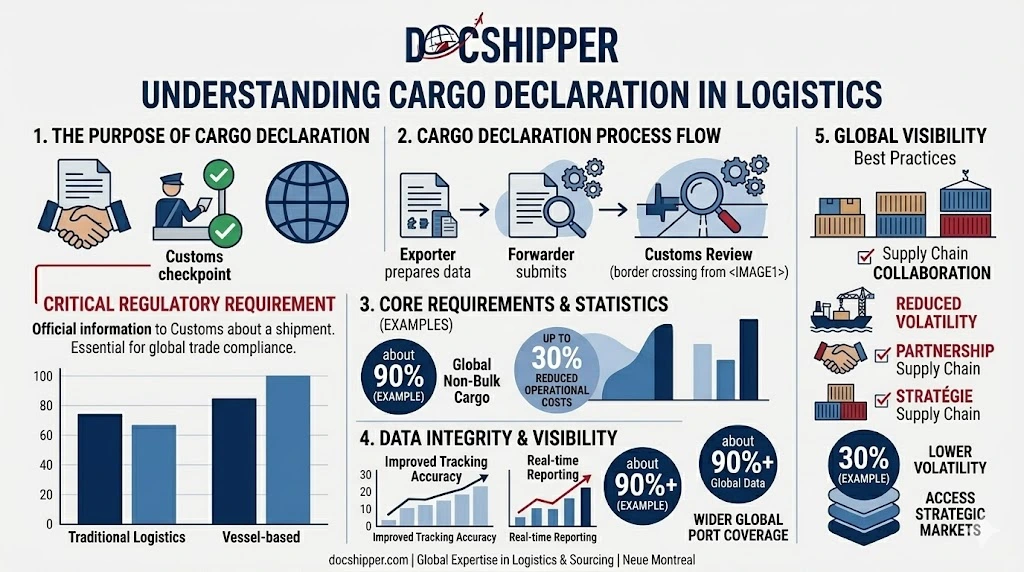
Electronic submission systems like the Automated Commercial Environment (ACE) in the U.S. or CHIEF/CDS in the UK validate data in real-time. These platforms reject incomplete declarations instantly, preventing submission errors. At DocShipper, we integrate directly with these customs portals to ensure your cargo declarations meet all technical specifications before filing, eliminating rejection risks.
The single-window concept consolidates all trade-related documents into one digital platform. Countries like Singapore and South Korea achieve 99% electronic declaration rates, reducing processing times from days to hours. Non-compliance with formatting standards—such as incorrect container seal numbers or missing EORI numbers—automatically flags shipments for manual review.
Practical Examples & Data Scenarios
Consider a textile shipment from Bangladesh to Germany: the exporter must declare 500 cartons of cotton t-shirts (HS code 6109.10) weighing 12,000 kg in a 40-foot container. The declaration includes the manufacturer’s name, consignee’s VAT number, and invoice value of €45,000. Without the correct HS code, German customs cannot calculate the 12% duty rate, causing clearance delays.
| Scenario | Declaration Type | Submission Deadline | Key Data Points |
|---|---|---|---|
| Sea freight to U.S. | ISF-10 | 24h before loading | Manufacturer, consignee, HS code, container stuffing location |
| Air cargo to EU | ENS (Entry Summary) | Before departure | EORI number, AWB number, value, weight |
| LCL shipment to Australia | Import Declaration | Before arrival | Tariff classification, country of origin, ABN |
| Dangerous goods to UK | Hazmat Declaration | 72h before loading | UN number, packing group, emergency contact |
Use Case: An electronics importer in Canada receives 200 laptops from China. The cargo declaration lists HS code 8471.30 (portable computers), total value CAD $80,000, and weight 1,500 kg. Canadian Border Services cross-references this against the commercial invoice and packing list. A discrepancy—declaring 180 units instead of 200—triggers an inspection, delaying clearance by five days and incurring storage fees of CAD $1,200.
Data accuracy directly impacts clearance speed. A 2023 WCO study found that 87% of customs delays stem from incomplete or incorrect cargo declarations. Common errors include:
- Mismatched container numbers: Declaring TEMU1234567 when the actual number is TEMU7654321
- Vague product descriptions: “Machinery parts” instead of “Hydraulic pump assemblies for excavators”
- Incorrect HS codes: Using 8-digit codes when 10-digit classifications are required
- Missing consignee tax IDs: Omitting VAT or EORI numbers in EU shipments
- Undervalued goods: Declaring $10,000 when actual value is $50,000 to evade duties
At DocShipper, we validate every cargo declaration against the latest customs requirements for your destination country, ensuring zero discrepancies before submission. Our automated verification system cross-checks HS codes, weights, and values against your commercial documents, preventing the errors that cause 8 out of 10 shipment holds.
Conclusion
The cargo declaration remains the cornerstone of compliant international shipping, directly influencing clearance speed, duty calculations, and regulatory adherence. Mastering its requirements prevents costly delays and positions your business for seamless global trade operations.
Need expert assistance with cargo declarations for your next shipment? Contact DocShipper for comprehensive customs documentation support tailored to your trade lanes.
📚 Quiz
Test Your Knowledge: Cargo Declaration
Q1 — What is the primary purpose of a Cargo Declaration?
Q2 — A common misconception is that the cargo declaration and the customs declaration are the same document. What is the key difference?
Q3 — A Canadian importer receives 200 laptops from China but accidentally declares only 180 units on the cargo declaration. What is the most likely outcome?
🎯 Your Result
📞 Free Quote in 24hFAQ | Cargo Declaration: Definition, Requirements & Practical Examples
A cargo declaration lists all goods on a transport vessel, submitted by the carrier. A customs declaration is filed by the importer for specific shipments, detailing duty calculations and clearance requests.
The shipping carrier (ocean line, airline, or freight forwarder) typically files the cargo declaration, though the shipper provides the necessary product details and documentation.
Most customs authorities allow amendments before cargo arrival, but late changes may incur penalties or trigger inspections. Electronic systems like ACE permit corrections within specific timeframes.
Errors result in shipment holds, manual inspections, storage fees, and potential fines. Severe discrepancies may lead to cargo seizure or criminal investigations for suspected fraud.
Timeframes vary: U.S. ISF requires 24 hours before loading, EU ENS before departure, and Australia before arrival. Always verify destination-specific deadlines to avoid non-compliance.
Yes. Air cargo requires declarations like the Air Waybill (AWB) and electronic customs notifications. The IATA e-AWB initiative mandates digital submissions for most international flights.
Essential data includes HS codes, product descriptions, quantities, weights, values, shipper/consignee details, container numbers, and country of origin. Omitting any element risks rejection.
No. Cargo declarations apply only to international trade. Domestic movements require transport documents like bills of lading but not customs declarations.
Customs use declared values and HS codes to determine applicable tariffs. Incorrect classifications can result in overpayment or underpayment of duties, both carrying legal consequences.
Yes. Licensed customs brokers and freight forwarders commonly handle cargo declaration submissions, ensuring compliance with technical requirements and reducing your administrative burden.
Penalties range from $5,000 to $10,000 per violation in the U.S., with similar fines in other jurisdictions. Repeat offenses may result in shipment seizures or import bans.
No. Electronic submissions through authorized customs portals serve as legally binding declarations. However, supporting documents like certificates of origin may require official stamps or notarization separately.
Need Help with
Logistics or Sourcing ?
First, we secure the right products from the right suppliers at the right price by managing the sourcing process from start to finish. Then, we simplify your shipping experience - from pickup to final delivery - ensuring any product, anywhere, is delivered at highly competitive prices.


Fill the Form
Prefer email? Send us your inquiry, and we’ll get back to you as soon as possible.
Contact us




