


In short ⚡
Door-to-Door is a comprehensive logistics service where a carrier manages the entire shipping process from the shipper's location to the final recipient's address. This all-inclusive solution covers pickup, transportation, customs clearance, and final delivery, providing complete end-to-end visibility and eliminating the need for multiple service providers.Introduction
Many importers struggle with coordinating multiple logistics partners—freight forwarders, customs brokers, trucking companies—each handling a fragment of the supply chain. This fragmentation creates delays, communication gaps, and hidden costs that erode profit margins.
Door-to-door shipping emerged as the solution to this operational nightmare. By consolidating the entire logistics chain under one provider, businesses gain a single point of accountability and streamlined international trade operations.
Key characteristics of door-to-door services include:
- Single contract covering all transportation stages
- Pickup coordination directly from manufacturer or warehouse
- Customs clearance management in origin and destination countries
- Final mile delivery to the consignee’s exact address
- Consolidated invoicing eliminating multiple billing relationships
Process & Logistics Expertise
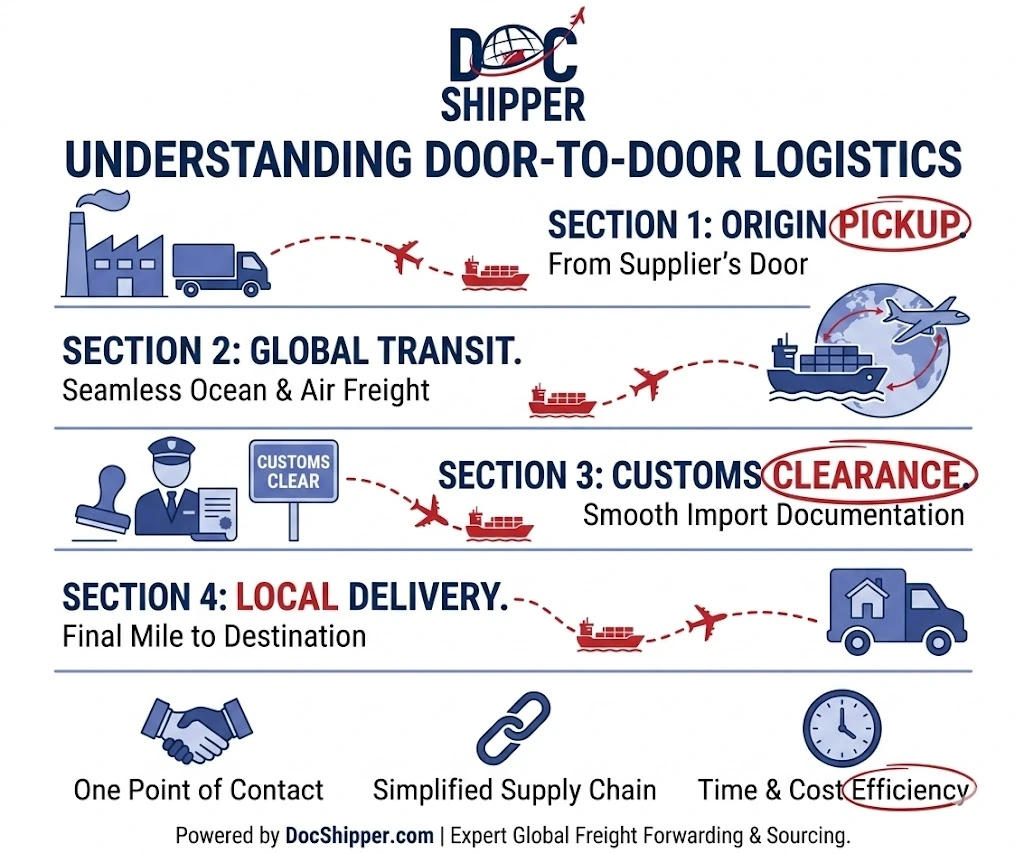
The door-to-door process involves five critical phases, each requiring specialized expertise and coordination. Understanding these stages helps businesses evaluate service providers and anticipate potential bottlenecks.
Origin pickup and consolidation marks the first phase. The logistics provider arranges collection from your supplier’s premises, regardless of location. For international shipments, this often involves coordinating with local trucking companies in the origin country and managing loading supervision to prevent damage.
Export customs clearance represents a crucial checkpoint. The provider prepares all documentation—commercial invoices, packing lists, certificates of origin—and submits declarations to origin country customs authorities. According to World Trade Organization data, incorrect export documentation causes 30% of shipping delays.
International transportation constitutes the main carriage phase. Whether by air, ocean, or multimodal routes, the provider manages booking, tracking, and carrier coordination. At DocShipper, we maintain partnerships with major carriers globally to secure competitive rates and reliable transit times for our clients.
Import customs clearance occurs at the destination port. This involves paying duties and taxes, presenting import licenses when required, and navigating country-specific regulations. The provider must possess in-depth knowledge of destination country customs procedures to avoid costly detentions.
Final delivery execution completes the cycle. This includes arranging last-mile transportation, coordinating delivery appointments, and obtaining proof of delivery. Many providers offer appointment scheduling and notification services to ensure smooth handoffs to recipients.
Practical Examples & Data
Understanding door-to-door through real-world scenarios illuminates its practical value and cost implications compared to fragmented shipping approaches.
Comparative Analysis: Door-to-Door vs. Fragmented Shipping
| Service Aspect | Door-to-Door | Fragmented Approach |
|---|---|---|
| Number of Contracts | 1 comprehensive agreement | 3-5 separate contracts |
| Transit Time (China-US) | 25-30 days average | 30-40 days with coordination delays |
| Cost Transparency | Single all-inclusive quote | Multiple invoices, hidden fees |
| Problem Resolution | One accountable party | Finger-pointing between providers |
| Documentation Handling | Provider manages all paperwork | Shipper coordinates between parties |
Use Case: Electronics Importer
A US-based electronics retailer importing smartphones from Shenzhen, China, compared door-to-door service against managing separate providers:
Shipment details: 500 units, total weight 250kg, value $75,000. The door-to-door quote from DocShipper included pickup from the factory, ocean freight to Los Angeles, customs clearance, duty payment, and delivery to the warehouse in Phoenix, Arizona—all for $3,200.
When the client attempted fragmented coordination, costs broke down as follows: factory pickup ($150), freight forwarding to port ($200), ocean freight ($1,800), customs broker fees ($450), inland transportation ($900), plus 15 hours of staff time coordinating five different companies. Total cost exceeded $3,500 with significantly higher stress levels.
Key benefits realized:
- Cost savings: 9% reduction in total landed cost
- Time efficiency: 5-day faster delivery due to pre-arranged connections
- Risk mitigation: Single liability insurance policy covering entire journey
- Cash flow improvement: One consolidated payment instead of staggered invoices
- Operational simplicity: 87% reduction in communication touchpoints
Industry data shows that 68% of importers using door-to-door services report improved supply chain predictability, according to recent logistics surveys.
Conclusion
Door-to-door shipping transforms complex international logistics into a manageable single-provider relationship, delivering cost transparency, reduced administrative burden, and faster transit times. For businesses seeking to streamline their import/export operations, this comprehensive approach eliminates coordination headaches while improving supply chain reliability.
Need assistance structuring your door-to-door shipping solution? Contact DocShipper for personalized logistics consultation tailored to your specific trade lanes and cargo requirements.
📚 Quiz
Test Your Knowledge: Door-to-Door Shipping
What is the primary defining characteristic of door-to-door shipping?
According to the article, what percentage of importers report improved supply chain predictability when using door-to-door services?
A company is importing electronics from China and wants to minimize coordination complexity while maintaining full shipment visibility. Which approach best fits their needs?
🎯 Your Results
📞 Get Your Free Quote in 24hFAQ | Door-to-Door: Definition, Process & Practical Examples
A comprehensive door-to-door quote covers origin pickup, export customs clearance, main carriage transportation (air/ocean), destination customs clearance with duty payment, and final delivery to your specified address. Most providers include standard cargo insurance, though high-value shipments may require additional coverage. Always verify whether duties and taxes are included or quoted separately, as this significantly impacts total landed cost calculations.
Port-to-port service covers only ocean or air transportation between departure and arrival terminals, requiring you to arrange origin pickup, export clearance, import clearance, and final delivery separately. Door-to-door encompasses the entire journey from shipper's door to consignee's door under one contract. While port-to-port may appear cheaper initially, hidden costs for additional services often make door-to-door more economical and vastly simpler administratively.
The door-to-door provider maintains responsibility throughout the entire journey, simplifying claims processes dramatically. Unlike fragmented shipping where liability passes between multiple carriers, your single contract holder investigates and settles damage claims. Most providers carry comprehensive cargo insurance covering all transit phases, though you should verify coverage limits match your shipment value and consider supplemental insurance for high-value goods.
Yes, specialized door-to-door providers manage dangerous goods, temperature-controlled cargo, oversized equipment, and other specialized freight. However, these shipments require providers with specific certifications, handling expertise, and carrier relationships. Always disclose cargo specifications upfront, as hazardous materials require additional documentation, special packaging, and compliance with international regulations like IMDG for ocean freight or IATA for air shipments.
Standard documentation includes commercial invoice, packing list, and supplier purchase agreement. Depending on your cargo and destination, you may also need certificates of origin, phytosanitary certificates for agricultural products, or FDA/CE compliance documents. Your door-to-door provider should guide documentation requirements based on your specific shipment, as incorrect paperwork causes the majority of customs delays and additional charges.
Door-to-door adds approximately 2-5 days to airport-to-airport transit times, accounting for origin pickup, export clearance, import clearance, and final delivery. However, this comparison misleads because airport-to-airport requires you to arrange these services anyway. Total elapsed time from factory to warehouse typically favors door-to-door because providers optimize connections between transit phases rather than waiting for separately arranged services.
Absolutely. Providers offer volume discounts and preferential rates for clients shipping regularly on specific trade lanes. If you import monthly from the same origin to the same destination, negotiate annual contracts with committed volume thresholds. Even without formal contracts, establishing a relationship with one provider generates better rates than spot quotes, as they invest in understanding your specific requirements and can optimize routing and consolidation opportunities.
Modern door-to-door providers offer end-to-end tracking through online portals or mobile apps, showing real-time location updates from pickup through delivery. Tracking granularity varies by provider and transportation mode—ocean freight updates occur at port milestones, while air freight and final mile delivery often provide GPS-level precision. Advanced systems send automated notifications at key checkpoints like customs clearance completion or out-for-delivery status.
Your door-to-door provider manages customs detention issues, investigating the hold reason, providing additional documentation if required, and communicating with customs authorities. Common detention causes include valuation disputes, missing certificates, or random inspections. While the provider handles resolution, customs-related delays remain outside their control regarding timing. Choosing experienced providers with strong customs broker networks minimizes detention frequency and resolution time.
Door-to-door economics improve with shipment size, but even small parcels benefit when you value convenience and time savings. For shipments under 100kg, express courier services offering door-to-door delivery (DHL, FedEx, UPS) often provide better value than freight forwarders. Above 100kg, freight forwarders' door-to-door services become increasingly competitive, especially for less time-sensitive cargo where ocean freight economics apply favorably.
Yes, most door-to-door providers offer duty and tax payment services, either advancing funds on your behalf for reimbursement or billing duties separately after customs assessment. This service simplifies cash flow planning, as you receive one consolidated invoice rather than unexpected customs bills. Ensure you understand payment terms clearly—some providers require duty deposits upfront based on estimated assessments, refunding differences after actual customs calculation.
Evaluate providers based on five criteria: trade lane expertise (do they regularly service your specific origin-destination pair?), customs clearance capability (in-house brokers vs. subcontracted), insurance coverage adequacy, technology platform sophistication for tracking and communication, and pricing transparency. Request references from clients shipping similar cargo on your intended routes. At DocShipper, we emphasize transparent pricing and dedicated account management to ensure consistent service quality across all trade lanes we serve.
Need Help with
Logistics or Sourcing ?
First, we secure the right products from the right suppliers at the right price by managing the sourcing process from start to finish. Then, we simplify your shipping experience - from pickup to final delivery - ensuring any product, anywhere, is delivered at highly competitive prices.


Fill the Form
Prefer email? Send us your inquiry, and we’ll get back to you as soon as possible.
Contact us




