


In short ⚡
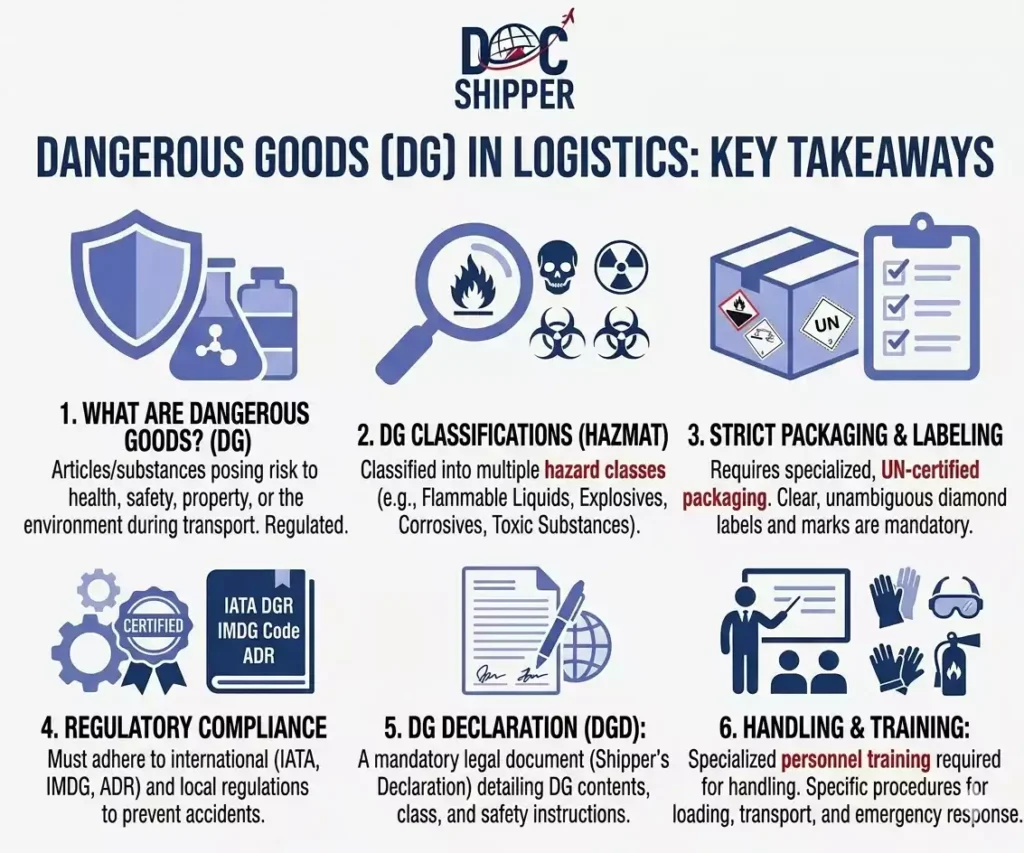
Dangerous Goods are substances or articles that pose risks to health, safety, property, or the environment during transport. Classified into nine categories by international regulations (IMDG, IATA, ADR), they require specific packaging, labeling, and documentation to ensure safe handling throughout the supply chain.Introduction
Many exporters underestimate the complexity of shipping everyday items like lithium batteries, perfumes, or aerosols. These products fall under Dangerous Goods regulations, triggering strict compliance requirements that, if ignored, can result in shipment rejection, fines, or safety incidents.
In international logistics, understanding Dangerous Goods classification is essential. Mishandling these materials creates delays at customs, damages brand reputation, and exposes companies to legal liability. Whether shipping by air, sea, or road, proper identification and documentation are non-negotiable.
- Nine UN classes categorize hazards from explosives to corrosives
- Modal-specific regulations (IATA for air, IMDG for sea, ADR for road)
- Mandatory certifications including MSDS, Shipper’s Declaration, and packaging approval
- Labeling requirements with hazard diamonds and UN numbers
- Carrier restrictions vary by mode, route, and material type
Classification & Regulatory Framework
The United Nations defines Dangerous Goods through the UN Model Regulations, which form the basis for all transport modes. Each substance receives a UN number (four-digit identifier) and a proper shipping name that must appear on all documentation.
The nine classes organize materials by primary hazard:
- Class 1: Explosives (fireworks, ammunition, airbag inflators)
- Class 2: Gases (compressed, liquefied, refrigerated, toxic)
- Class 3: Flammable Liquids (perfumes, paints, alcohols)
- Class 4: Flammable Solids (matches, self-reactive substances)
- Class 5: Oxidizers and Organic Peroxides (bleach, pool chemicals)
- Class 6: Toxic and Infectious Substances (pesticides, medical waste)
- Class 7: Radioactive Materials (medical isotopes, industrial gauges)
- Class 8: Corrosives (acids, batteries, cleaning agents)
- Class 9: Miscellaneous (lithium batteries, dry ice, asbestos)
Each mode of transport applies these classes through specific codes. IATA Dangerous Goods Regulations govern air freight, while IMDG Code applies to maritime shipping. Road transport in Europe follows ADR (Agreement on Dangerous Goods by Road). These frameworks mandate packaging standards, quantity limits, and segregation rules.
The Shipper’s Declaration for Dangerous Goods certifies compliance. This document includes the UN number, proper shipping name, class, packing group, and emergency contact. Incorrect or missing declarations trigger automatic rejection by carriers and customs authorities.
At DocShipper, we systematically verify Dangerous Goods classifications during pre-shipment audits. Our compliance team cross-references MSDS (Material Safety Data Sheets) with transport regulations to prevent costly delays and ensure carrier acceptance on the first submission.
For authoritative guidance, consult the UN Economic Commission for Europe, which publishes the Model Regulations updated biennially.
Practical Examples & Shipping Requirements
Understanding abstract regulations becomes clearer through real-world scenarios. Consider these common export situations where Dangerous Goods rules apply:
Case Study: Lithium Battery Shipments
A consumer electronics company ships 5,000 power banks (UN 3481, Class 9) from Shenzhen to Rotterdam. Each unit contains 20,000 mAh lithium-ion batteries. Air freight restrictions limit lithium batteries to 30% state of charge. The shipper must:
- Obtain UN 38.3 test certification proving battery safety
- Use packaging meeting Packing Instruction 966 (IATA)
- Apply Class 9 hazard labels and handling marks
- Declare exact watt-hour rating per battery
- Provide 24-hour emergency contact on documentation
By sea, the same shipment faces different rules under IMDG. Batteries can ship at full charge but require segregation from flammable materials (Class 3) and oxidizers (Class 5).
Comparative Requirements by Transport Mode
| Product Example | UN Number | Class | Air Freight Limit | Sea Freight Requirement |
|---|---|---|---|---|
| Perfume (alcohol-based) | UN 1266 | 3 | 5 L per package | Limited quantity exemption available |
| Aerosol spray paint | UN 1950 | 2.1 | Prohibited on passenger aircraft | Allowed in cargo holds with ventilation |
| Lithium-ion batteries | UN 3480 | 9 | Section II (≤5 kg net) | No weight limit with proper packaging |
| Sulfuric acid (batteries) | UN 2796 | 8 | 1 L per package | Requires corrosive-resistant containers |
| Dry ice (cooling) | UN 1845 | 9 | 200 kg per package | Ventilation requirements apply |
Key Documentation Checklist
Successful Dangerous Goods shipments require meticulous paperwork. Missing documents cause immediate rejection:
- Material Safety Data Sheet (MSDS): Chemical composition, hazards, first aid measures (16 sections per GHS standard)
- Shipper’s Declaration: Signed certification of compliance with transport regulations
- Packing Certificate: Confirmation that packaging meets UN performance standards (e.g., 4G/Y1.2/100 marking)
- Emergency Response Information: 24-hour contact number for incident management
- Transport License: Required for certain high-hazard materials (Class 1, 6.2, 7)
Cost Implications
Dangerous Goods handling adds 20-40% to standard freight costs. Specialized packaging, hazmat fees, and carrier surcharges accumulate quickly. A 100 kg shipment of Class 3 liquids might incur:
- Base freight: $800
- Dangerous Goods surcharge: $150
- Specialized packaging: $200
- Documentation fees: $75
- Total: $1,225 (53% premium over standard cargo)
At DocShipper, we negotiate consolidated Dangerous Goods rates with certified carriers, reducing surcharges by up to 25% through volume agreements. Our packaging partnerships ensure compliance without inflated costs.
Conclusion
Dangerous Goods compliance protects supply chains from disruptions while ensuring global safety standards. Proper classification, documentation, and carrier selection transform regulatory complexity into operational advantage.
Need expert guidance on your Dangerous Goods shipments? Contact DocShipper for compliant logistics solutions tailored to your industry.
📚 Quiz
Test Your Knowledge: Dangerous Goods
Q1. What is the correct definition of "Dangerous Goods" in international logistics?
Q2. A shipper believes that once a lithium battery shipment was accepted by a carrier last year, the same documentation is valid for this year's shipment. Is this correct?
Q3. A company wants to ship aerosol spray paint (UN 1950, Class 2.1) by air on a passenger aircraft. Which scenario applies?
🎯 Your Result
📞 Free Quote in 24hFAQ | Dangerous Goods: Definition, Classification & Concrete Examples
Any substance posing health, safety, property, or environmental risks during transport. Classification depends on chemical properties, physical state, and hazard potential as defined by UN Model Regulations.
Most express carriers (DHL, FedEx, UPS) accept limited quantities under strict conditions. Prohibited items include explosives, radioactive materials, and highly toxic substances. Always check carrier-specific restrictions.
Packing Groups (I, II, III) indicate danger levels. Group I represents high danger, requiring reinforced packaging. Group III allows lighter containers. This classification influences costs, carrier acceptance, and documentation.
Small amounts of Dangerous Goods (e.g., 1 L of perfume) may qualify for relaxed rules. Packaging must display the Limited Quantity mark (diamond with "Y" inside). Exemptions reduce costs but still require proper labeling.
Batteries under 100 Wh (portable devices) may ship as Section II, with simplified documentation. Larger batteries or standalone shipments demand full Dangerous Goods compliance, including UN 38.3 testing.
IATA updates annually (January 1), IMDG biennially. Shippers must verify current editions before each shipment. Non-compliance with outdated rules triggers penalties even if previous shipments succeeded.
Carriers reject shipments immediately. Customs may impose fines ranging from $5,000 to $50,000 depending on jurisdiction and hazard severity. Repeat violations can result in export license suspension.
Yes, but segregation rules apply. Incompatible classes (e.g., flammables with oxidizers) require physical separation. Container packing certificates must list all hazardous materials with exact positions.
Manufacturers test packaging against UN performance standards. Approved containers display UN marks (e.g., "4G/Y1.2/100"). Using non-certified packaging violates regulations regardless of material safety.
Yes. Saudi Arabia bans alcohol shipments (Class 3). Australia restricts asbestos (Class 9). Always verify destination-specific prohibitions through customs authorities before booking shipments.
Materials like vaccines (Class 6.2) or certain chemicals require reefer containers. Temperature logs accompany shipments. Deviations trigger product rejection, making real-time monitoring essential.
IATA requires recurrent training every 24 months for air freight personnel. Sea freight handlers follow IMDG training standards. Certifications must be documented and available for inspection during audits.
Need Help with
Logistics or Sourcing ?
First, we secure the right products from the right suppliers at the right price by managing the sourcing process from start to finish. Then, we simplify your shipping experience - from pickup to final delivery - ensuring any product, anywhere, is delivered at highly competitive prices.


Fill the Form
Prefer email? Send us your inquiry, and we’ll get back to you as soon as possible.
Contact us




