


In short ⚡
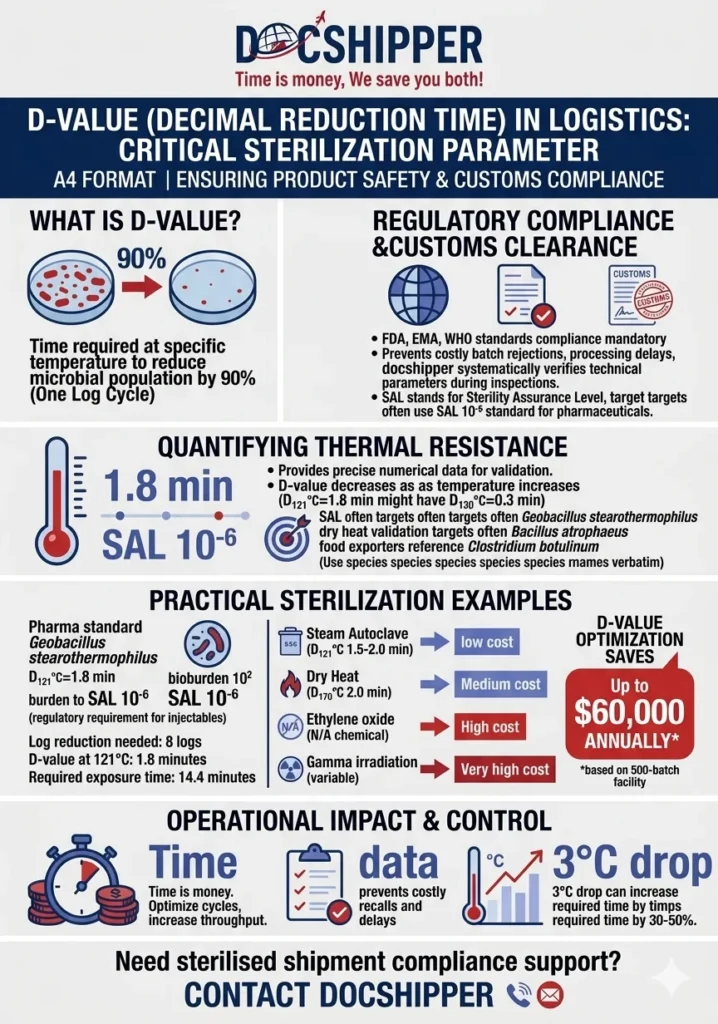
The D-value (Decimal Reduction Time) is the time required at a specific temperature to reduce a microbial population by 90% (one log cycle). This critical sterilization parameter ensures product safety in pharmaceutical, food, and medical device industries by quantifying thermal resistance of microorganisms during heat treatment processes.
Introduction
International shipments of sterilized goods face constant regulatory scrutiny. A single miscalculation in sterilization parameters can result in entire batches being rejected at customs, costing thousands in delays and re-processing.
The D-value serves as the foundation for validating sterilization cycles across global supply chains. Whether shipping pharmaceutical injectables from India to Europe or medical devices from China to the United States, this metric ensures compliance with FDA, EMA, and WHO standards.
- Quantitative measurement: Provides precise numerical data for sterilization validation
- Temperature-specific: Each microorganism has unique D-values at different temperatures
- Regulatory requirement: Mandatory documentation for customs clearance of sterile products
- Quality assurance tool: Enables consistent batch-to-batch sterilization control
- Risk mitigation: Prevents product recalls and cross-border shipment rejections
Technical Fundamentals & Regulatory Framework
The D-value calculation follows logarithmic kinetics based on first-order reaction principles. The mathematical relationship determines how long heat exposure must continue to achieve sterility assurance levels (SAL) required by international pharmacopoeias.
Calculation methodology: D-value = (t₁ – t₂) / (log N₁ – log N₂), where t represents time points and N represents viable microbial counts. This formula establishes the time interval needed for one log reduction in population.
Temperature dependency: D-values decrease exponentially with rising temperature. A microorganism with D₁₂₁°C = 1.5 minutes may have D₁₃₀°C = 0.3 minutes, demonstrating the critical relationship between temperature and sterilization efficiency.
Z-value correlation: The Z-value (temperature coefficient) describes the temperature change required to alter the D-value by one log cycle. This parameter connects D-values across different temperature ranges for process optimization.
Regulatory standards: The FDA guidance on sterile drug products mandates comprehensive D-value documentation for all thermal sterilization processes. European Pharmacopoeia Chapter 5.1.1 and ISO 11138 series establish parallel requirements for international trade.
Documentation requirements: Export documentation must include sterilization cycle validation reports, D-value determination studies, and biological indicator certificates. At DocShipper, we systematically verify these technical parameters during pre-shipment inspections to prevent customs delays and ensure regulatory compliance across all destination markets.
Practical Applications & Calculation Examples
Understanding D-value application through real-world scenarios clarifies its practical importance in international logistics. The following examples demonstrate calculation methods and decision-making processes.
Use Case: Pharmaceutical Injectable Sterilization
A manufacturer ships insulin vials from Germany to Brazil. The target organism is Geobacillus stearothermophilus with D₁₂₁°C = 1.8 minutes. To achieve SAL of 10⁻⁶ (pharmaceutical standard):
| Parameter | Value | Explanation |
|---|---|---|
| Initial bioburden | 10² CFU | Starting microbial load per unit |
| Target SAL | 10⁻⁶ | Regulatory requirement for injectables |
| Log reduction needed | 8 logs | From 10² to 10⁻⁶ |
| D-value at 121°C | 1.8 minutes | Species-specific thermal resistance |
| Required exposure time | 14.4 minutes | 8 × 1.8 = 14.4 minutes minimum |
Comparative analysis across sterilization methods:
| Sterilization Method | Typical D-Value | Cycle Time | Cost Impact |
|---|---|---|---|
| Steam autoclave (121°C) | 1.5-2.0 min | 15-20 min | Low |
| Dry heat (160°C) | 0.5-1.0 min | 120-180 min | Medium |
| Ethylene oxide (54°C) | N/A (chemical) | 12-16 hours | High |
| Gamma irradiation | Variable (kGy) | Minutes to hours | Very high |
Industry-specific D-value ranges: Medical device manufacturers typically target Bacillus atrophaeus spores (D₁₇₀°C = 2.0 minutes) for dry heat validation. Food exporters reference Clostridium botulinum (D₁₂₁°C = 0.21 minutes) for low-acid canned foods, while cosmetic producers use less stringent parameters based on product risk classification.
Temperature deviation impact: A 3°C temperature drop during autoclave cycles can increase required exposure time by 30-50%. For a shipment of 10,000 surgical instruments, this translates to an additional 6-8 hours of processing time and potential schedule delays affecting delivery commitments.
Economic considerations: Optimizing D-value parameters reduces energy consumption and increases throughput. A pharmaceutical facility processing 500 batches monthly can save $45,000-$60,000 annually through validated cycle reduction while maintaining sterility assurance.
Conclusion
The D-value represents the quantitative backbone of international sterile product trade, ensuring both regulatory compliance and product safety. Accurate determination and documentation prevent costly shipment rejections and protect public health across global supply chains.
Need expert guidance on sterilization validation for your international shipments? Contact DocShipper for comprehensive compliance support and documentation services.
📚 Quiz
Test Your Knowledge: D-Value
Q1 — What does the D-value (Decimal Reduction Time) measure in a sterilization process?
Q2 — A manufacturer needs to sterilize injectable vials with an initial bioburden of 10² CFU and a target SAL of 10⁻⁶, using a microorganism with D₁₂₁°C = 1.8 minutes. What is the minimum required exposure time?
Q3 — A customs officer detains a shipment of sterile medical devices because the D-value documentation is missing. Which of the following best describes what this means for the shipper?
🎯 Your Result
📞 Free Quote in 24hFAQ | D-Value: Definition, Calculation & Practical Examples
The D-value measures time for one log reduction at a specific temperature, while F-value represents equivalent sterilization time at 121°C accounting for temperature variations throughout the cycle. F-value integrates D-values across the entire thermal profile.
FDA and EMA guidelines require revalidation every 2-3 years or whenever process parameters change. Annual verification using biological indicators maintains continuous compliance between full revalidation cycles.
Yes, using the Z-value relationship: log(D₁/D₂) = (T₂ - T₁)/Z. However, extrapolation beyond ±10°C from experimental data introduces significant error and is discouraged by regulatory authorities.
Select the most resistant organism relevant to your product and process. Steam sterilization typically uses Geobacillus stearothermophilus, while dry heat employs Bacillus atrophaeus. Consult ISO 11138 series for specific recommendations.
Certificate of sterilization, validation summary report, D-value determination study, biological indicator results, and batch records. EU shipments additionally require EU GDP compliance certificates.
Dense packaging creates heat penetration barriers, increasing effective D-values by 20-40%. Validation must include worst-case packaging configurations to ensure sterilant reaches all product surfaces.
Significantly different. Moist heat (steam) achieves sterilization 10-100 times faster than dry heat at equivalent temperatures due to superior heat transfer and protein denaturation mechanisms.
Spore age, culture conditions, sporulation medium composition, and storage conditions affect microbial heat resistance. Standardized biological indicator production minimizes these variables for consistent validation.
No. Chemical sterilants (ethylene oxide, hydrogen peroxide) use concentration-time relationships rather than thermal kinetics. These processes require separate validation protocols per ISO 11135 and ISO 14937.
Through document review, certificate authentication, and occasional product sampling. High-risk shipments (injectables, implantables) face stricter scrutiny including third-party laboratory verification before clearance.
Shipments face detention, quarantine, or rejection. Costs include storage fees ($50-$200/day), re-documentation expenses, and potential product destruction. Complete pre-shipment validation prevents these scenarios.
Depends on product classification and destination regulations. Medical devices, certain cosmetics, and food products require validation. Consumer goods without sterility claims generally do not, though quality standards may recommend it.
Need Help with
Logistics or Sourcing ?
First, we secure the right products from the right suppliers at the right price by managing the sourcing process from start to finish. Then, we simplify your shipping experience - from pickup to final delivery - ensuring any product, anywhere, is delivered at highly competitive prices.


Fill the Form
Prefer email? Send us your inquiry, and we’ll get back to you as soon as possible.
Contact us




