


In short ⚡
D represents the depth dimension in logistics measurements, specifically indicating the distance from front to back of a cargo unit. In international shipping, D is a critical parameter for calculating volumetric weight, container loading optimization, and freight classification. It works alongside Length (L) and Height (H) to determine cubic volume, directly impacting transportation costs and space allocation.Introduction
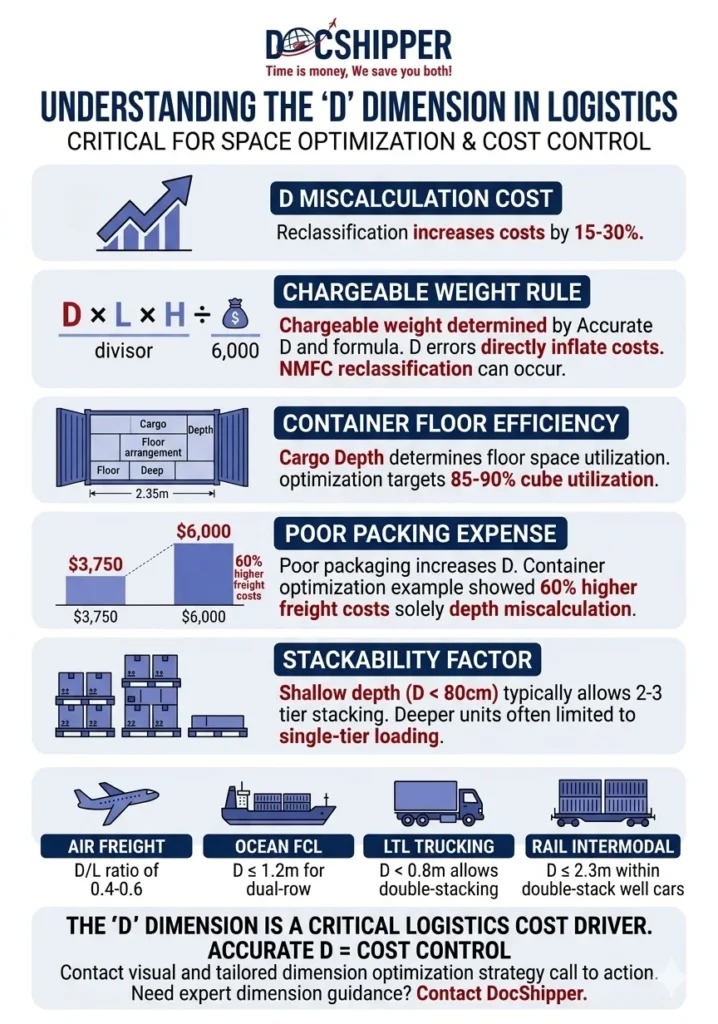
Many shippers underestimate how depth measurement errors can trigger unexpected freight charges. A miscalculated D dimension by just 10 centimeters can reclassify your shipment into a higher freight bracket, increasing costs by 15-30%.
In global logistics, the D dimension determines how efficiently cargo fits into standardized transport units. Whether shipping via ocean containers, air freight pallets, or road transport, accurate depth measurement ensures optimal space utilization and cost control.
Key characteristics of the D dimension in logistics:
- Volumetric weight calculation: D × L × H ÷ dimensional factor determines chargeable weight
- Container optimization: Affects how many units fit per TEU or pallet position
- Freight classification: Influences NMFC codes and density-based pricing in LTL shipping
- Handling requirements: Impacts forklift clearance, warehouse racking, and loading equipment selection
- Customs documentation: Required for accurate HS code classification and duty assessment
Technical Implications & Expertise
The depth dimension plays a fundamental role in the dimensional weight formula used by carriers worldwide. For air freight, the standard calculation divides cubic centimeters by 6,000 (or cubic inches by 366), while ocean freight uses different divisors depending on the carrier and trade lane.
Understanding measurement protocols is crucial. The International Air Transport Association (IATA) mandates measuring the longest point of each dimension, including any protrusions like handles or protective corners. The IATA Dangerous Goods Regulations specify that irregular shapes must use the maximum depth point, not average measurements.
In container loading optimization, the D dimension determines floor space efficiency. Standard 20-foot containers have an internal depth of approximately 2.35 meters, while 40-foot containers offer 12.03 meters of length but the same width constraints. Cargo with excessive depth relative to length creates wasted vertical space, reducing cube utilization below the optimal 85-90% threshold.
The stackability factor directly correlates with depth measurements. Palletized goods with shallow depth (D < 80 cm) typically allow 2-3 tier stacking in standard containers, while deeper units may be restricted to single-tier loading, dramatically reducing cost efficiency.
At DocShipper, we implement 3D scanning technology during pre-shipment inspections to capture precise D measurements within ±2mm accuracy. This eliminates disputes with carriers over dimensional weight charges and ensures our clients receive accurate freight quotes before shipment departure.
From a customs compliance perspective, the depth dimension affects tariff classification under the Harmonized System. Products with specific depth thresholds may fall into different HS code categories, impacting duty rates. For example, certain electronic devices are classified differently based on whether their depth exceeds 170mm, triggering higher import duties in EU markets.
Practical Examples & Data
To illustrate how the D dimension impacts shipping costs, consider these real-world scenarios:
| Cargo Type | L × D × H (cm) | Actual Weight | Volumetric Weight | Chargeable Weight | Cost Impact |
|---|---|---|---|---|---|
| Electronics (shallow) | 120 × 40 × 30 | 25 kg | 24 kg | 25 kg | Baseline |
| Electronics (deep) | 120 × 80 × 30 | 25 kg | 48 kg | 48 kg | +92% cost |
| Furniture (optimized) | 200 × 50 × 80 | 45 kg | 133 kg | 133 kg | Standard rate |
| Furniture (poor packing) | 200 × 90 × 80 | 45 kg | 240 kg | 240 kg | +80% cost |
Use Case: Container Loading Efficiency
A European importer ships 500 cartons of consumer goods from Shenzhen to Rotterdam. Each carton measures 60cm (L) × 40cm (D) × 50cm (H). With proper depth optimization, they achieve:
- Floor arrangement: 10 cartons per row (40cm depth allows 5 rows across 2.35m container width)
- Vertical stacking: 4 tiers fit within 2.39m container height
- Total capacity: 200 cartons per 20ft container = 2.5 containers needed
- Cost: $3,750 total freight (at $1,500/container)
If depth increases to 60cm due to poor packaging:
- Floor arrangement: 7 cartons per row (reduced from 10)
- Total capacity: 140 cartons per container = 4 containers needed
- Cost: $6,000 total freight
- Additional expense: $2,250 (60% increase) solely from depth miscalculation
Industry data shows that optimal depth-to-length ratios vary by transport mode:
- Air freight: D/L ratio of 0.4-0.6 maximizes pallet efficiency on aircraft ULDs
- Ocean FCL: D should not exceed 1.2 meters for dual-row loading in 20ft containers
- LTL trucking: Depth under 0.8 meters allows double-stacking on standard 2.4m width trailers
- Rail intermodal: Maximum depth of 2.3 meters fits within double-stack well cars
Conclusion
The D dimension is far more than a simple measurement—it’s a critical cost driver in international logistics. Accurate depth calculation and strategic packaging design directly impact your bottom line through volumetric weight charges, container utilization, and freight classification.
Need expert guidance on optimizing your cargo dimensions for cost-effective shipping? Contact DocShipper for a comprehensive logistics audit and dimension optimization strategy.
📚 Quiz
Test Your Knowledge: D (Depth Dimension)
Q1 — In logistics, what does the "D" dimension specifically measure?
Q2 — A shipper measures an irregularly shaped crate. The average depth is 45 cm, but a handle protrudes to 52 cm. Which value should be declared to the carrier?
Q3 — Two identical electronics shipments weigh 25 kg each. One has a depth of 40 cm, the other 80 cm (same L and H). What is the most likely outcome for the deeper shipment?
🎯 Your Result
📞 Free Quote in 24hFAQ | D: Definition, Calculation & Practical Examples
Always measure the maximum depth point, including any protrusions, handles, or protective packaging. Use the longest distance from front to back, regardless of the item's shape. For air freight, IATA requires measuring the furthest protruding points.
Air freight typically uses 6,000 (cm³/kg) or 166 (in³/lb). Ocean freight varies by carrier, commonly using 1,000,000 cm³/ton. Express couriers like DHL use 5,000, while FedEx International uses 5,000 for metric and 139 for imperial measurements.
Once palletized, the D dimension includes the pallet base (typically 14-16cm). Reducing depth requires repackaging before palletization. Some 3PLs offer "deconsolidation and repack" services, though this adds $50-150 per pallet in handling fees.
Certain HS codes have specific dimension thresholds. For example, EU customs classifies televisions differently based on screen diagonal, which correlates with depth. Misreporting D dimensions can trigger customs audits and penalty assessments of 10-40% of shipment value.
Most carriers allow ±2% variance for manual measurements. Discrepancies beyond 5% trigger re-weighing and dimension verification fees ($75-200 per shipment). Systematic errors above 10% may result in account audits and retroactive billing adjustments.
Always round up to the next full centimeter for freight calculations. Carriers universally round dimensions upward, and underreporting triggers billing corrections. For example, 49.3cm should be reported as 50cm to avoid disputes.
Warehouses charge by cubic meter or pallet position. Cargo with depth exceeding 1.2 meters often requires double pallet positions, effectively doubling storage fees. Deep items (D > 1.5m) may incur "non-standard" handling surcharges of 15-25% above base rates.
Yes, for compressible goods like textiles or bedding, vacuum sealing can reduce depth by 40-60%. However, carriers measure the packaged dimensions, so vacuum bags must maintain compression throughout transit. Re-expansion during transport voids any dimensional savings.
For standard cartons, target 40-50cm depth to allow 4-5 rows across the 2.35m container width. This configuration, combined with 60cm length and 50cm height, achieves 85-90% cube utilization, the industry benchmark for efficient loading.
Most carriers use automated dimensioning systems with laser scanners or 3D cameras at major hubs. Manual verification occurs for shipments flagged by discrepancies. Persistent measurement errors can result in mandatory third-party inspection requirements, adding 3-5 days transit time.
Indirectly, yes. Oversized depth increases handling risk and potential for damage during loading/unloading. Insurers may apply 5-15% premium surcharges for cargo with depth exceeding 1.5 meters or requiring specialized handling equipment.
Laser distance meters offer ±2mm accuracy and are industry standard for professional freight forwarders. DocShipper uses Bosch GLM 400 CL devices combined with 3D scanning for complex shapes, ensuring measurements meet carrier verification standards and eliminate billing disputes.
Need Help with
Logistics or Sourcing ?
First, we secure the right products from the right suppliers at the right price by managing the sourcing process from start to finish. Then, we simplify your shipping experience - from pickup to final delivery - ensuring any product, anywhere, is delivered at highly competitive prices.


Fill the Form
Prefer email? Send us your inquiry, and we’ll get back to you as soon as possible.
Contact us




