


In short ⚡
DBA (Doing Business As) is a fictitious business name or trade name that allows companies to operate under a different name than their legal entity. This registration enables businesses to create distinct brand identities, expand market presence, and conduct transactions without forming separate legal entities for each brand.
Introduction
Many entrepreneurs face confusion when their legal business name doesn’t match the brand they want customers to recognize. A sole proprietor named John Smith might want to operate as “Smith Logistics Solutions” rather than conducting business under his personal name. This is where a DBA becomes essential.
In international trade and logistics, DBAs play a crucial role in establishing market credibility and operational flexibility. Companies engaged in import/export activities often use DBAs to create specialized divisions, target different customer segments, or operate in multiple jurisdictions without the complexity of forming separate corporations.
Key characteristics of a DBA include:
- No separate legal entity – The DBA operates under the umbrella of the original business structure
- Public registration requirement – Most jurisdictions mandate filing with county or state authorities
- Limited liability protection – The DBA itself doesn’t provide additional liability shielding beyond the underlying entity
- Banking and contracts – Allows opening business accounts and signing agreements under the trade name
- Brand flexibility – Enables multiple brand identities without multiple entity formations
Legal Framework & Registration Requirements
Understanding the legal distinction between a DBA and a legal entity is fundamental. A DBA is not a separate legal structure—it’s a registration that allows an existing entity (sole proprietorship, partnership, LLC, or corporation) to operate under an alternative name. The underlying entity retains all legal responsibilities, tax obligations, and liability exposure.
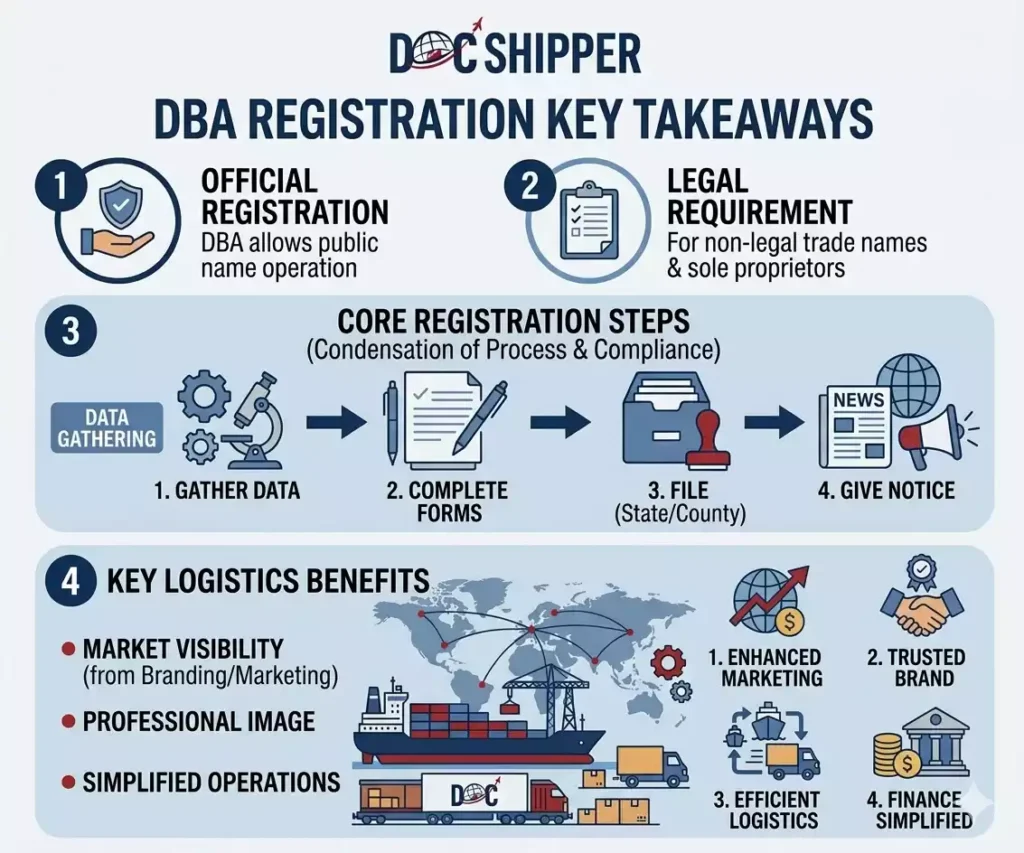
The registration process varies by jurisdiction but typically involves filing with the county clerk’s office or state business registration authority. In the United States, most states require publication of the DBA in a local newspaper to notify the public of the fictitious name. This transparency requirement protects consumers by creating a public record linking the trade name to the actual business owner.
From an international logistics perspective, customs documentation requires careful attention when using DBAs. Shipping documents, commercial invoices, and import/export declarations must clearly identify the legal entity while potentially referencing the DBA. At DocShipper, we systematically verify that all customs paperwork correctly reflects both the legal entity and any registered DBAs to prevent clearance delays.
The renewal requirements for DBAs differ significantly across jurisdictions. Some states mandate renewal every five years, while others require more frequent updates. Failure to renew can result in the DBA becoming available for registration by another business, potentially creating brand confusion and legal complications.
Regarding intellectual property protection, registering a DBA does not provide trademark protection. A business may register “Global Freight Solutions” as a DBA, but this doesn’t prevent another company in a different jurisdiction from using the same name. For comprehensive brand protection, businesses should pursue trademark registration through the appropriate national or international trademark offices, as outlined by the World Intellectual Property Organization.
Practical Examples & Registration Scenarios
Consider a practical scenario in international logistics: ABC Corporation, a freight forwarding company, wants to launch a specialized division focusing exclusively on pharmaceutical shipments. Rather than forming a new LLC, ABC Corporation registers the DBA “MediFreight Express.”
| Aspect | Without DBA | With DBA |
|---|---|---|
| Business Name | ABC Corporation only | ABC Corporation + MediFreight Express |
| Registration Cost | $0 | $50-150 (varies by state) |
| Tax Reporting | Single EIN, one tax return | Same EIN, consolidated reporting |
| Bank Accounts | ABC Corporation account only | Separate account under MediFreight Express |
| Liability Protection | Corporate veil protection | Same corporate veil (no additional protection) |
Use Case: E-commerce Expansion
An established import company, “Johnson Trading LLC,” operates a successful B2B wholesale business. The owners decide to launch a direct-to-consumer e-commerce platform. Instead of creating a new LLC (which would require separate business licenses, tax registrations, and annual filings costing approximately $800-2,000 annually), they register the DBA “DirectImportDeals.com” for approximately $100.
This approach provides several advantages:
- Simplified accounting – All revenue flows through Johnson Trading LLC’s existing tax structure
- Unified customs declarations – Import documentation continues under the established importer of record
- Lower administrative burden – No separate annual reports or compliance filings required
- Flexible branding – The consumer-facing brand differs completely from the wholesale identity
- Cost efficiency – Estimated savings of $700-1,900 annually compared to forming a separate entity
At DocShipper, we regularly assist clients in navigating the documentation requirements when operating under multiple DBAs. We ensure that shipping manifests, commercial invoices, and customs entries properly reference both the legal entity and the applicable DBA to maintain compliance across jurisdictions.
Conclusion
A DBA registration represents a strategic tool for businesses seeking brand flexibility without the complexity and expense of forming multiple legal entities. In international logistics, proper DBA management ensures seamless customs clearance while maintaining distinct market identities.
Need guidance on structuring your business for international trade operations? Contact DocShipper for expert consultation on business registration, customs compliance, and global logistics solutions.
📚 Quiz
Test Your Knowledge: DBA (Doing Business As)
What is a DBA in legal terms?
Does registering a DBA provide trademark protection for your business name?
Your company "ABC Logistics LLC" wants to launch a specialized pharmaceutical shipping division. Which approach is most cost-effective?
🎯 Your Result
📞 Free Quote in 24hFAQ | DBA (Doing Business As): Definition, Registration & Practical Examples
A DBA is not a legal entity—it's simply a registered name under which an existing business operates. An LLC (Limited Liability Company) is a distinct legal structure that provides liability protection to its owners. You can register a DBA under an LLC, sole proprietorship, partnership, or corporation, but the DBA itself doesn't create a separate legal entity or provide additional liability protection.
A DBA isn't required for international shipping, but it can be beneficial if you want to ship under a brand name different from your legal entity name. All customs documentation must reference your registered legal entity (the importer or exporter of record), though you can include your DBA on commercial documents. Proper documentation linking your DBA to your legal entity helps prevent customs delays.
DBA registration costs vary by jurisdiction, typically ranging from $10 to $150 for the initial filing. Some states require publication in local newspapers, adding $50-200 to the total cost. Renewal fees (usually every 5 years) range from $10-100. Additional costs may include bank account setup fees and updating business licenses with the new name.
Yes, a single legal entity can register multiple DBAs. This is common for businesses operating diverse product lines or targeting different market segments. Each DBA requires separate registration and filing fees. However, all DBAs operate under the same tax identification number (EIN) and legal structure of the parent entity, simplifying tax reporting and compliance.
No, a DBA registration only prevents other businesses in your specific registration jurisdiction (typically county or state) from using that exact name. It doesn't provide trademark protection or prevent use of the name in other jurisdictions. For comprehensive brand protection, you must register a trademark with the USPTO (United States Patent and Trademark Office) or equivalent authority in your country.
No, you don't need separate insurance policies for each DBA. Your existing business insurance policy covers all registered DBAs operating under your legal entity. However, you should notify your insurance provider about any DBAs and ensure your policy adequately covers all business activities conducted under those names, especially if they involve different risk profiles.
Most banks allow you to open business accounts under your DBA name, but you'll need to provide documentation proving the connection between the DBA and your legal entity. Required documents typically include your DBA certificate, EIN confirmation letter, business formation documents (articles of incorporation or organization), and personal identification. The legal entity remains the actual account holder.
If you fail to renew your DBA before the expiration date, the registration becomes invalid and another business may register that name. You'll be unable to legally conduct business under that name, open new bank accounts, or enforce contracts signed under the DBA. Most jurisdictions allow late renewals with penalty fees, typically $25-100 additional, but availability of the name isn't guaranteed if it lapses.
Sole proprietors operating under their legal name (e.g., "John Smith Consulting") typically don't need a DBA. However, if you want to operate under any name other than your personal legal name, most jurisdictions require DBA registration. This provides public transparency about who owns the business and protects consumers from fraudulent business practices.
On customs documentation (commercial invoices, bills of lading, entry forms), the legal entity name must be the primary identifier as the importer or exporter of record. You can include your DBA as a secondary reference, typically formatted as "Legal Entity Name d/b/a Trade Name." For example: "Johnson Trading LLC d/b/a DirectImportDeals.com." This clarifies the legal relationship while maintaining brand recognition.
Yes, foreign companies can register DBAs in U.S. jurisdictions, but they typically must first establish a legal presence through foreign entity registration or by forming a U.S. subsidiary. The specific requirements vary by state. Foreign businesses engaged in regular commercial activity in the U.S. usually need to register as a foreign corporation or LLC before obtaining a DBA in that state.
A DBA is a local or state-level registration allowing you to operate under a specific business name within that jurisdiction. A trademark is federal (or international) intellectual property protection that prevents others from using confusingly similar names, logos, or branding nationwide. A DBA doesn't prevent others outside your registration jurisdiction from using the same name, while a trademark provides broader geographic and legal protection across product categories.
Need Help with
Logistics or Sourcing ?
First, we secure the right products from the right suppliers at the right price by managing the sourcing process from start to finish. Then, we simplify your shipping experience - from pickup to final delivery - ensuring any product, anywhere, is delivered at highly competitive prices.


Fill the Form
Prefer email? Send us your inquiry, and we’ll get back to you as soon as possible.
Contact us




:%20Definition,%20Registration%20&%20Practical%20Examples)