


In short ⚡
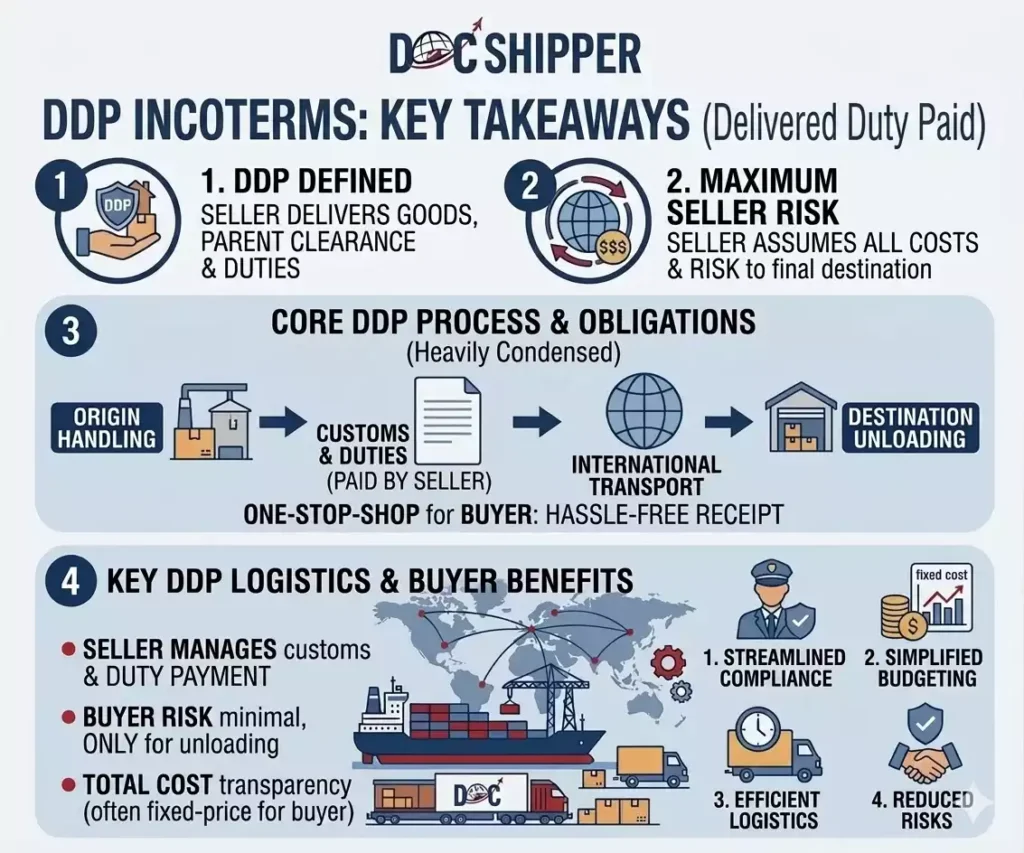
DDP (Delivered Duty Paid) is an Incoterm where the seller assumes maximum responsibility, delivering goods to the buyer's specified destination with all costs paid, including import duties, taxes, and customs clearance. The buyer receives the shipment ready for unloading, with zero additional financial obligations.Introduction
Many international buyers expect a seamless purchasing experience comparable to domestic transactions. However, traditional import terms often transfer complex customs obligations to the buyer, creating unexpected costs and administrative burdens. DDP eliminates this friction by making the seller responsible for the entire delivery chain, including the most challenging component: customs clearance in the destination country.
This Incoterm represents the seller’s maximum obligation under the ICC’s Incoterms 2020 framework. It’s particularly relevant for e-commerce, B2C shipments, and situations where buyers lack customs expertise or import licenses.
Key characteristics of DDP include:
- Complete cost transparency: The quoted price includes all expenses until delivery
- Seller manages customs: Export and import formalities handled by the supplier
- Destination delivery: Goods arrive at the buyer’s premises or agreed location
- Risk transfer at destination: Seller bears risk until unloading point
- Maximum buyer convenience: No hidden costs or administrative tasks for the purchaser
In-Depth Analysis & Expertise
Under DDP terms, the seller’s obligations extend far beyond simple product manufacturing. The supplier must navigate both export procedures in the origin country and import regulations in the destination country—a requirement that demands substantial logistical infrastructure and customs expertise.
The customs clearance responsibility represents the most complex aspect of DDP. The seller must either establish a legal presence in the destination country or work with a customs broker authorized to clear goods on their behalf. This involves obtaining an importer of record status, which requires tax identification numbers, compliance registrations, and potentially security bonds. According to ICC Incoterms 2020, the seller must clear goods for import unless otherwise agreed.
The duty and tax calculation requires precise knowledge of destination country tariff classifications. Each product must be classified under the Harmonized System (HS) code, and the seller must determine applicable import duties, VAT, excise taxes, and anti-dumping duties if relevant. Misclassification can result in penalties, shipment delays, and unexpected costs that erode profit margins.
Risk management under DDP extends throughout the entire transit. The seller bears responsibility for damage, loss, or theft until the moment goods are ready for unloading at the destination. This necessitates comprehensive insurance coverage and careful carrier selection. Many sellers underestimate this extended risk exposure, particularly for high-value shipments.
The regulatory compliance burden is substantial. The seller must ensure products meet destination country standards, possess required certifications, and comply with product-specific regulations (safety standards, labeling requirements, restricted substances). At DocShipper, we systematically verify compliance documentation before shipment to prevent costly customs rejections and regulatory penalties.
Practical Examples & Data
Understanding DDP through real-world scenarios clarifies its financial implications and operational complexity. The total landed cost under DDP encompasses multiple cost layers that sellers must accurately predict and absorb.
Use Case: Electronics Shipment (China to USA)
A Chinese manufacturer sells $10,000 worth of consumer electronics under DDP terms to a California retailer. The complete cost breakdown includes:
- Product cost: $10,000
- Inland transport (factory to port): $300
- Export customs clearance: $150
- Ocean freight: $1,200
- Marine insurance: $180
- US import duty (6.5% for electronics): $650
- Customs brokerage fee: $250
- ISF filing & processing: $75
- Destination port charges: $400
- Trucking to California warehouse: $650
- Total DDP cost: $13,855
The seller must quote at least $13,855 to break even, representing a 38.5% increase over the product cost alone.
Comparative Analysis: DDP vs. Other Incoterms
| Incoterm | Seller’s Obligations | Risk Transfer Point | Buyer Effort |
|---|---|---|---|
| EXW | Make goods available at factory | Seller’s premises | Maximum (all logistics) |
| FOB | Deliver to vessel + export clearance | On board ship | High (freight + import) |
| CIF | Freight + insurance to destination port | On board ship | Medium (import clearance) |
| DAP | Deliver to destination (pre-import) | Destination address | Low (only import duties) |
| DDP | Complete delivery + all duties paid | Destination address | Minimum (unloading only) |
Industry Data: According to logistics industry surveys, only 12% of international B2B transactions use DDP terms, primarily due to the complexity of foreign customs compliance. However, in e-commerce cross-border sales, DDP usage exceeds 45%, as consumer buyers expect “all-inclusive” pricing similar to domestic purchases.
Risk Scenario: A European furniture manufacturer quoted DDP pricing for US delivery but failed to verify product compliance with California’s Proposition 65 labeling requirements. The shipment was detained at customs, requiring $8,500 in additional compliance testing, label redesign, and a 6-week delay—costs entirely borne by the seller under DDP terms.
Conclusion
DDP represents the ultimate convenience for buyers but demands comprehensive logistics expertise and risk management from sellers. Success requires precise cost calculation, regulatory compliance knowledge, and robust customs partnerships.
Need assistance navigating DDP obligations or optimizing your international shipping terms? Contact DocShipper for expert guidance on choosing the right Incoterm for your business model.
📚 Quiz
Test Your Knowledge: DDP (Delivered Duty Paid)
Under DDP terms, who is responsible for import customs clearance and payment of duties?
A manufacturer quotes $10,000 DDP for electronics. Import duties increase by 3% after the quote but before shipment. Who absorbs this additional cost?
A first-time exporter is choosing between FOB and DDP for their initial international shipment. Which statement reflects best practice?
🎯 Your Result
📞 Free Quote in 24hFAQ | DDP (Delivered Duty Paid): Definition, Calculation & Practical Examples
Under DAP (Delivered at Place), the seller delivers goods to the destination but the buyer pays import duties and handles customs clearance. With DDP, the seller assumes all costs including duties and manages import formalities. DDP transfers maximum convenience to the buyer but requires the seller to have customs clearance capability in the destination country.
Absolutely. Sellers can decline DDP requests if they lack the infrastructure for foreign customs clearance or cannot accurately predict import costs. Many companies avoid DDP for destinations with complex customs regimes or volatile duty rates. The choice of Incoterm is negotiable between parties and should reflect each party's capabilities and risk tolerance.
The buyer is responsible for unloading the vehicle at the agreed destination. The seller's obligation ends when goods arrive ready for unloading. However, parties can negotiate variations—if the contract states "DDP unloaded," the seller must also handle unloading operations and associated costs.
When selling DDP into the European Union, sellers often must register for VAT in the destination country and pay import VAT. If the seller is not established in the EU, they typically cannot reclaim this VAT, making it a pure cost. Some sellers use fiscal representation services or Importer of Record providers to manage VAT obligations and potential reclaim scenarios.
Under standard DDP terms, the seller absorbs duty increases that occur between quotation and actual importation. This represents a significant risk, particularly for products subject to anti-dumping investigations or changing trade agreements. Smart sellers include contractual clauses specifying the duty rate basis or reserve rights to adjust pricing for material tariff changes.
DDP does not automatically include insurance—it only defines delivery and cost responsibility. However, prudent sellers always insure DDP shipments since they bear risk until destination delivery. Buyers should verify whether the DDP quote includes insurance coverage and request certificates of insurance for high-value shipments.
Yes, DDP is transport-mode neutral and can apply to ocean, air, road, rail, or multimodal shipments. Unlike FOB or CIF (which are specific to sea/inland waterway transport), DDP functions across all logistics modes. The key requirement is that the seller delivers to a named destination place, regardless of how goods travel there.
The seller must provide all documents necessary for the buyer to take delivery, including commercial invoice, packing list, delivery note, and proof of customs clearance. The seller should also retain import documentation (customs entry, duty payment receipts) for their records. Certificate of origin, inspection certificates, and product-specific compliance documents may also be required depending on the commodity.
Currency volatility creates substantial risk for DDP sellers, especially when quoting in the buyer's currency. If the buyer's currency strengthens against the seller's currency between quotation and payment, the seller receives less value. Long-term DDP contracts should include currency adjustment clauses or use forward exchange contracts to hedge exposure.
Frequent errors include underestimating total delivery costs (particularly last-mile transport), failing to research destination country import restrictions, not accounting for storage fees if delivery is delayed, miscalculating duty rates, and lacking proper customs representation. Many sellers also overlook compliance costs for product certifications required in the destination market, leading to shipment detention and unexpected expenses.
Generally not recommended. DDP requires comprehensive knowledge of both origin and destination regulations, established customs broker relationships abroad, and accurate cost forecasting capability. First-time exporters typically lack this infrastructure and risk significant losses from underestimated costs or compliance failures. Starting with simpler terms like FOB or CIF allows new exporters to build experience before assuming maximum delivery obligations.
DDP only governs delivery and cost responsibility—it does not define warranty terms or after-sales service obligations. These must be addressed separately in the sales contract. However, sellers offering DDP often extend their service commitment geographically, since they've already established destination-country logistics capabilities. Clear contractual language should distinguish between delivery obligations (covered by Incoterm) and warranty/service obligations (covered by sales terms).
Need Help with
Logistics or Sourcing ?
First, we secure the right products from the right suppliers at the right price by managing the sourcing process from start to finish. Then, we simplify your shipping experience - from pickup to final delivery - ensuring any product, anywhere, is delivered at highly competitive prices.


Fill the Form
Prefer email? Send us your inquiry, and we’ll get back to you as soon as possible.
Contact us




:%20Definition,%20Calculation%20&%20Practical%20Examples)