


In short ⚡
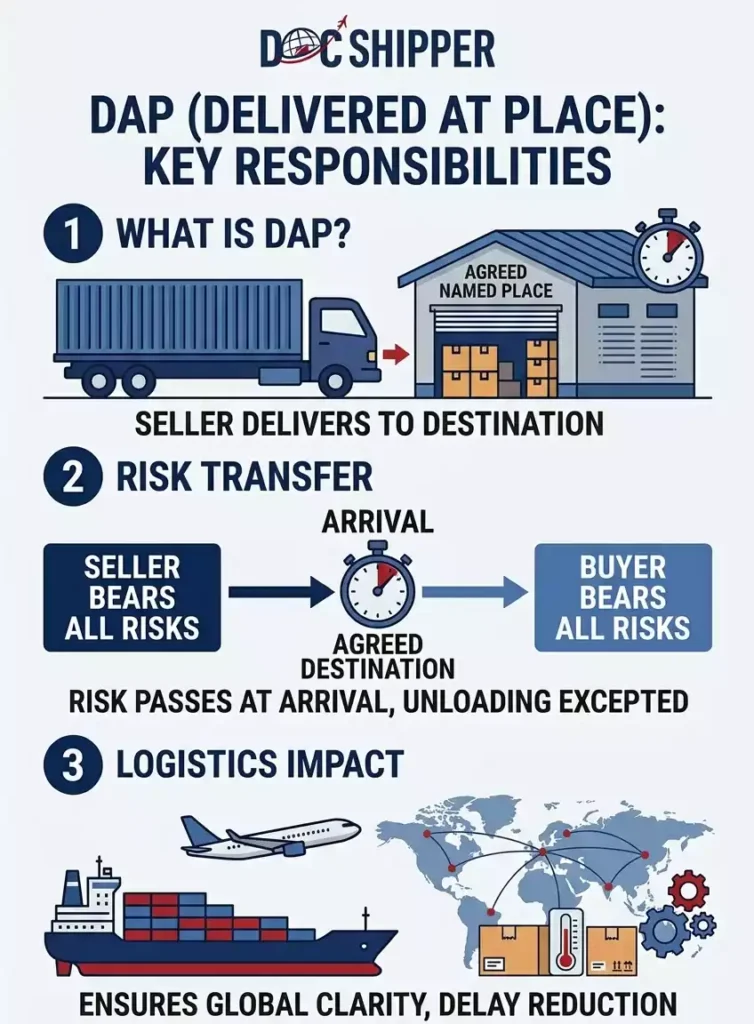
DAP (Delivered at Place) is an Incoterm where the seller delivers goods to a named destination, ready for unloading, bearing all risks and costs until that point. The buyer assumes responsibility for import clearance, duties, and unloading at the agreed location.Introduction
Many importers confuse DAP with DDP, assuming the seller handles everything including customs clearance. This misunderstanding creates significant delays and unexpected costs at destination ports.
DAP represents a balanced risk allocation in international trade. The seller controls transportation to destination, while the buyer manages import formalities. This split makes DAP ideal for transactions where buyers have established customs relationships or prefer to control import duties.
Key characteristics of DAP include:
- Seller delivers goods at the named place, ready for unloading by the buyer
- Risk transfers when goods are placed at buyer’s disposal at destination
- Buyer handles import clearance, duties, taxes, and unloading costs
- Applicable to all transport modes, including multimodal shipments
- Named place must be specific (warehouse address, terminal, buyer’s facility)
DAP Obligations: Complete Breakdown
Understanding the precise responsibility split prevents disputes. The seller’s obligations extend further than many realize, covering not just initial transportation but all risks until goods reach the agreed destination.
Seller’s responsibilities under DAP:
- Export clearance and documentation including licenses, certificates, and customs declarations
- All transportation costs from origin to the named destination point
- Loading charges at origin and during transit (not unloading at destination)
- Transit insurance (optional but recommended for seller’s protection)
- Risk until delivery meaning any loss or damage during transport remains seller’s liability
Buyer’s responsibilities under DAP:
- Import customs clearance including all required documentation and compliance checks
- Import duties and taxes such as VAT, excise duties, and anti-dumping duties
- Unloading at destination from the arriving vehicle or container
- Risk after delivery once goods are placed at their disposal at the named place
- Onward transportation if the named place differs from final destination
The legal framework governing DAP comes from the ICC Incoterms® 2020 rules, which provide standardized interpretations accepted worldwide. The named place must be precisely identified in the sales contract to avoid ambiguity.
At DocShipper, we verify DAP delivery points with buyers before shipment to ensure accessible locations for truck delivery and proper customs facilities. This proactive check prevents delivery failures and demurrage charges.
Common DAP variations and their implications:
- DAP Terminal – delivery at a container terminal or freight station
- DAP Warehouse – delivery at buyer’s designated storage facility
- DAP Border – delivery at customs border crossing (requires clear specification)
The choice of named place significantly impacts costs. Delivering to a buyer’s warehouse 200 km inland costs more than terminal delivery but transfers unloading responsibility and reduces buyer’s logistics burden.
Practical Examples & Cost Comparisons
Real-world scenarios demonstrate how DAP functions across different trade situations. Cost structures vary significantly based on destination, product classification, and local regulations.
Case Study: Electronics shipment from Shenzhen to Hamburg
| Cost Element | Seller (DAP) | Buyer (DAP) | Amount (USD) |
|---|---|---|---|
| Export customs clearance | ✓ | — | 150 |
| Ocean freight (FCL 40′) | ✓ | — | 3,200 |
| Destination port charges | ✓ | — | 420 |
| Inland transport to warehouse | ✓ | — | 380 |
| Import customs clearance | — | ✓ | 200 |
| Import duty (3.7% electronics) | — | ✓ | 740 |
| VAT (19% Germany) | — | ✓ | 3,990 |
| Container unloading | — | ✓ | 120 |
| Total Seller | — | 4,150 | |
| Total Buyer | — | 5,050 |
This example shows buyers pay approximately 55% of total landed costs under DAP terms, primarily due to import duties and VAT. Negotiating DAP becomes advantageous when buyers have preferential duty rates or VAT deferment schemes.
Scenario comparison: DAP vs. other Incoterms
- DAP vs. EXW – DAP eliminates buyer’s export logistics burden but increases seller’s quoted price
- DAP vs. DDP – DAP reduces seller’s compliance risk by transferring import clearance to buyer
- DAP vs. CIF – DAP provides door delivery instead of port delivery, adding convenience
- DAP vs. FCA – DAP includes main carriage costs, simplifying buyer’s logistics coordination
Industry data from 2023 international trade surveys indicates DAP usage increased by 18% for B2B e-commerce shipments, as sellers prefer controlling delivery quality while buyers manage local compliance.
DocShipper manages DAP shipments by coordinating export clearance, booking optimal freight routes, and arranging final-mile delivery to the exact named place. We provide buyers with comprehensive documentation packages for smooth import clearance.
Conclusion
DAP balances responsibilities effectively, making it suitable for buyers with established import capabilities and sellers wanting delivery control without compliance risks. Clear specification of the named delivery place prevents disputes and ensures smooth handover.
Need assistance structuring your DAP shipments or verifying delivery locations? Contact DocShipper for expert guidance on Incoterms selection and logistics execution.
📚 Quiz
Test Your Knowledge: DAP (Delivered at Place)
Under DAP Incoterms, when does risk transfer from seller to buyer?
Which statement about DAP and DDP is correct?
Your German buyer requests DAP delivery to their Hamburg warehouse. As the seller, which costs are you responsible for?
🎯 Your Result
📞 Free Quote in 24hFAQ | DAP (Delivered at Place): Definition, Obligations & Practical Examples
DAP requires the buyer to handle import customs clearance, duties, and taxes, while DDP places all these responsibilities on the seller. Under DAP, the seller delivers goods ready for unloading but cleared only for export. DDP includes complete import clearance, making it a "delivered duty paid" arrangement where the buyer receives goods fully cleared.
The buyer pays for unloading under DAP. The seller's responsibility ends when goods are placed at the buyer's disposal on the arriving vehicle at the named place. This means the container or truck remains loaded, and the buyer must arrange and pay for offloading equipment, labor, and any associated costs.
Yes, DAP applies to all transport modes including air freight. For air shipments, the named place might be the destination airport cargo terminal or the buyer's warehouse if the seller arranges onward trucking. The principle remains the same: seller delivers goods at the specified location, buyer handles import clearance and unloading.
The seller bears risk and liability for any damage occurring before delivery at the named place. If damage occurs during ocean freight, trucking, or any transit phase before goods are placed at buyer's disposal, the seller must replace goods or compensate the buyer. Risk transfers only when goods reach the specified destination point.
The named place must be precise enough to identify the exact delivery point. Vague terms like "buyer's city" create disputes. Specify complete addresses: "123 Industrial Avenue, Hamburg Warehouse District, 20537 Hamburg, Germany." Include access instructions for trucks, operating hours, and contact details for delivery coordination.
Insurance is not mandatory under DAP, but highly recommended. Neither party has a contractual obligation to insure the goods. However, since the seller bears risk until delivery, sellers typically purchase cargo insurance. Buyers should verify coverage or obtain their own insurance from the delivery point onward.
Buyers must provide import licenses, permits, certificates of conformity, and any documentation required by destination country regulations. They handle customs declarations, security filings, and compliance paperwork. Sellers should deliver export documents (commercial invoice, packing list, certificate of origin) to facilitate buyer's clearance process.
Yes, the named place can be a bonded warehouse, allowing buyers to defer duty payments. This arrangement requires careful specification in the contract, as goods remain under customs control. The seller completes delivery when goods enter the bonded facility, but the buyer must later clear them for domestic consumption.
For LCL (Less than Container Load), DAP typically involves delivery to the buyer's premises after deconsolidation. The seller arranges main carriage, pays deconsolidation fees at destination, and books final delivery trucking. The buyer handles import clearance before deconsolidation and pays for unloading at their facility.
Common delays include incorrect delivery addresses, inaccessible locations for trucks, absence of unloading equipment, and customs holds due to incomplete documentation. Prevention requires pre-shipment verification of delivery site accessibility, advance notice to buyers for unloading preparation, and providing complete export documentation for smooth import clearance.
No, the seller does not need an import license under DAP. Import licensing, registration, and compliance with destination country regulations are the buyer's responsibility. The seller only requires export licenses and authorizations from the origin country. This separation makes DAP attractive when sellers lack import registration capabilities.
Total landed cost under DAP equals: product cost + seller's delivery charges (freight, export clearance, inland transport) + buyer's import costs (duties, taxes, clearance fees, unloading). Buyers should request DAP pricing including all seller costs to the named place, then add their local import expenses for accurate budget planning.
Need Help with
Logistics or Sourcing ?
First, we secure the right products from the right suppliers at the right price by managing the sourcing process from start to finish. Then, we simplify your shipping experience - from pickup to final delivery - ensuring any product, anywhere, is delivered at highly competitive prices.


Fill the Form
Prefer email? Send us your inquiry, and we’ll get back to you as soon as possible.
Contact us




:%20Definition,%20Obligations%20&%20Practical%20Examples)