


In short ⚡
Denied Party Screening is a compliance verification process that cross-references business partners, customers, and shipment recipients against government-maintained restricted party lists to prevent illegal trade with sanctioned entities. This mandatory procedure ensures companies comply with export control regulations and avoid severe legal penalties in international logistics.
Introduction
A single oversight in partner verification can result in millions in fines and immediate shipment seizures. Many businesses unknowingly engage with sanctioned entities, triggering export control violations.
In global trade, governments maintain dynamic lists of prohibited individuals and organizations for national security, anti-terrorism, and economic sanction purposes. Denied Party Screening acts as the first line of defense against compliance breaches.
This verification process is critical because:
- It prevents transactions with entities subject to U.S., EU, or UN sanctions
- It protects companies from criminal liability and business license revocation
- It ensures cargo clearance at borders without regulatory delays
- It maintains supply chain integrity across multiple jurisdictions
- It demonstrates due diligence in corporate governance audits
Compliance Mechanisms & Legal Framework
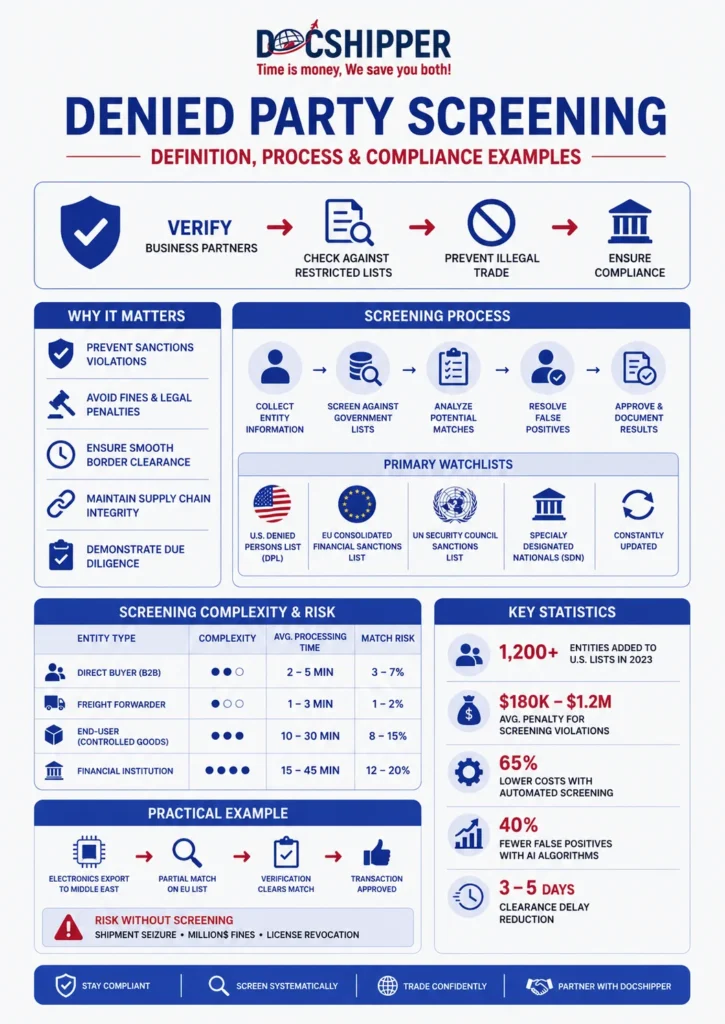
Denied Party Screening operates through systematic comparison of business entities against consolidated watchlists. The process involves automated database queries that scan names, addresses, and identification numbers against constantly updated government registries.
Primary screening lists include the U.S. Denied Persons List (DPL), the Specially Designated Nationals (SDN) List, the EU Consolidated Financial Sanctions List, and the UN Security Council Sanctions List. Each jurisdiction maintains separate criteria for inclusion, requiring multi-source verification.
The legal obligation extends beyond direct customers. Companies must screen ultimate consignees, intermediate consignees, freight forwarders, and even end-users in certain controlled technology transfers. Failure constitutes strict liability—intent is irrelevant.
Screening frequency requirements vary. Best practices mandate checks at initial engagement, before each transaction, and through periodic re-screening of existing partners. Lists update weekly, sometimes daily during geopolitical crises.
At DocShipper, we integrate real-time screening protocols into our customs clearance procedures, automatically flagging matches before shipment authorization. This prevents costly cargo holds and ensures regulatory compliance across 50+ countries.
For authoritative guidance, consult the U.S. Bureau of Industry and Security consolidated screening list repository.
Implementation Examples & Screening Data
Understanding screening outcomes requires examining real-world application scenarios. The following table compares screening results across different entity types:
| Entity Type | Screening Complexity | Average Processing Time | Match Risk Level |
|---|---|---|---|
| Direct Buyer (B2B) | Moderate | 2-5 minutes | 3-7% false positives |
| Freight Forwarder | Low | 1-3 minutes | 1-2% false positives |
| End-User (Controlled Goods) | High | 10-30 minutes | 8-15% false positives |
| Financial Institution | Very High | 15-45 minutes | 12-20% false positives |
Use Case: Electronics Export to Middle East
A European electronics manufacturer received an order for €500,000 worth of semiconductor components from a Dubai-based distributor. Initial screening returned a partial name match on the EU sanctions list.
Further investigation revealed the flagged entity shared only a common surname but operated in a different country with distinct registration numbers. Secondary verification through business registry cross-reference cleared the transaction within 48 hours. Without proper screening, the company risked €2.5 million in potential fines under EU dual-use regulations.
Key Implementation Statistics:
- Over 1,200 entities added to U.S. sanctions lists in 2023 alone
- Average penalty for screening violations: $180,000-$1.2 million per occurrence
- Automated screening reduces compliance costs by 65% compared to manual checks
- False positive rates decrease by 40% with AI-enhanced fuzzy matching algorithms
- Real-time screening integration cuts clearance delays by 3-5 business days
Conclusion
Denied Party Screening represents non-negotiable due diligence in international trade. Systematic implementation protects businesses from catastrophic legal exposure while ensuring supply chain continuity across regulated markets.
Need assistance implementing compliant screening protocols for your shipments? Contact DocShipper for integrated compliance solutions.
📚 Quiz
Test Your Knowledge: Denied Party Screening
What is the primary purpose of Denied Party Screening in international trade?
When conducting denied party screening, which statement about legal liability is correct?
A logistics company receives a screening alert showing a partial name match with a sanctioned entity. What is the correct next step?
🎯 Your Result
📞 Free Quote in 24hFAQ | Denied Party Screening: Definition, Process & Compliance Examples
Violations result in civil penalties ranging from $10,000 to $1 million per incident, criminal prosecution with potential imprisonment, seizure of goods, loss of export privileges, and permanent reputational damage. Regulators consider lack of screening as willful negligence, eliminating most legal defenses.
Government watchlists update continuously. Best practice requires daily synchronization for high-volume exporters and weekly updates at minimum for occasional shippers. Real-time API integrations provide immediate notifications when existing partners are added to restricted lists.
Automated systems provide essential efficiency but require human oversight for match resolution. False positives demand contextual analysis of alternate spellings, transliterations, and entity relationships. Compliance programs must combine technology with trained personnel review.
The United States enforces the most comprehensive regime through OFAC, BIS, and State Department lists. The European Union maintains equally strict standards under Common Foreign and Security Policy regulations. China, Japan, and South Korea have rapidly strengthened enforcement in recent years.
Yes, when transactions involve controlled goods or dual-use technologies. Sanctioned entities operate globally, including within major economies. Domestic sales to front companies for sanctioned parties constitute violations. Geographic location does not exempt screening obligations.
A false positive occurs when screening software flags a legitimate entity due to name similarity with a restricted party. Common causes include common surnames, abbreviated business names, and transliteration variations. Resolution requires documentation proving the entity's distinct identity through registration numbers and address verification.
Each jurisdiction maintains separate lists based on foreign policy objectives. A party sanctioned by the U.S. may not appear on EU lists and vice versa. Multinational operations require screening against all applicable jurisdictions where the company maintains business presence or banking relationships.
Maintain timestamped screening reports for every transaction, policy manuals detailing screening procedures, staff training records, system update logs, and escalation protocols for match resolution. Auditors expect seven-year retention of all screening documentation with audit trails demonstrating consistent application.
Removal permits resumed transactions, but exercise caution. Verify official delisting through government publications, not third-party reports. Some jurisdictions impose cooling-off periods or require special licenses for previously sanctioned parties. Conduct enhanced due diligence before re-engagement.
Denied party screening verifies who you trade with, while export classification determines what you can export and under what conditions. Both are mandatory compliance steps but address different regulatory requirements. A clean screening does not authorize export of controlled items without proper licensing.
Freight forwarders must screen their direct customers but ultimate legal responsibility remains with the exporter of record. However, forwarders face liability if they knowingly facilitate prohibited transactions. Best practice involves contractual screening obligations across all supply chain parties.
Immediately cease all transaction activity with the flagged party. Do not notify them of the screening result. Report the attempted transaction to relevant authorities within your jurisdiction. Conduct internal review to determine how the entity entered your pipeline and strengthen screening protocols to prevent recurrence.
Need Help with
Logistics or Sourcing ?
First, we secure the right products from the right suppliers at the right price by managing the sourcing process from start to finish. Then, we simplify your shipping experience - from pickup to final delivery - ensuring any product, anywhere, is delivered at highly competitive prices.


Fill the Form
Prefer email? Send us your inquiry, and we’ll get back to you as soon as possible.
Contact us




