


In short ⚡
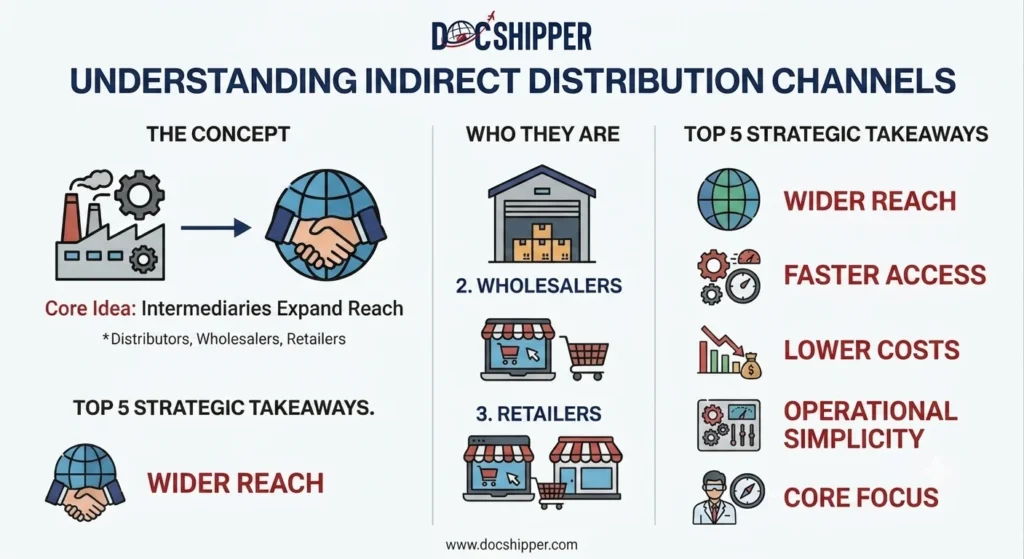
An indirect/distributor channel is a distribution strategy where manufacturers sell products through intermediaries (distributors, wholesalers, agents) rather than directly to end customers. This approach reduces manufacturer involvement in logistics and customer relationships while leveraging specialized networks to reach broader markets efficiently.
Introduction
Many businesses struggle with the fundamental question: should we control every aspect of distribution or delegate to specialized partners? This confusion often stems from underestimating the complexity of managing international logistics networks while maintaining profitability.
The indirect/distributor channel represents a cornerstone of global trade architecture. Manufacturers leverage third-party expertise to penetrate foreign markets without establishing local infrastructure. This approach proves particularly critical when entering markets with complex regulatory environments or cultural nuances.
Key characteristics of indirect distribution channels include:
- Reduced operational burden: Manufacturers transfer warehousing, transportation, and customer service responsibilities to intermediaries
- Market penetration speed: Distributors provide immediate access to established customer networks and local market knowledge
- Financial efficiency: Lower capital requirements compared to building proprietary distribution infrastructure
- Risk distribution: Intermediaries absorb inventory risks and market fluctuations
- Specialized expertise: Distributors bring sector-specific knowledge, regulatory compliance capabilities, and established relationships
Distribution Mechanisms & Strategic Expertise
The indirect channel operates through a carefully orchestrated ecosystem where each intermediary layer adds specific value. Manufacturers typically sell to master distributors or regional wholesalers, who then supply retailers or secondary distributors. This tiered approach creates market depth while maintaining manufacturer focus on production innovation.
Legal frameworks governing distributor relationships vary significantly across jurisdictions. The European Union enforces strict competition laws regarding exclusive distribution agreements, while countries like China impose specific licensing requirements for foreign manufacturers. At DocShipper, we systematically review distribution agreements to ensure compliance with both origin and destination country regulations, preventing costly legal disputes.
The margin structure in indirect channels typically allocates 15-40% to distributors, depending on industry sector and value-added services provided. Technology products generally command lower margins (15-25%) due to price transparency, while specialized industrial equipment may justify 30-40% margins reflecting technical support requirements.
Inventory management represents a critical negotiation point. Consignment models transfer inventory risk back to manufacturers, while firm purchase agreements provide cash flow certainty but require stronger distributor financial capacity. Hybrid approaches using minimum purchase commitments with promotional stock consignment balance risk appropriately.
According to the UNCTAD Trade Analysis, approximately 70% of international trade flows through intermediary channels, demonstrating the model’s dominance in global commerce. Territory exclusivity provisions require careful consideration—overly broad exclusivity may violate competition laws, while insufficient protection discourages distributor investment in market development.
The performance metrics framework should include minimum purchase volumes, market coverage targets, inventory turnover rates, and customer satisfaction indicators. These measurable criteria provide clear expectations while enabling fair contract termination provisions when distributors underperform.
Concrete Examples & Market Data
Real-world applications demonstrate how indirect channels function across diverse industries. Consider a French cosmetics manufacturer entering Southeast Asian markets—establishing wholly-owned subsidiaries in six countries would require €15-20 million in infrastructure investment, while appointing regional distributors reduces entry costs to €500,000-800,000 in initial support and training.
| Distribution Model | Initial Investment | Time to Market | Control Level | Risk Profile |
|---|---|---|---|---|
| Direct (Owned Subsidiaries) | $5-20M | 18-36 months | Complete | High |
| Indirect (Distributors) | $200K-800K | 3-6 months | Moderate | Moderate |
| Hybrid (Regional Hubs + Distributors) | $2-8M | 9-18 months | High | Balanced |
Use Case: German Industrial Equipment Manufacturer
A Bavarian precision machinery producer appointed exclusive distributors across Latin America. The distributor network generated €28 million revenue in year two, with manufacturer margins of 42%. The manufacturer invested only €650,000 in technical training and marketing support, achieving ROI within 14 months. This compared favorably to their North American subsidiary, which required €4.2 million to establish and took 31 months to profitability.
Key success factors in this implementation:
- Selective partner criteria: Required distributors to maintain certified technical staff and dedicated product showrooms
- Quarterly business reviews: Structured performance assessments preventing relationship drift
- Co-marketing investment: 50/50 cost sharing on trade shows and local advertising campaigns
- Transparent pricing: Published price lists preventing distributor margin manipulation
- Technical support infrastructure: Remote diagnostics platform enabling distributors to resolve 80% of customer issues without manufacturer intervention
Industry data reveals that 63% of B2B manufacturers utilize hybrid models combining direct sales for strategic accounts with distributor networks for broader market coverage. This approach optimizes resource allocation while maintaining control over key relationships.
Conclusion
The indirect/distributor channel remains the most capital-efficient method for manufacturers to achieve global market presence. Success demands rigorous partner selection, clearly defined performance expectations, and ongoing relationship investment to align distributor incentives with manufacturer objectives.
Need guidance structuring your international distribution strategy? Contact DocShipper for expert consultation on channel design and partner evaluation frameworks.
📚 Quiz
Test Your Knowledge: Indirect/Distributor Channel
What is the primary characteristic of an indirect/distributor channel?
A company assumes that using distributors means completely losing control over brand consistency and customer experience. Is this concern accurate?
A European cosmetics manufacturer wants to enter six Southeast Asian markets. Which distribution approach would be most capital-efficient for rapid market entry?
🎯 Your Result
📞 Free Quote in 24hFAQ | Indirect/Distributor Channel: Definition, Strategy & Concrete Examples
A distributor purchases products outright and resells them, assuming inventory risk and setting final prices within agreed parameters. An agent facilitates transactions between manufacturer and customer without taking ownership, earning commissions on completed sales. Distributors require higher margins (15-40%) but provide market penetration depth, while agents cost less (5-15%) but offer limited market development capabilities.
Optimal initial terms range from 2-3 years with automatic renewal clauses contingent on performance metrics. Shorter periods (12-18 months) discourage distributor investment in market development, while longer commitments (5+ years) create exit difficulties if performance disappoints. Include clear termination provisions tied to minimum purchase volumes or market share targets to protect both parties.
Standard distributor margins vary by sector: consumer electronics (15-22%), industrial machinery (25-35%), specialty chemicals (20-30%), and luxury goods (30-50%). Margins reflect the distributor's value-added services including warehousing, technical support, credit extension, and market development activities. Negotiated margins should align with competitive norms while ensuring distributor profitability to sustain relationship commitment.
Exclusivity appropriateness depends on market maturity and distributor capability. Emerging markets benefit from exclusive arrangements incentivizing substantial distributor investment in brand building and customer education. Mature markets often warrant non-exclusive or semi-exclusive models preventing distributor complacency. Always include performance thresholds—if distributors fail to achieve minimum sales targets, exclusivity automatically converts to non-exclusive status.
Implement comprehensive distributor guidelines covering product positioning, pricing frameworks, promotional messaging, and customer service standards. Provide marketing assets including product photography, technical documentation, and sales presentation templates. Conduct regular audits of distributor customer touchpoints and establish brand compliance as a contractual requirement with remediation procedures for violations.
Three primary models exist: firm purchase (distributor owns all inventory), consignment (manufacturer retains ownership until sale), and hybrid (minimum purchase commitment plus consignment promotional stock). Firm purchase provides manufacturer cash flow certainty but may limit distributor aggressiveness on newer products. Consignment reduces distributor risk but strains manufacturer working capital. Hybrid approaches typically optimize mutual interests.
Establish clear customer classification criteria in initial agreements. Strategic accounts (defined by revenue thresholds or strategic importance) remain manufacturer-managed with distributor receiving fulfillment commissions. Standard accounts belong to the distributor securing initial contact. Include house account provisions allowing manufacturers to serve specific customers directly while compensating distributors for territory exclusivity through reduced commission structures on those accounts.
Include termination for cause (immediate termination for contract breaches like payment defaults or brand violations) and termination for convenience (typically requiring 90-180 days notice). Address post-termination inventory repurchase obligations, customer transition procedures, and intellectual property return requirements. Governing law selection significantly impacts enforceability—choose jurisdictions with established commercial law frameworks favoring contract enforcement.
Define channel conflict resolution procedures addressing pricing disparities and customer ownership disputes. Implement differentiated product strategies where distributors handle standard configurations while manufacturers directly sell customized solutions. Establish transparent pricing structures preventing manufacturer undercutting of distributor pricing. Most importantly, maintain regular communication forums where both parties collaboratively address emerging conflicts before they escalate.
Track primary metrics including revenue growth rates, inventory turnover (target: 4-8 turns annually), customer acquisition numbers, market share evolution, and payment timeliness. Secondary indicators include customer satisfaction scores, technical support quality assessments, marketing program participation rates, and competitive intelligence contribution. Quarterly business reviews should address all metrics with corrective action plans for underperformance areas.
Transition feasibility depends on contractual provisions and local commercial agency laws. Some jurisdictions (notably EU countries and several Latin American nations) grant distributors compensation rights upon contract termination regardless of contract language. Plan transitions carefully with legal counsel, ideally incorporating stepped commission reductions over 12-24 months allowing distributors to adjust business models. Alternatively, acquire high-performing distributors rather than terminating relationships to preserve customer relationships and market knowledge.
DocShipper provides end-to-end support including distributor identification and vetting, contract negotiation facilitation, logistics infrastructure setup, customs compliance frameworks, and ongoing performance monitoring systems. Our expertise in international trade regulations ensures distribution agreements comply with both origin and destination country requirements while optimizing logistics costs and delivery reliability throughout the channel network.
Need Help with
Logistics or Sourcing ?
First, we secure the right products from the right suppliers at the right price by managing the sourcing process from start to finish. Then, we simplify your shipping experience - from pickup to final delivery - ensuring any product, anywhere, is delivered at highly competitive prices.


Fill the Form
Prefer email? Send us your inquiry, and we’ll get back to you as soon as possible.
Contact us




