


In short ⚡
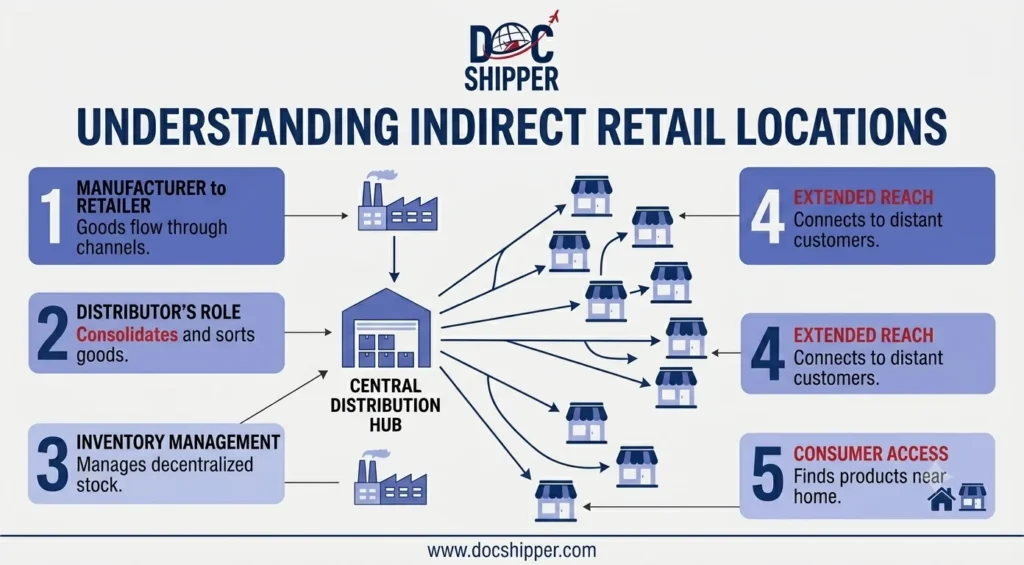
Indirect Retail Locations are distribution points where products reach consumers through intermediaries rather than company-owned stores. This model includes franchises, wholesalers, distributors, and third-party retailers. It enables businesses to expand market reach without direct capital investment in brick-and-mortar infrastructure, making it essential for international market penetration and supply chain optimization.
Introduction
Many businesses struggle with the astronomical costs of establishing direct retail presence in foreign markets. A single flagship store can require $500,000+ in initial investment. This challenge becomes particularly acute when entering multiple territories simultaneously or testing market viability.
Indirect retail locations solve this dilemma by leveraging existing distribution networks. Instead of building proprietary stores, manufacturers and brands partner with established retailers, wholesalers, or franchisees. This approach transforms fixed costs into variable expenses while accelerating market entry.
Key characteristics of indirect retail distribution include:
- Reduced capital requirements – No real estate acquisition or long-term lease commitments
- Accelerated market penetration – Immediate access to established customer bases
- Shared operational responsibility – Partners handle staffing, inventory management, and local compliance
- Scalability flexibility – Easy expansion or contraction based on market performance
- Local market expertise – Partners bring regional knowledge and consumer insights
This distribution model dominates sectors like consumer goods, electronics, fashion, and food products. Understanding its mechanics is crucial for optimizing supply chain strategies and achieving cost-effective international expansion.
Strategic Depth & Implementation Framework
Indirect retail locations operate through several distinct channel configurations, each with specific legal and operational implications. The franchise model grants independent operators the right to sell products under the brand’s name, typically requiring royalty payments and strict brand compliance. Franchisees assume most operational costs while the parent company maintains quality control.
The wholesale distribution channel involves selling bulk quantities to intermediaries who then resell to retailers or end consumers. This model sacrifices margin control for volume efficiency and minimal logistical complexity. Wholesalers handle inventory storage, regional transportation, and retailer relationships.
Third-party retail partnerships place products in established stores like department chains, specialty boutiques, or online marketplaces. Brands negotiate shelf space, positioning, and promotional support. This requires careful contract structuring around pricing authority, return policies, and brand representation standards.
The distributor agreement model appoints exclusive or non-exclusive regional representatives responsible for all sales activities within defined territories. Distributors typically purchase inventory outright, assuming demand risk while gaining pricing flexibility. According to the U.S. Department of Commerce, this model accounts for approximately 60% of international market entry strategies.
Legal considerations vary significantly across jurisdictions. EU regulations require clear delineation of responsibilities regarding product liability and warranty obligations. At DocShipper, we verify distribution agreement compliance with local commercial laws to prevent contractual disputes that could disrupt supply chains.
The primary trade-off involves control versus capital efficiency. Direct retail provides complete brand control but demands substantial investment. Indirect channels sacrifice some control for reduced financial risk and faster scaling. Successful strategies often employ hybrid models, using direct stores for flagship markets while leveraging indirect channels for secondary territories.
Concrete Examples & Comparative Data
Consider a European electronics manufacturer entering the Southeast Asian market. Establishing 20 company-owned stores across five countries would require approximately $8-12 million in initial capital, plus ongoing operational expenses exceeding $3 million annually. Using indirect retail locations through regional distributors reduces initial investment to $500,000-800,000 for marketing support and inventory placement.
| Distribution Model | Initial Investment | Time to Market | Brand Control | Margin Retention |
|---|---|---|---|---|
| Direct Company Stores | $400,000-600,000 per location | 12-18 months | Complete | 85-95% |
| Franchise Network | $50,000-150,000 setup costs | 6-9 months | High (via agreements) | 60-75% |
| Wholesale Distribution | $20,000-80,000 | 3-6 months | Moderate | 45-60% |
| Third-Party Retailers | $10,000-50,000 | 2-4 months | Limited | 40-55% |
Use Case: A French cosmetics brand partnered with established beauty retailers across Japan rather than opening proprietary boutiques. This strategy enabled placement in 150 locations within eight months, compared to the projected 24-month timeline for establishing 15 company-owned stores. The brand achieved market validation and customer feedback before committing to direct retail investment.
Key performance metrics for evaluating indirect retail effectiveness include:
- Market penetration rate – Geographic coverage achieved versus investment
- Revenue per distribution point – Sales performance across channel types
- Brand consistency scores – Customer experience uniformity measurements
- Inventory turnover ratios – Product movement efficiency through channels
- Cost per customer acquisition – Marketing efficiency across distribution models
Industry data shows that brands using hybrid distribution models combining direct flagship stores with extensive indirect retail networks achieve 27% higher market coverage while maintaining comparable profit margins to pure direct retail strategies.
Conclusion
Indirect retail locations represent a capital-efficient pathway to market expansion, balancing growth ambitions with financial prudence. By strategically selecting channel partners and maintaining quality oversight, businesses can achieve rapid market presence without direct retail investment.
Need expert guidance on optimizing your distribution strategy? Contact DocShipper for tailored logistics and market entry solutions.
📚 Quiz
Test Your Knowledge: Indirect Retail Locations
What defines indirect retail locations?
What is the primary trade-off when using indirect retail channels?
A European manufacturer wants to test market viability in Southeast Asia with minimal capital risk. Which approach aligns with indirect retail strategy?
🎯 Your Result
📞 Free Custom Quote in 24hFAQ | Indirect Retail Locations: Definition, Strategy & Practical Examples
Direct retail locations are company-owned and operated stores where the brand controls all aspects of the customer experience. Indirect retail locations involve third-party intermediaries (franchisees, distributors, retailers) who handle sales operations. The key distinction lies in ownership structure, capital investment requirements, and operational control levels.
Indirect channels typically reduce per-unit profit margins by 20-45% compared to direct sales due to partner commissions, wholesale discounts, and revenue sharing agreements. However, this trade-off often results in higher overall profitability through increased sales volume, reduced overhead costs, and eliminated real estate expenses.
International distribution agreements must address territorial exclusivity rights, intellectual property protections, product liability allocation, pricing authority, termination clauses, and compliance with local commercial laws. EU regulations require specific consumer protection provisions, while certain jurisdictions mandate local partner equity participation. Consulting legal experts familiar with target market regulations is essential.
Yes, through contractual provisions requiring brand standard adherence, regular audits, training programs, and performance metrics. Many agreements include mystery shopper evaluations, customer satisfaction benchmarks, and product presentation guidelines. Technology solutions like POS integration and inventory management systems enable real-time monitoring of partner compliance.
Revenue generation timelines vary by channel type. Third-party retail placements can produce sales within 4-8 weeks of product placement. Wholesale arrangements typically show results within 2-3 months. Franchise networks require 6-12 months for full operational maturity. Direct stores often need 12-18 months to achieve profitability.
Primary risks include reduced brand control, potential partner performance inconsistencies, pricing conflicts, inventory management challenges, and dependency on third-party business health. Market intelligence gaps may occur as customer data remains with intermediaries. Contractual disputes and partner termination complications can disrupt supply chains.
Selection criteria include market coverage and customer access, financial stability and creditworthiness, complementary product portfolio alignment, operational capabilities and infrastructure, brand reputation alignment, and cultural compatibility. Due diligence should verify partner sales history, facility inspections, reference checks, and legal compliance records.
Modern distribution management systems provide inventory visibility, sales tracking, automated reordering, performance analytics, and communication platforms. Cloud-based solutions enable real-time data sharing between brands and partners. Digital tools facilitate training delivery, marketing asset distribution, and compliance monitoring across geographically dispersed networks.
Fast-moving consumer goods typically use extensive wholesale and retail partnerships for maximum market penetration. Luxury brands maintain tighter control through selective retail partnerships with brand-aligned premium stores. Technical products often require specialized distributors offering installation and support services. Perishable goods demand partners with appropriate cold chain infrastructure.
Yes, hybrid strategies are common and often optimal. Brands typically use flagship company-owned stores in key metropolitan markets for brand experience control while leveraging indirect channels for geographic expansion and secondary markets. Clear channel conflict policies, differentiated product offerings, and coordinated pricing strategies prevent cannibalization issues.
Key indicators include same-store sales growth rates, inventory turnover velocity, market share gains versus competitors, customer satisfaction scores across locations, return and warranty claim rates, partner renewal percentages, and comparative cost-per-acquisition versus direct channels. Balanced scorecards should track both financial and operational performance dimensions.
Exchange rate volatility affects wholesale pricing to international distributors and can erode margins if not properly managed. Strategies include currency hedging instruments, periodic pricing adjustments, local currency invoicing, or sharing exchange rate risk through contractual provisions. Some agreements include automatic price adjustment clauses triggered by defined currency movement thresholds.
Need Help with
Logistics or Sourcing ?
First, we secure the right products from the right suppliers at the right price by managing the sourcing process from start to finish. Then, we simplify your shipping experience - from pickup to final delivery - ensuring any product, anywhere, is delivered at highly competitive prices.


Fill the Form
Prefer email? Send us your inquiry, and we’ll get back to you as soon as possible.
Contact us




