


In short ⚡
Direct Retail Locations are physical points of sale owned and operated by manufacturers or brands themselves, bypassing traditional distribution intermediaries. This retail strategy allows companies to control customer experience, pricing, and brand presentation while capturing full retail margins and direct consumer insights.Introduction
Many businesses struggle with inconsistent brand representation when relying on third-party retailers. Direct retail locations eliminate this challenge by giving manufacturers complete control over how products reach consumers.
In international trade and logistics, this model transforms supply chain dynamics. Companies shipping goods globally must adapt their distribution networks when transitioning from wholesale to direct retail operations.
- Full margin capture: Elimination of wholesale discounts increases profitability per unit sold
- Brand control: Complete authority over store design, merchandising, and customer service standards
- Consumer data access: Direct collection of purchasing behavior and preferences
- Market testing capability: Rapid implementation of pricing strategies and product launches
- Inventory management: Real-time visibility into stock levels and demand patterns
Strategic Depth & Operational Expertise
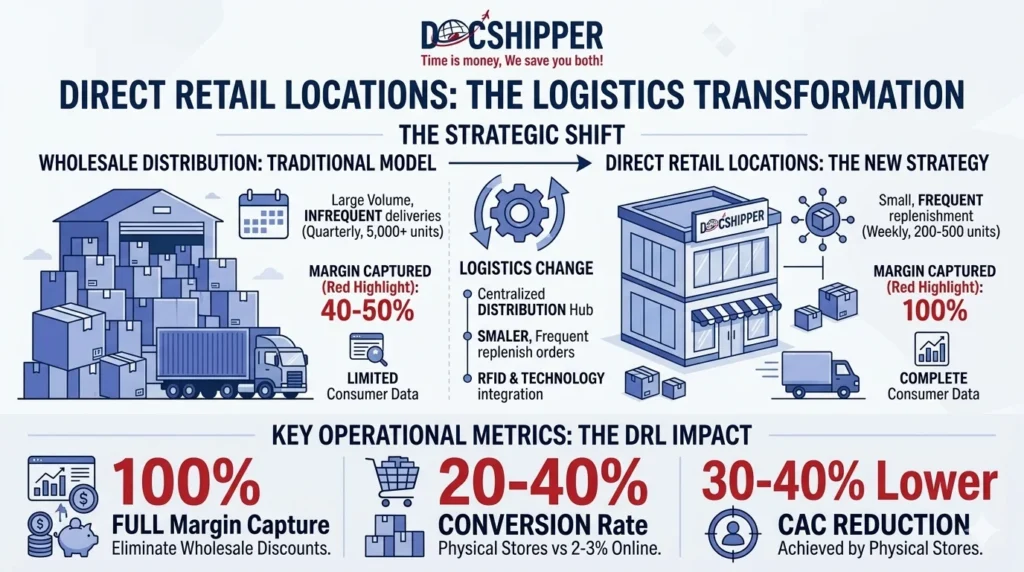
Direct retail locations fundamentally alter logistics requirements. Traditional B2B shipments to distributors involve large-volume, infrequent deliveries. Direct retail demands smaller, frequent replenishment to individual store locations.
The omnichannel integration becomes critical when operating physical stores. Inventory must synchronize across online platforms and retail locations to prevent stockouts or overstocking. This requires sophisticated warehouse management systems capable of handling both e-commerce fulfillment and store replenishment.
Customs compliance complexity increases when importing goods directly for retail operations in foreign markets. Companies must navigate local regulations, establish legal entities, and manage tax obligations in each jurisdiction. According to World Trade Organization guidelines, direct importers bear full responsibility for regulatory compliance.
The real estate selection process requires extensive market analysis. Location determines foot traffic, demographic alignment, and operational costs. Lease negotiations for retail spaces differ significantly from warehouse agreements, involving percentage rent clauses and co-tenancy provisions.
Staffing and training represent ongoing operational challenges. Unlike wholesale relationships where the retailer handles customer interaction, direct locations require hiring, training, and managing frontline employees who embody brand values.
At DocShipper, we assist brands transitioning to direct retail by coordinating international shipments to multiple store locations, ensuring regulatory compliance, and optimizing inventory distribution across retail networks.
Practical Examples & Data Analysis
Consider a European footwear manufacturer opening direct retail locations in Asia. The logistics transformation involves several measurable changes:
| Distribution Model | Shipment Frequency | Average Order Size | Margin Captured | Data Access |
|---|---|---|---|---|
| Wholesale Distribution | Quarterly | 5,000+ units | 40-50% | Limited |
| Direct Retail Locations | Weekly | 200-500 units | 100% | Complete |
Case Study: A cosmetics brand operating 15 direct retail locations across three countries implemented centralized distribution from a regional hub. By consolidating inventory in Singapore and utilizing cross-border e-commerce regulations, they reduced landed costs by 18% while maintaining 2-day replenishment cycles to stores.
Key operational metrics for successful direct retail networks include:
- Inventory turnover ratio: Optimal range of 8-12 turns annually for fashion retail, 4-6 for luxury goods
- Sales per square meter: Premium locations should generate €5,000-€15,000 annually depending on product category
- Customer acquisition cost: Direct stores typically achieve 30-40% lower CAC compared to pure e-commerce
- Shrinkage rate: Target below 1.5% through proper security and inventory controls
- Conversion rate: Physical stores average 20-40% versus 2-3% for online channels
Technology integration proves essential. Point-of-sale systems must connect with enterprise resource planning platforms to provide real-time inventory visibility. RFID tagging enables accurate stock counts and reduces manual labor in high-volume locations.
Conclusion
Direct retail locations offer manufacturers unprecedented control over brand presentation and customer relationships, though they demand sophisticated logistics coordination and operational expertise. Success requires balancing inventory investment, real estate costs, and staffing against the benefits of margin capture and market intelligence.
Need assistance establishing or optimizing your direct retail supply chain? Contact DocShipper for customized logistics solutions supporting your retail expansion.
📚 Quiz
Test Your Knowledge: Direct Retail Locations
Q1 — What best defines a Direct Retail Location?
Q2 — A common misconception about Direct Retail Locations is that they capture the same margin as wholesale distribution. What is the correct interpretation?
Q3 — A European footwear brand is expanding into Asia and switching from wholesale to direct retail. Which logistics scenario correctly reflects this transition?
🎯 Your Result
📞 Free Quote in 24hFAQ | Direct Retail Locations: Definition, Strategy & Practical Examples
Direct retail locations allow brands to capture full retail margins (100% versus 40-50% wholesale) while maintaining complete control over customer experience, pricing strategies, and brand presentation standards.
They require transitioning from large, infrequent wholesale shipments to smaller, frequent replenishment deliveries to multiple store addresses, necessitating more sophisticated logistics coordination and inventory management systems.
Companies must establish legal entities in destination countries, register as importers of record, manage local tax obligations, and ensure compliance with consumer product safety regulations specific to each market.
Direct retail requires real-time inventory visibility across all locations, omnichannel integration with e-commerce platforms, and demand forecasting at the individual store level rather than bulk distributor orders.
Initial investments range from $150,000 to $500,000 per location depending on market, including lease deposits, store buildout, initial inventory, staffing, and technology infrastructure.
Yes, many brands operate hybrid models, though this requires careful channel management to prevent price conflicts and maintain distributor relationships through geographic or product line segmentation.
Critical systems include point-of-sale platforms, warehouse management software, enterprise resource planning integration, customer relationship management tools, and inventory optimization algorithms.
They enable capture of purchase history, demographic information, product preferences, and shopping behavior directly from consumers, providing insights unavailable through wholesale intermediaries.
Key obstacles include maintaining brand consistency across cultures, managing diverse regulatory environments, coordinating international logistics, recruiting qualified local staff, and adapting product assortments to regional preferences.
DocShipper coordinates multi-location shipments, manages customs clearance in destination markets, provides warehousing solutions for retail replenishment, and offers supply chain optimization consulting for direct-to-consumer operations.
Key performance indicators include sales per square meter, inventory turnover ratio, conversion rates, average transaction value, customer retention rates, and operating margin after accounting for all location-specific costs.
They enable faster market feedback loops, allowing brands to test new products in controlled environments, gather immediate consumer reactions, and adjust designs or features before broader market releases.
Need Help with
Logistics or Sourcing ?
First, we secure the right products from the right suppliers at the right price by managing the sourcing process from start to finish. Then, we simplify your shipping experience - from pickup to final delivery - ensuring any product, anywhere, is delivered at highly competitive prices.


Fill the Form
Prefer email? Send us your inquiry, and we’ll get back to you as soon as possible.
Contact us




