


In short ⚡
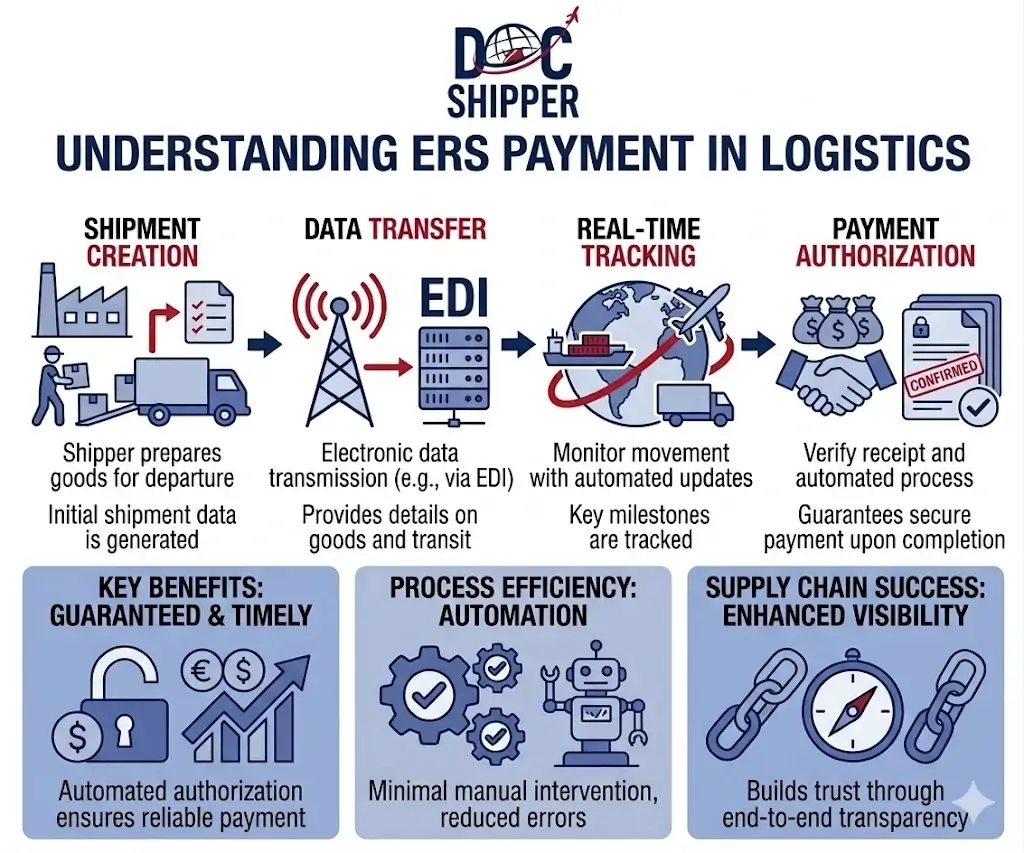
Evaluated Receipts Settlement (ERS) is an automated invoice-less payment system where buyers pay suppliers based on goods received rather than invoices submitted. This procurement method eliminates traditional invoice processing by matching receipts with purchase orders, reducing administrative costs and accelerating payment cycles in international trade logistics.
Introduction
Traditional invoice processing creates bottlenecks in global supply chains. Paper invoices get lost, mismatched, or delayed, causing payment disputes and strained supplier relationships. In cross-border logistics, these inefficiencies multiply across currencies, regulations, and time zones.
Evaluated Receipts Settlement emerged as a solution for high-volume procurement environments. It transforms accounts payable from reactive document chasing to proactive financial automation. The system proves particularly valuable in import/export operations where speed and accuracy determine competitive advantage.
Key characteristics of ERS include:
- Invoice elimination: Payments triggered automatically upon goods receipt confirmation
- Three-way matching: Purchase order, goods receipt note, and pre-agreed pricing aligned systematically
- Trusted supplier relationships: Requires established partnerships with verified quality standards
- EDI integration: Electronic Data Interchange enables seamless system-to-system communication
- Cost reduction: Eliminates invoice processing labor, postage, and reconciliation expenses
ERS Mechanism & Technical Expertise
The ERS framework operates on pre-negotiated commercial agreements between buyer and supplier. Unlike traditional procurement, pricing terms, delivery schedules, and quality specifications are locked before any transaction occurs. This foundation enables automated processing without human verification for each shipment.
When implementing ERS, companies establish master purchase agreements covering payment terms (typically net 30-60 days), unit prices with volume discounts, and acceptable quality tolerances. These contracts eliminate negotiation cycles for repeat orders, critical for just-in-time manufacturing or retail replenishment.
The technical workflow follows five stages. First, the buyer issues a purchase order (PO) electronically to the supplier’s ERP system. Second, the supplier ships goods with an advanced shipment notice (ASN) containing item quantities and delivery dates. Third, the buyer’s warehouse performs goods receipt, scanning barcodes or RFID tags to update inventory systems.
Fourth, the system executes automatic three-way matching: comparing PO line items, received quantities, and pre-agreed pricing. If discrepancies exceed threshold tolerances (often 2-5%), the transaction flags for manual review. Fifth, payment instructions generate automatically based on contractual terms, bypassing accounts payable queues entirely.
From a legal perspective, ERS requires modifications to standard Incoterms documentation. The absence of supplier invoices means alternative proof of delivery—such as digitally signed goods receipt notes—must satisfy customs authorities and auditors. Progressive jurisdictions now recognize electronic records under frameworks like eIDAS in Europe or UETA in the United States.
At DocShipper, we configure ERS protocols for clients managing repetitive imports, ensuring warehouse management systems integrate correctly with supplier EDI standards. Our compliance team verifies that automated payment triggers meet destination country tax and audit requirements, preventing regulatory complications.
Concrete Examples & Data Analysis
Manufacturing industries demonstrate ERS’s highest adoption rates. Automotive sector data shows 68% of tier-1 suppliers use ERS for component deliveries, reducing invoice processing costs from $15-25 per transaction to under $2. A European car manufacturer processing 50,000 monthly line items saves approximately $900,000 annually through ERS implementation.
Consider a practical scenario: A French electronics retailer imports smartphone accessories from Vietnamese suppliers. Under traditional invoicing, each shipment requires:
- Supplier invoice generation and mailing (2-3 days)
- Accounts payable receipt and data entry (1-2 days)
- Three-way matching and approval workflow (3-5 days)
- Payment processing and bank transfer (2-3 days)
Total cycle: 8-13 days post-delivery. With ERS, goods receipt in the French warehouse triggers immediate payment scheduling, reducing the cycle to same-day processing. The retailer negotiates 2% early payment discounts, saving €180,000 annually on €9 million procurement spend.
Comparative analysis reveals sector-specific benefits:
| Industry | Traditional Cost/Invoice | ERS Cost/Transaction | Annual Savings (50K transactions) |
|---|---|---|---|
| Automotive | $18 | $2 | $800,000 |
| Retail | $22 | $3 | $950,000 |
| Electronics | $15 | $1.50 | $675,000 |
| Food & Beverage | $25 | $4 | $1,050,000 |
A critical success factor involves supplier onboarding discipline. Companies achieve optimal results when limiting ERS to vendors meeting strict criteria: minimum annual spend thresholds ($100K+), zero quality defect rates over six months, and certified EDI capabilities. Expanding the program prematurely to unreliable suppliers creates matching errors that negate efficiency gains.
Technology requirements include cloud-based ERP systems with real-time inventory tracking. Legacy systems requiring overnight batch processing cannot support ERS’s instantaneous matching logic. Integration costs range from $50,000 for SMEs to $500,000 for multinational corporations, with ROI typically achieved within 18-24 months.
Conclusion
Evaluated Receipts Settlement represents procurement’s evolution toward frictionless financial automation, particularly valuable in high-volume import/export operations. The system’s efficiency gains extend beyond cost savings to strategic supplier partnerships and accelerated cash-to-cash cycles.
Need guidance implementing ERS protocols for your international supply chain? Contact DocShipper’s experts for customized integration support.
📚 Quiz
Test Your Knowledge: Evaluated Receipts Settlement (ERS)
What is the core definition of Evaluated Receipts Settlement (ERS)?
Which statement correctly describes a critical requirement for successful ERS implementation?
A manufacturing company processes 50,000 monthly transactions. Traditional invoicing costs $18 per transaction, while ERS costs $2 per transaction. What is the correct application of ERS in this scenario?
🎯 Your Result
📞 Free Customized QuoteFAQ | Evaluated Receipts Settlement (ERS): Definition, Process & Concrete Examples
Ideal ERS suppliers demonstrate consistent quality records, stable pricing, high transaction volumes (minimum 100 monthly orders), and EDI infrastructure. Strategic partners supplying standardized products with predictable delivery schedules benefit most. Avoid ERS for custom-manufactured items or vendors with frequent specification changes requiring invoice-level detail.
Advanced ERS systems incorporate tolerance parameters for quantity variances (typically 2-5%). Partial shipments trigger proportional payments based on goods actually received. Damaged goods flagged during warehouse inspection automatically pause payment until quality disputes resolve. Integration with warehouse management systems enables real-time adjustment of payment calculations.
Yes, modern ERS platforms support multi-currency transactions using exchange rates locked at purchase order creation or daily spot rates. Cross-border implementations require additional configuration for VAT/GST calculation variations and compliance with local tax documentation requirements. Currency hedging strategies should align with your ERS payment terms to manage foreign exchange risk.
ERS relies on electronically signed goods receipt notes, advanced shipment notices (ASNs), and master purchase agreements. These documents provide audit trails satisfying tax authorities in most jurisdictions. Companies must ensure their ERP systems generate tamper-proof records with timestamps and user authentication meeting local electronic signature laws.
Phased implementations range from 4-9 months depending on organizational complexity. Initial pilot programs with 3-5 suppliers launch in 8-12 weeks. Full enterprise rollout covering 50+ vendors requires 6-9 months for contract renegotiation, system integration, and change management. Rush implementations under three months often experience higher error rates during stabilization.
Three major challenges arise: inadequate master data governance causing PO-receipt mismatches, insufficient supplier training on ASN requirements, and underestimating change management for accounts payable teams losing traditional workflows. Successful transitions dedicate 20-30% of project budgets to training and establish clear escalation procedures for exception handling.
Properly configured ERS systems meet SOX compliance by maintaining complete audit trails of authorization, goods receipt, and payment execution. Controls must demonstrate segregation of duties between purchasing, receiving, and payment approval functions. Annual audits verify that automated matching logic operates within approved tolerance parameters and exceptions receive appropriate review.
ERS accelerates supplier payments by eliminating invoice processing delays (typically 5-10 days). However, buyers often negotiate extended payment terms (net 60 vs. net 30) in exchange for payment certainty and reduced administrative burden. Net effect depends on negotiated terms—some suppliers prefer predictability despite slightly longer cycles.
SMEs with annual procurement exceeding $5 million from repeat suppliers can achieve positive ROI using cloud-based ERS solutions costing $10,000-30,000 annually. Key requirement is existing electronic purchasing and inventory systems capable of integration. Companies still using manual processes should modernize base systems before attempting ERS.
ERS agreements include formal dispute resolution protocols. Suppliers submit evidence (shipment documentation, quality certificates) within defined timeframes (usually 5-10 business days). Disputed amounts enter temporary hold status while reconciliation teams investigate. Frequent disputes indicate inadequate master agreement terms or poor goods receipt accuracy requiring process improvement.
Enterprise ERP systems include native ERS modules requiring configuration rather than custom development. Integration connects procurement, inventory management, and accounts payable modules through standard APIs. Implementation partners map your existing workflows to ERS logic, typically customizing tolerance rules, approval hierarchies, and payment scheduling to match corporate policies.
Critical KPIs include: invoice processing cost reduction (target: 70-80% decrease), days payable outstanding changes, supplier dispute rates (should remain under 2%), payment accuracy rates (target: 98%+), and accounts payable FTE reduction. Leading organizations also track supplier satisfaction scores and early payment discount capture rates to measure relationship improvements.
Need Help with
Logistics or Sourcing ?
First, we secure the right products from the right suppliers at the right price by managing the sourcing process from start to finish. Then, we simplify your shipping experience - from pickup to final delivery - ensuring any product, anywhere, is delivered at highly competitive prices.


Fill the Form
Prefer email? Send us your inquiry, and we’ll get back to you as soon as possible.
Contact us




:%20Definition,%20Process%20&%20Concrete%20Examples)